Teaching robots to identify human activities
July 19, 2011 By Bill Steele
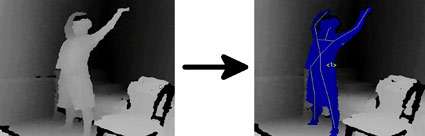
To simplify computation, a human image is reduced to a skeleton lof lines and angles. To infer what a person is doing, a computer breaks down activities into a sequence of short actions and compares them with previous observations.
(PhysOrg.com) -- If we someday live in "smart houses" or have personal robots to help around the home and office, they will need to be aware of what humans are doing. You don't remind grandpa to take his arthritis pills if you already saw him taking them -- and robots need the same insight.
So Cornell researchers are programming robots to identify human activities by observation. Their most recent work will be described at the 25th Conference on Artificial Intelligence in San Francisco, in an Aug. 7 workshop on "plan, activity and intent recognition." Ashutosh Saxena, assistant professor of computer science, and his research team report that they have trained a robot to recognize 12 different human activities, including brushing teeth, drinking water, relaxing on a couch and working on a computer. The work is part of Saxena's overall research on personal robotics.
Others have tried to teach robots to identify human activities, the researchers note, using video cameras. The Cornell team used a 3-D camera that, they said, greatly improves reliability because it helps separate the human image from background clutter. They used an inexpensive Microsoft Kinect camera, designed to control video games with body movements. The camera combines a video image with infrared ranging to create a "point cloud" with 3-D coordinates of every point in the image. To simplify computation, images of people are reduced to skeletons.
The computer breaks activities into a series of steps. Brushing teeth, for example, can be broken down into squeezing toothpaste, bringing hand to mouth, moving hand up and down and so on. The computer is trained by watching a person perform the activity several times; each time it breaks down what it sees into a chain of sub-activities and stores the result, ending with an average of all the observations.
When it's time to recognize what a person is doing, the computer again breaks down the activity it observes into a chain of sub-activities, then compares that with the various options in its memory. Of course no human will produce the exact same movements every time, so the computer calculates the probability of a match for each stored chain and chooses the most likely one.
In experiments with four different people in five environments, including a kitchen, living room and office, the computer correctly identified one of the 12 specified activities 84 percent of the time when it was observing a person it had trained with, and 64 percent of the time when working with a person it had not seen before. It also was successful at ignoring random activities that didn't fit any of the known patterns.
The researchers note that some people may regard robot monitoring of their activities as an invasion of privacy. One answer, they suggest, is to tell the robot that it can't go into rooms where the door is closed.
Computer code for converting and processing Kinect data is publicly available at http://pr.cs.corne … nactivities/ .
Provided by
Cornell University
-
From lemons to lemonade: Reaction uses carbon dioxide to make carbon-based semiconductor,
32 comments
-
Thioridazine kills cancer stem cells in human while avoiding toxic side-effects of conventional cancer treatments,
3 comments
-
SpaceX private rocket blasts off for space station (Update),
42 comments
-
Climate scientists say they have solved riddle of rising sea,
31 comments
-
SpaceX capsule has 'new car' smell, astronauts say (Update),
2 comments
-
Ideas to mitigate risk of 911 calls being misdirected
May 24, 2012
-
Live scribe pen?
May 10, 2012
-
Shallow water flow simulation
May 07, 2012
-
Tablet for taking notes?
May 05, 2012
-
Best fit tablet for me?
May 05, 2012
-
Measure of Informaton
May 04, 2012
- More from Physics Forums - Computing & Technology
More news stories
Browser wars flare in mobile space
The browser wars are heating up again, but this time the fight is for dominance of the mobile Internet.
6 hours ago |
5 / 5 (1) |
2
Probability of contamination from severe nuclear reactor accidents is higher than expected: study
Catastrophic nuclear accidents such as the core meltdowns in Chernobyl and Fukushima are more likely to happen than previously assumed. Based on the operating hours of all civil nuclear reactors and the number ...
Technology / Energy & Green Tech
May 22, 2012 |
3.6 / 5 (22) |
56
|
SpotterRF debuts Radar Backpack Kit (w/ Video)
(Phys.org) -- SpotterRF has announced a special radar backpack kit designed to enhance situational awareness for soldiers on the ground. The company says its special radar is designed for warfighters as part ...
HyperSolar shows dirty water no barrier to power world
(Phys.org) -- The Santa Barbara, California, company, HyperSolar, is set to transparently share the ups and downs of its research experiences toward the companys ultimate vision, successfully producing ...
Tesla to launch electric sedan in US on June 22
Tesla Motors said Tuesday it would begin deliveries of "the world's first premium electric sedan" on June 22, slightly ahead of schedule.
Technology / Energy & Green Tech
May 22, 2012 |
4.5 / 5 (11) |
18
Nvidia trumpets Tegra 3 phone design wins for 2012
(Phys.org) -- Nvidias competitive war paint has a name, Tegra 3. On the heels of Nvidia announcements about lowering costs of its Tegra 3 processors and Nvidia-enabled tablets running Android Ice Cream ...
Scientist: Evolution debate will soon be history
(AP) -- Richard Leakey predicts skepticism over evolution will soon be history. Not that the avowed atheist has any doubts himself.
Dell tablet leak: 10.1-inch display, two-battery choice
(Phys.org) -- Headline after headline talks about vendors tablets in the wings as likely number-one contenders for the iPad. Such claims have justifiably been taken with a grain of salt, considering ...
Keep food safety in mind this memorial day weekend
(HealthDay) -- Picnics, parades and cookouts are as much a part of Memorial Day weekend as tributes to the United States' war veterans.
Social welfare cuts ultimately come with heavy price, researchers say
(Phys.org) -- Slashing government funding for Medicaid, food stamps and other programs that serve the poor while politically popular with some lawmakers and many conservatives may do more harm ...
Is a classical electrodynamics law incompatible with special relativity?
(Phys.org) -- The laws of classical electromagnetism that were developed in the 19th century are the same laws that scientists use today. They include Maxwell’s four equations along with the Lorentz la ...
Jul 19, 2011
Rank: not rated yet