NOAA study suggests aerosols might be inhibiting global warming
July 22, 2011 by Bob Yirka
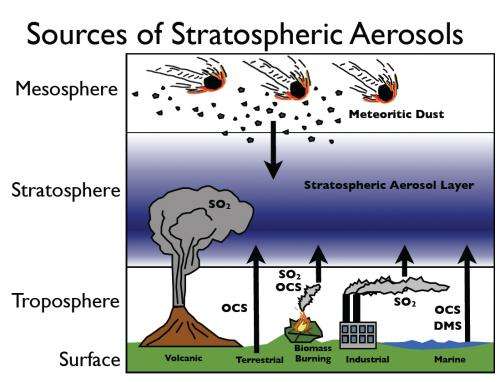
Sources of aerosols reach the stratosphere from above and below, as shown in the graph. Sulfur dioxide (SO2), carbonyl sulfide (OCS), and dimethyl sulfide(DMS) are the dominant surface emissions which contribute to aerosol formation. (Credit: NOAA)
(PhysOrg.com) -- A new study led by the U.S, National Oceanic and Atmospheric Administration (NOAA) shows that tiny particles that make their way all the way up into the stratosphere may be offsetting a global rise in temperatures due to carbon emissions. And while scientists cannot yet say with any certainty where exactly the particles are coming from, they are saying that they have confidence that such particles have likely muted global temperature gains by as much as a third of what they would have been. They team, led by John Daniel, a physicist at the NOAA Earth System Research Laboratory (ESRL) in Boulder, CO, has published their results in Science.
The new research has focused on aerosols, the tiny solid or liquid particles that exist in the atmosphere that can affect global temperatures, such as when Mt. Pinatubo in the Philippines, erupted in 1991 causing a worldwide average decrease in temperature of 1 degree Celsius for more than a year. The cooling is not the result of the ash, notes co-author Susan Soloman, but from the sulfur dioxide that is thrust all the way up into the stratosphere, where it oxidizes and adds to the sun reflecting properties of other already existing particles.
The team focused on the most recent decade because of the relative absence of massive volcanic eruptions , giving them a more clear environmental view of how much impact minor volcanic eruptions and human activities have on the amount of aerosols in the atmosphere and thus global temperatures. To find out what was going on, they used both ground based data and information from satellites such as Cloud-Aerosol Lidar and Infrared Pathfinder Satellite Observations (Calipso), to measure the amount of aerosols in the atmosphere and at what altitudes.
NOAA has released a statement outlining the results of the study, and in it Daniel, says, stratospheric aerosol increased surprisingly rapidly in that time, almost doubling during the decade, which forms the basis of the teams conclusions that such aerosols are responsible for the slowdown in increased temperatures that scientist around the world have been expecting due to greenhouse gas emissions.
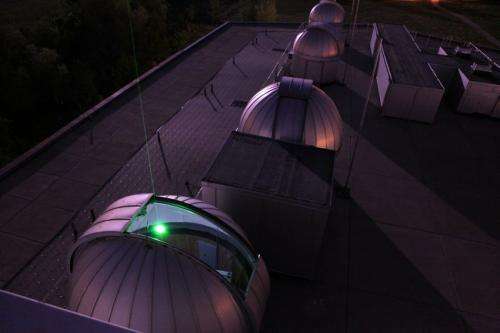
Lidar instruments - pointing up from the ground or down from satellites - use reflected light to measure the amounts of particles and their locations, which can influence climate. (Credit: CIRES/NOAA)
The surprising aspect of the study is the large amount of aerosols found during a period when there werent any giant volcanoes going off, which leads researches to wonder if the aerosols are from the combined effects of multiple small eruptions, or human activity, such as the particles emitted from coal fired power plants, particularly in Asia, where such plants have multiplied in recent years. One thing the research is not able to tell us is what impact aerosols will likely have in the future, because of the uncertainty of their origin, which means there is no way to tell at this point if there will be more, or less of them, which means scientists can only guess if the temperature muting will continue to offset global warming from current and future carbon emissions.More information: The Persistently Variable Background Stratospheric Aerosol Layer and Global Climate Change, Science DOI:10.1126/science.1206027
ABSTRACT
Recent measurements demonstrate that the background stratospheric aerosol layer is persistently variable rather than constant, even in the absence of major volcanic eruptions. Several independent data sets show that stratospheric aerosols increased in abundance since 2000. Near-global satellite aerosol data imply a negative radiative forcing due to stratospheric aerosol changes over this period of about 0.1 W/m2, reducing the recent global warming that would otherwise have occurred. Observations from earlier periods are limited but suggest an additional negative radiative forcing of about 0.1 W/m2 from 1960 to 1990. Climate model projections neglecting these changes would continue to overestimate the radiative forcing and global warming in coming decades if these aerosols remain present at current values or increase.
© 2010 PhysOrg.com
-
From lemons to lemonade: Reaction uses carbon dioxide to make carbon-based semiconductor,
32 comments
-
Thioridazine kills cancer stem cells in human while avoiding toxic side-effects of conventional cancer treatments,
3 comments
-
SpaceX private rocket blasts off for space station (Update),
42 comments
-
Climate scientists say they have solved riddle of rising sea,
31 comments
-
SpaceX capsule has 'new car' smell, astronauts say (Update),
2 comments
-
Hypothetical desert earth
14 hours ago
-
More human population = greater mass?
May 25, 2012
-
Conversion from aircraft bearing to normal degrees
May 23, 2012
-
Interpretation/Analysis of the Lab results(HEPA filter)
May 22, 2012
-
Has anyone here attended the The Urbino Summer School in Paleoclimatology?
May 22, 2012
-
Earthquakes: Mag 6 N. Italy and Mag 5.6 W. Bulgaria
May 21, 2012
- More from Physics Forums - Earth
More news stories
Sophisticated simulations predict future warming
The chances of our planet being hit by a global warming of 3 degrees Celsius by 2050 is as likely as it being hit by an increase of 1.4 degrees, new research shows. Presented in the journal Nature Geoscience, the British study ...
Space & Earth / Earth Sciences
May 22, 2012 |
4.4 / 5 (9) |
51
Kyoto Protocol architect 'frustrated' by climate dialogue
UN climate talks are going nowhere, as politicians dither or bicker while the pace of warming dangerously speeds up, one of the architects of the Kyoto Protocol told AFP.
May 23, 2012 |
3.7 / 5 (7) |
39
Aliens don't want to eat us, says former SETI director
Alien life probably isnt interested in having us for dinner, enslaving us or laying eggs in our bellies, according to a recent statement by former SETI director Jill Tarter.
Space & Earth / Space Exploration
May 25, 2012 |
4.4 / 5 (13) |
37
Dragon arrives at space station in historic 1st (Update 2)
The privately bankrolled Dragon capsule made a historic arrival at the International Space Station on Friday, triumphantly captured by astronauts wielding a giant robot arm.
Space & Earth / Space Exploration
May 25, 2012 |
5 / 5 (10) |
19
What's the big deal about private space launches?
(AP) -- The first private spaceship is headed to the International Space Station. Some questions and answers about the cargo mission by Space Exploration Technologies, known as SpaceX:
Space & Earth / Space Exploration
May 22, 2012 |
5 / 5 (6) |
35
Browser wars flare in mobile space
The browser wars are heating up again, but this time the fight is for dominance of the mobile Internet.
Nvidia trumpets Tegra 3 phone design wins for 2012
(Phys.org) -- Nvidias competitive war paint has a name, Tegra 3. On the heels of Nvidia announcements about lowering costs of its Tegra 3 processors and Nvidia-enabled tablets running Android Ice Cream ...
Scientist: Evolution debate will soon be history
(AP) -- Richard Leakey predicts skepticism over evolution will soon be history. Not that the avowed atheist has any doubts himself.
Dell tablet leak: 10.1-inch display, two-battery choice
(Phys.org) -- Headline after headline talks about vendors tablets in the wings as likely number-one contenders for the iPad. Such claims have justifiably been taken with a grain of salt, considering ...
Keep food safety in mind this memorial day weekend
(HealthDay) -- Picnics, parades and cookouts are as much a part of Memorial Day weekend as tributes to the United States' war veterans.
Social welfare cuts ultimately come with heavy price, researchers say
(Phys.org) -- Slashing government funding for Medicaid, food stamps and other programs that serve the poor while politically popular with some lawmakers and many conservatives may do more harm ...

Jul 22, 2011
Rank: 3.5 / 5 (6)
Jul 22, 2011
Rank: 3.1 / 5 (15)
Jul 22, 2011
Rank: 2.7 / 5 (10)
Jul 22, 2011
Rank: 3.1 / 5 (8)
Jul 22, 2011
Rank: 1.8 / 5 (5)
Jul 22, 2011
Rank: 4.3 / 5 (3)
Jul 22, 2011
Rank: 4.8 / 5 (5)
Jul 22, 2011
Rank: 2.8 / 5 (5)
Have you even looked at the carbon cycle? The net change from year to year is a small fraction of the total amounts 1) released into and 2) removed from, the atmosphere. When we run out of coal to burn, or (and I definitely hope) the human race gets smart enough to stop burning coal, the atmospheric levels of CO2 will return to normal within a century.
What is normal? How quickly? How will it affect global temperatures? All those are questions which atmospheric models are not yet good enough/validated to be able to answer.
Jul 22, 2011
Rank: 1 / 5 (4)
Jul 22, 2011
Rank: 4 / 5 (8)
Warming is definitely occurring, unfortunately. The 2000s were undisputedly the hottest decade in recorded history.
Jul 23, 2011
Rank: 3.6 / 5 (7)
Jul 23, 2011
Rank: 2.8 / 5 (11)
Jul 23, 2011
Rank: 3.2 / 5 (9)
Jul 23, 2011
Rank: 3.6 / 5 (7)
The scientific method is that you come up with a theory and then try as hard as you can to prove it wrong. Skepticism is the heart of modern discovery. True scientists in fields such as astronomy understand that. Climate study has two camps, the larger camp is not scientific in the way I just described. They are funded by special interest groups and motivated by social agendas. The smaller group is called deniers, but they are the ones using the scientific methhod of questioning themseves and others.
By the way, the slowdown of warming we have now is because of decadal ocean cycles, just as the warming (most of it) was also due to decedal ocean cyycles.
Expect 2012 to be cooler than average.
I'm not sure that's right, but that's one theory that's being thrown out right now by deniers who actually question their own work.
Jul 23, 2011
Rank: 5 / 5 (5)
Jul 23, 2011
Rank: 5 / 5 (1)
Jul 23, 2011
Rank: 3 / 5 (2)
No, I don't have a good reference, aside from the NINO3-4 record which is readily available at NCDC. I'm sure you can find it?
The super-nino of last year was predicted by Hansen of Penn State, and the warming that resulted was also predictable. NOw we're already in a cool PDO state, as you can clearly see from the weather patterns here in the US. They are saying that ENSO looks like it'll stay neutral for the forseeable future, and maybe go negative again. The AMO is also due to go cold any time now. If we get a tripple play on all three of those, then we'll be below the 130 year average. If we only get two out of three, then we'll be at 1970's levels. If only one out of three, then we're back to the ten year average low you mentioned.
I assume that you knew that all three of those have been mostly warm for the past 100 years. Even when one of them went cool, it was short and the other two were warm. Data speaks
Jul 23, 2011
Rank: 3.5 / 5 (2)
Jul 23, 2011
Rank: 3 / 5 (2)
Jul 23, 2011
Rank: not rated yet
Jul 23, 2011
Rank: 5 / 5 (1)
NCDC publishes a record of the ocean states. It's easily accessed at the NOAA web sites. the ENSO index, AMO and PDO record are all published. The data is there for anybody who wants to look at it. A published study with conclusions based on the data is an entirely different matter.
That happens all the time. There have been numerous corrections to the UAH satellite temperature record over time, with no published papers. The data is subject to constant review, regardless of publication in journals. Publication isn't limited to journals, you know. Most data that's collected on a regular basis, such as daily weather, doesn't ever get into a journal. That doesn't mean that I can't look at the data and interpret it, and you can too.
Jul 23, 2011
Rank: 5 / 5 (2)
All kidding aside, if you can't find the ENSO index record then you aren't even trying. The data is free and public. Go look man.
Jul 24, 2011
Rank: 3.7 / 5 (6)
Or sit in the dark and freeze.
Jul 25, 2011
Rank: not rated yet
One more thing about that statement. You aren't talking about discovery in that example. That is applied physics, invention, engineering, or tool-making. The basic physics behind his work had already been done by people long before him. Electromagnetics was already a well established field of science theory by the time he figured out a way to artificially broadcast and recieve them for communication. When I said that skepticism was the heart of discovery, I was talking about fundamental science, not applied science or engineering based on those fundamental principles. When Newton worked out his calculus and laws of motion, it wasn't until Einstien questioned them that he came up with a better theory.
Jul 25, 2011
Rank: 1 / 5 (1)
Jul 25, 2011
Rank: 2 / 5 (4)
And just watch the world boil over from global warming. Extinction and death. Nice call POS.
Jul 25, 2011
Rank: 1 / 5 (3)
The super-nino of last year was predicted by Hansen of Penn State, and the warming that resulted was also predictable. NOw we're already in a cool PDO state, as you can clearly see from the weather patterns here in the US.
Bull to the max guy. The PDO is crap theory that only looser believe in. The nino's are controlled by global warming now. In fact, the Nino's and Nina's will never be the same for millions of years now, thanks to global warming.
Jul 28, 2011
Rank: not rated yet
http://www.mdpi.c.../8/1603/
As with any new and contradictory study, I would view the article with extreme caution. Yes, I'm skeptical of the skeptics too.