New test measures key properties of polymer thin films and membranes
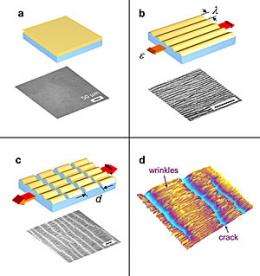
Nanomechanical measurements (model system and microimage of typical specimen). a) thin rigid film on elastic substrate b) initial strain induces surface wrinkles parallel to stress c) additional strain induces regular pattern of cracks in the film d) typical specimen imaged with optical profilometer (280 X 210 micrometers.)Credit: Chung, Lee/NIST
(PhysOrg.com) -- Researchers at the National Institute of Standards and Technology (NIST) have demonstrated a measurement technique that reliably determines three fundamental mechanical properties of near-nanoscale films. The technique, which highlights the challenge of making mechanical measurements on an object with at least one dimension comparable to the size of a virus, should enable better design and engineering for a variety of thin-film technologies, particularly reverse-osmosis membranes for water purification.
Reverse-osmosis membranes, explains NIST researcher Chris Stafford, are an interesting challenge for the materials scientist. The membranes are used in water purification systemsa polyamide film no more than 200 nanometers thick backed by a thicker, porous support layer. Water holding dissolved salts or other contaminants is forced against one side of the membrane at substantial pressures up to about a thousand psi (roughly 7 megapascal), and comes out the other side leaving most of the impurities behind. The mechanical integrity of the membrane is obviously essentialit can't tear or develop pinhole leaks under the pressurebut engineers lacked a good way to measure the strength and breaking point, under stress, of these extremely thin films.
The NIST technique builds on earlier work by the team that demonstrated that you can reliably determine Young's modulusa measure of stiffness or elasticityfor thin and ultrathin films by bonding it to a piece of silicon rubber, and then carefully stretching it in one direction. The film will develop a regularly spaced pattern of wrinkles (try it with a piece of plastic wrap), and the spacing of the wrinkles, the amount of stretch and some math gives you the modulus. In the new work, they basically pull harder until the film starts developing minute cracks crosswise to the tension. These too, it turns out, occur in regular patterns, and the spacing can be analyzed to determine both the fracture strength and the onset fracture strain, or the failure point, of the film.
Applying their technique to study the effect of chlorine on reverse-osmosis membranes, the team uncovered a puzzle. Chlorine in the water is known to cause a progressive deterioration in membrane performance, generally thought to be the result of prolonged chemical attack by the chlorine. Not so, according to the NIST team. "Chemically the chlorine attack is pretty quick," says Stafford. Spectroscopic chemical analysis showed that all the chemical damage from chlorine exposure happens in the first few hours. Tests using the wrinkle-crack method, however, show that the mechanical properties degrade continuouslythe material becoming more and more stiff, brittle and weakup to the longest duration tested, 10 days. "It may be an aging effect in polymers," says Stafford. "We're continuing to study that to figure out what's going on in there, because it's a real measurement challenge to get in on that length scale to follow the structure over time."
The project is part of a broader NIST program to study materials issues related to sustainable technologies like water purification, but the research team notes that the wrinkle-crack method itself would be broadly applicable to mechanical studies of almost any nanoscale thin film in fields as diverse as artificial skin, flexible electronics, thin-film sensors, fuel cells and photovoltaics.
More information: J.Y. Chung, et al. Stiffness, strength, and ductility of nanoscale thin films and membranes A combined wrinkling-cracking methodology. Nano Letters. Articles ASAP (As Soon As Publishable), July 15, 2011. DOI: 10.1021/nl201764b
Provided by
National Institute of Standards and Technology
-
From lemons to lemonade: Reaction uses carbon dioxide to make carbon-based semiconductor,
32 comments
-
Thioridazine kills cancer stem cells in human while avoiding toxic side-effects of conventional cancer treatments,
3 comments
-
SpaceX private rocket blasts off for space station (Update),
42 comments
-
Climate scientists say they have solved riddle of rising sea,
31 comments
-
SpaceX capsule has 'new car' smell, astronauts say (Update),
2 comments
-
Events tonight
28 minutes ago
-
does cold gasoline have less energy
1 hour ago
-
distribution of molecules throughout the atmosphere
2 hours ago
-
The Global Positioning System !
4 hours ago
-
A Question relating Power
5 hours ago
-
Writing a book so im learning about things, i have some general questions please read
7 hours ago
- More from Physics Forums - General Physics
More news stories
In nanorod crystal growth, nanoparticles seen as artificial atoms
In the growth of crystals, do nanoparticles act as "artificial atoms" forming molecular-type building blocks that can assemble into complex structures? This is the contention of a major but controversial theory ...
May 24, 2012 |
4.8 / 5 (6) |
0
|
First direct observation of oriented attachment in nanocrystal growth
Berkeley Lab researchers have reported the first direct observation of nanoparticles undergoing oriented attachment, the critical step in biomineralization and the growth of nanocrystals. A better understanding ...
May 24, 2012 |
4.7 / 5 (3) |
0
|
Dopant gives graphene solar cells highest efficiency yet
(Phys.org) -- By taking advantage of graphenes favorable electrical and optical properties, and then adding an organic dopant, researchers have achieved the highest power conversion efficiency yet for ...
Synthetic nano-waste does not disappear
(Phys.org) -- Tiny particles of cerium oxide do not burn or change in the heat of a waste incineration plant. They remain intact on combustion residues or in the incineration system, as a new study by Swiss ...
Nanotechnology / Bio & Medicine
May 25, 2012 |
5 / 5 (2) |
1
|
'Metamaterials,' quantum dots show promise for new technologies
(Phys.org) -- Researchers are edging toward the creation of new optical technologies using "nanostructured metamaterials" capable of ultra-efficient transmission of light, with potential applications including ...
May 24, 2012 |
5 / 5 (7) |
1
|
Nvidia trumpets Tegra 3 phone design wins for 2012
(Phys.org) -- Nvidias competitive war paint has a name, Tegra 3. On the heels of Nvidia announcements about lowering costs of its Tegra 3 processors and Nvidia-enabled tablets running Android Ice Cream ...
Browser wars flare in mobile space
The browser wars are heating up again, but this time the fight is for dominance of the mobile Internet.
Scientist: Evolution debate will soon be history
(AP) -- Richard Leakey predicts skepticism over evolution will soon be history. Not that the avowed atheist has any doubts himself.
Dell tablet leak: 10.1-inch display, two-battery choice
(Phys.org) -- Headline after headline talks about vendors tablets in the wings as likely number-one contenders for the iPad. Such claims have justifiably been taken with a grain of salt, considering ...
SpotterRF debuts Radar Backpack Kit (w/ Video)
(Phys.org) -- SpotterRF has announced a special radar backpack kit designed to enhance situational awareness for soldiers on the ground. The company says its special radar is designed for warfighters as part ...
SpaceX capsule has 'new car' smell, astronauts say (Update)
SpaceX's Dragon cargo vessel smells like a new car, said astronauts at the International Space Station after opening the hatches Saturday following the spacecraft's landmark mission to the orbiting lab.