Can you hear the shape of a graph?
The University of Bristol team members working on their exhibit at the Royal Society Summer Exhibition 2011. Image by Jasmin Meinecke/Oliver Sargent
The Bristol exhibit focuses on quantum graphs, which can be thought of as a network of guitar strings tied to each other. When a system like this vibrates it produces a series of sounds with different pitches.
Visitors to the exhibition, which opens today, will be invited to create quantum graphs and check out their properties on a large multi-touch surface in the Bristol exhibit. Varying the number and length of the strings, and trying different ways to connect them will create different quantum graphs with their own spectrum of sounds.
Visitors will also be able to explore how this spectrum changes with the quantum graph, observe the vibrating strings of the graph and note that some special points of the strings do not move at all. These nodal points are a fascinating phenomenon and discovering their patterns is still an unsolved challenge.
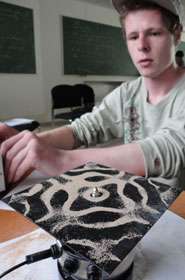
The exhibit also asks whether a quantum graph can be rebuilt just from knowing its spectrum of sounds, that is: can you hear the shape of a graph? This riddle is known as an inverse problem, whereby indirect measurements help us see the shape of an object. Real world examples of inverse problems include radar, sonar and ultrasound.
Dr Ram Band, research assistant in Bristols School of Mathematics and the director of the project, said: The idea of seeing sound has captivated people for hundreds of years. In the late 18th century, a German physicist and musician, Ernst Chladni, delighted audiences with his demonstrations, pouring sand on a brass plate and making it vibrate using a violin bow. The sand arranged itself into beautiful patterns which astounded the people who came to see his lectures. We hope that visitors to our exhibit will be equally enthralled by the opportunity to see for themselves the beauty of quantum graphs.
The Royal Societys annual Summer Science Exhibition opens today. The scientists will be on hand at the exhibition, which runs from 5 July to 10 July, to talk to visitors about their research.
The Bristol exhibit was designed, planned and built entirely by students from the School of Mathematics and the School of Physics. The project was directed by the post-doctoral researcher Dr Ram Band, with the PhD student, Adam Sawicki as the deputy director and Dr Dane Comerford as the consultant. The team worked together on all aspects of the project from the initial planning to the final realisation of the exhibit.
The team members are: George Adje, Ram Band, Dane Comerford, Yating Deng, Orestis Georgiou, Joanna Hutchinson, Chris Joyner, Lionel Kameni, Maxim Kirsebom, Ben Leadbetter, Jasmin Meinecke, Andrew Poulton, Oliver Sargent, Adam Sawicki, Peter Shadbolt and Nick Simm.
Provided by
University of Bristol
-
From lemons to lemonade: Reaction uses carbon dioxide to make carbon-based semiconductor,
32 comments
-
Thioridazine kills cancer stem cells in human while avoiding toxic side-effects of conventional cancer treatments,
3 comments
-
SpaceX private rocket blasts off for space station (Update),
42 comments
-
Climate scientists say they have solved riddle of rising sea,
31 comments
-
SpaceX capsule has 'new car' smell, astronauts say (Update),
2 comments
-
distribution of molecules throughout the atmosphere
2 hours ago
-
The Global Positioning System !
3 hours ago
-
A Question relating Power
4 hours ago
-
Writing a book so im learning about things, i have some general questions please read
7 hours ago
-
Question about induced E field.
8 hours ago
-
Charging a capacitor in a tesla coil
8 hours ago
- More from Physics Forums - General Physics
More news stories
Is a classical electrodynamics law incompatible with special relativity?
(Phys.org) -- The laws of classical electromagnetism that were developed in the 19th century are the same laws that scientists use today. They include Maxwell’s four equations along with the Lorentz la ...
Landmark calculation clears the way to answering how matter is formed
(Phys.org) -- An international collaboration of scientists, including Thomas Blum, associate professor of physics, is reporting in landmark detail the decay process of a subatomic particle called a kaon ...
May 25, 2012 |
4.2 / 5 (21) |
47
|
Lying in wait for WIMPs: Researchers seek to dramatically increase sensitivity of Large Underground Xenon detector
Although it's invisible, dark matter accounts for at least 80 percent of the matter in the universe. No one knows what it is, but most scientists would bet on weakly interacting massive particles, or WIMPs.
May 23, 2012 |
4 / 5 (7) |
15
|
Hawaii lab turns laser-powered bubbles into microrobots
(Phys.org) -- A team of scientists from the University of Hawaii are working on microrobots created from bubbles of air in a saline solution. The bubbles take on their title of robots as a laser ...
Sound increases the efficiency of boiling
Scientists at the Georgia Institute of Technology achieved a 17-percent increase in boiling efficiency by using an acoustic field to enhance heat transfer. The acoustic field does this by efficiently removing vapor bubbles ...
May 24, 2012 |
5 / 5 (2) |
2
Nvidia trumpets Tegra 3 phone design wins for 2012
(Phys.org) -- Nvidias competitive war paint has a name, Tegra 3. On the heels of Nvidia announcements about lowering costs of its Tegra 3 processors and Nvidia-enabled tablets running Android Ice Cream ...
Browser wars flare in mobile space
The browser wars are heating up again, but this time the fight is for dominance of the mobile Internet.
Scientist: Evolution debate will soon be history
(AP) -- Richard Leakey predicts skepticism over evolution will soon be history. Not that the avowed atheist has any doubts himself.
Dell tablet leak: 10.1-inch display, two-battery choice
(Phys.org) -- Headline after headline talks about vendors tablets in the wings as likely number-one contenders for the iPad. Such claims have justifiably been taken with a grain of salt, considering ...
SpotterRF debuts Radar Backpack Kit (w/ Video)
(Phys.org) -- SpotterRF has announced a special radar backpack kit designed to enhance situational awareness for soldiers on the ground. The company says its special radar is designed for warfighters as part ...
SpaceX capsule has 'new car' smell, astronauts say (Update)
SpaceX's Dragon cargo vessel smells like a new car, said astronauts at the International Space Station after opening the hatches Saturday following the spacecraft's landmark mission to the orbiting lab.
Jul 07, 2011
Rank: 1 / 5 (1)