DARPA's compact high-power laser program completes key milestone
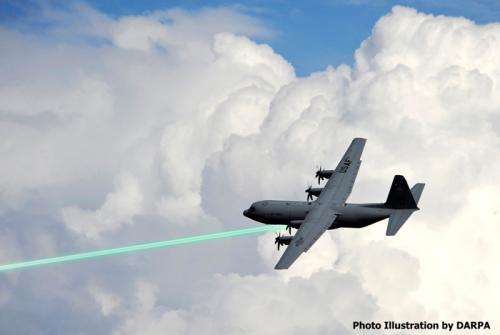
Enemy surface-to-air threats to manned and unmanned aircraft have become increasingly sophisticated, creating a need for rapid and effective response to this growing category of threats. A potential solution for countering these threats is high-powered lasers, which can harness the speed and power of light to counter multiple threats. But these lasers need to be lighter and require less space than current state-of-the-art for use on many of todays air assets. The goal of DARPAs High-Energy Liquid Laser Area Defense System (HELLADS) is to develop a 150 kilowatt (kW) laser weapon system that is ten times smaller and lighter than current lasers of similar power, enabling integration onto tactical aircraft to defend against and defeat ground threats.
DARPA recently completed laboratory testing of a fundamental building block for HELLADS, a single laser module that successfully demonstrated the ability to achieve high power and beam quality from a significantly lighter and smaller laser.
Successful testing of the single laser module is a major accomplishment, said Richard Bagnell, DARPAs HELLADS program manager. Advances in diodes, cooling, lightweight electronics, pumps, optics, and metal structures have made shrinking the size and weight possible without losing laser effectiveness.
The program now enters the final development phase where a second laser module will be built and combined with the first module to generate 150 kW of power. The goal is to have the 150 kW laser completed by the end of 2012.
Following the final development phase, plans call for the laser to be transported to White Sands Missile Range in the early-2013 timeframe for ground testing against rockets, mortars, surface-to-air missiles and to conduct simulated air-to-ground offensive missions.
DARPA is also in discussion with the Air Force about transitioning the technology to conduct an airborne demonstration following the ground testing phase.
Provided by DARPA
-
From lemons to lemonade: Reaction uses carbon dioxide to make carbon-based semiconductor,
32 comments
-
Thioridazine kills cancer stem cells in human while avoiding toxic side-effects of conventional cancer treatments,
3 comments
-
SpaceX private rocket blasts off for space station (Update),
42 comments
-
Climate scientists say they have solved riddle of rising sea,
31 comments
-
SpaceX capsule has 'new car' smell, astronauts say (Update),
2 comments
-
Need a rigid insulation material???
11 hours ago
-
magnets or EMF in car bumpers to protect from fender bender
May 26, 2012
-
length of wire in a coil of known dimensions?
May 25, 2012
-
India Engineering Powerhouse
May 25, 2012
-
electromagnet core dereference between hard and soft iron
May 25, 2012
-
Measuring water pressure in an open tank
May 24, 2012
- More from Physics Forums - General Engineering
More news stories
Browser wars flare in mobile space
The browser wars are heating up again, but this time the fight is for dominance of the mobile Internet.
4 hours ago |
5 / 5 (1) |
2
Probability of contamination from severe nuclear reactor accidents is higher than expected: study
Catastrophic nuclear accidents such as the core meltdowns in Chernobyl and Fukushima are more likely to happen than previously assumed. Based on the operating hours of all civil nuclear reactors and the number ...
Technology / Energy & Green Tech
May 22, 2012 |
3.6 / 5 (21) |
56
|
SpotterRF debuts Radar Backpack Kit (w/ Video)
(Phys.org) -- SpotterRF has announced a special radar backpack kit designed to enhance situational awareness for soldiers on the ground. The company says its special radar is designed for warfighters as part ...
HyperSolar shows dirty water no barrier to power world
(Phys.org) -- The Santa Barbara, California, company, HyperSolar, is set to transparently share the ups and downs of its research experiences toward the companys ultimate vision, successfully producing ...
Tesla to launch electric sedan in US on June 22
Tesla Motors said Tuesday it would begin deliveries of "the world's first premium electric sedan" on June 22, slightly ahead of schedule.
Technology / Energy & Green Tech
May 22, 2012 |
4.5 / 5 (11) |
18
Nvidia trumpets Tegra 3 phone design wins for 2012
(Phys.org) -- Nvidias competitive war paint has a name, Tegra 3. On the heels of Nvidia announcements about lowering costs of its Tegra 3 processors and Nvidia-enabled tablets running Android Ice Cream ...
Scientist: Evolution debate will soon be history
(AP) -- Richard Leakey predicts skepticism over evolution will soon be history. Not that the avowed atheist has any doubts himself.
Dell tablet leak: 10.1-inch display, two-battery choice
(Phys.org) -- Headline after headline talks about vendors tablets in the wings as likely number-one contenders for the iPad. Such claims have justifiably been taken with a grain of salt, considering ...
Keep food safety in mind this memorial day weekend
(HealthDay) -- Picnics, parades and cookouts are as much a part of Memorial Day weekend as tributes to the United States' war veterans.
Social welfare cuts ultimately come with heavy price, researchers say
(Phys.org) -- Slashing government funding for Medicaid, food stamps and other programs that serve the poor while politically popular with some lawmakers and many conservatives may do more harm ...
Is a classical electrodynamics law incompatible with special relativity?
(Phys.org) -- The laws of classical electromagnetism that were developed in the 19th century are the same laws that scientists use today. They include Maxwell’s four equations along with the Lorentz la ...
Jul 04, 2011
Rank: not rated yet
Jul 05, 2011
Rank: not rated yet
Later they will have bazooka size lasers, too.
Jul 05, 2011
Rank: not rated yet
Depends on what it hits.
If it hits a reflective surface: not much
If it hits a rotating target: not much
If it hits a target with an ablative surface: not much
If it hits a traget where the warhead is coverd with a minimum of lead (or other protective) housing: not much
If it needs to traverse a cloud or heavy rain before hitting the target: not much
If it hits a flimsy, straight flying, well absorbing, highly explosive, non-protected target in fair weather: Then it could cause enough damage to deflect/destroy it.
Jul 11, 2011
Rank: not rated yet