Silicon waveguide that converts polarization mode of light could speed up photonic circuits operation
June 9, 2011 By Lee Swee Heng
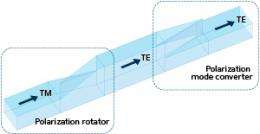
A schematic diagram of a combined polarization rotator and mode converter provides mode conversion to reduce propagation loss in the waveguide while retaining the original polarization state
Silicon is the dominant material for the fabrication of integrated circuits and is also becoming a popular material for making photonics circuits -- miniaturized circuits that use light instead of electronic signals for processing information. One of the challenges in the field, however, has been silicons intrinsic sensitivity to the polarization of light, which can limit the rate of information transmission. Jing Zhang, Tsung-Yang Liow and co-workers at the A*STAR Institute of Microelectronics have now developed a novel solution to this problem.
Light of different polarizations, which normally travel at the same speed in air, travel at different speeds in silicon waveguides due to random imperfections and asymmetries in the silicon itself. To overcome this problem, the researchers turned to a scheme known as polarization diversity, by which incoming light is split into two perpendicular modes of polarization, called the transverse electric (TE) and transverse magnetic (TM) modes. They then rotated the TM mode by 90° so that both of the modes propagate in parallel at the same speed inside the photonic circuit.
Zhang, Liow and their co-workers had previously demonstrated a silicon-based device, called a polarization rotator, which comprises the first half of the diversity scheme (see image). The rotator transforms TM light into TE light by passing the light through a horizontal waveguide and then rotating it into a vertical waveguide. In their present work, they designed, built and characterized a device that completes the second half of the scheme. Called a polarization mode converter, it transforms TE light in the vertical waveguide into TE light in a horizontal waveguide. By connecting their mode converter to their rotator, the researchers were able to construct a polarization diversity scheme that provides mode conversion to reduce propagation loss in the waveguide while retaining the original polarization state.
Both halves of the polarization rotation device work by gradually changing the geometry of the waveguide, which in turn changes the polarization mode of the light it is guiding. The Singapore research team characterized their devices by studying the signal loss introduced over the transition length between polarization modes, as well as the propagation loss in the rest of the device. They found that the device efficiencies would need to be improved to be practical, for example by reducing the roughness of the waveguide walls through thermal oxidation, and by improving the coupling between the waveguide and the fiber optic cable connected to it.
More information: Zhang, J., et al. Silicon waveguide based TE mode converter. Optics Express 18, 2526425270 (2010). http://dx.doi.org/ … OE.18.025264
Provided by Agency for Science, Technology and Research (A*STAR)
-
From lemons to lemonade: Reaction uses carbon dioxide to make carbon-based semiconductor,
32 comments
-
Thioridazine kills cancer stem cells in human while avoiding toxic side-effects of conventional cancer treatments,
3 comments
-
SpaceX private rocket blasts off for space station (Update),
42 comments
-
Climate scientists say they have solved riddle of rising sea,
31 comments
-
SpaceX capsule has 'new car' smell, astronauts say (Update),
2 comments
-
[Drift velocity] Factors affecting velocity
2 hours ago
-
does cold gasoline have less energy
3 hours ago
-
distribution of molecules throughout the atmosphere
4 hours ago
-
The Global Positioning System !
5 hours ago
-
A Question relating Power
7 hours ago
-
Writing a book so im learning about things, i have some general questions please read
9 hours ago
- More from Physics Forums - General Physics
More news stories
Is a classical electrodynamics law incompatible with special relativity?
(Phys.org) -- The laws of classical electromagnetism that were developed in the 19th century are the same laws that scientists use today. They include Maxwell’s four equations along with the Lorentz la ...
Landmark calculation clears the way to answering how matter is formed
(Phys.org) -- An international collaboration of scientists, including Thomas Blum, associate professor of physics, is reporting in landmark detail the decay process of a subatomic particle called a kaon ...
May 25, 2012 |
4.2 / 5 (21) |
47
|
Lying in wait for WIMPs: Researchers seek to dramatically increase sensitivity of Large Underground Xenon detector
Although it's invisible, dark matter accounts for at least 80 percent of the matter in the universe. No one knows what it is, but most scientists would bet on weakly interacting massive particles, or WIMPs.
May 23, 2012 |
4 / 5 (7) |
15
|
Hawaii lab turns laser-powered bubbles into microrobots
(Phys.org) -- A team of scientists from the University of Hawaii are working on microrobots created from bubbles of air in a saline solution. The bubbles take on their title of robots as a laser ...
Sound increases the efficiency of boiling
Scientists at the Georgia Institute of Technology achieved a 17-percent increase in boiling efficiency by using an acoustic field to enhance heat transfer. The acoustic field does this by efficiently removing vapor bubbles ...
May 24, 2012 |
5 / 5 (2) |
2
Nvidia trumpets Tegra 3 phone design wins for 2012
(Phys.org) -- Nvidias competitive war paint has a name, Tegra 3. On the heels of Nvidia announcements about lowering costs of its Tegra 3 processors and Nvidia-enabled tablets running Android Ice Cream ...
Browser wars flare in mobile space
The browser wars are heating up again, but this time the fight is for dominance of the mobile Internet.
Scientist: Evolution debate will soon be history
(AP) -- Richard Leakey predicts skepticism over evolution will soon be history. Not that the avowed atheist has any doubts himself.
Dell tablet leak: 10.1-inch display, two-battery choice
(Phys.org) -- Headline after headline talks about vendors tablets in the wings as likely number-one contenders for the iPad. Such claims have justifiably been taken with a grain of salt, considering ...
Keep food safety in mind this memorial day weekend
(HealthDay) -- Picnics, parades and cookouts are as much a part of Memorial Day weekend as tributes to the United States' war veterans.
Social welfare cuts ultimately come with heavy price, researchers say
(Phys.org) -- Slashing government funding for Medicaid, food stamps and other programs that serve the poor while politically popular with some lawmakers and many conservatives may do more harm ...