Salt-loving microbe provides new enzymes for the production of next-gen biofuels
June 30, 2011

Salt-loving microbe provides new enzymes for the production of next-gen biofuels

Enlarge

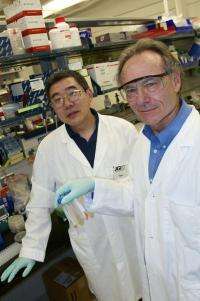
As a test of a bioenergy-related application of DNA sequencing and enzyme discovery, US Department of Energy Joint Genome Institute researchers led by the DOE JGI Director Eddy Rubin, and colleagues from the Joint BioEnergy Institute at DOE's Lawrence Berkeley National Laboratory employed a cellulose-degrading enzyme from a salt-tolerant microbe that was isolated from the Great Salt Lake. Credit: David Gilbert, DOE JGI

In order to realize the full potential of advanced biofuels that are derived from non-food sources of lignocellulosic biomass—e.g., agricultural, forestry, and municipal waste, and crops such as poplar, switchgrass and miscanthus—new technologies that can efficiently and cost-effectively break down this biomass into simple sugars are required. Existing biomass pretreatment technologies are typically derived from the pulp and paper industry and rely on dilute acids and bases to break down the biomass. The treated biomass product is then exposed to biological catalysts, or enzymes, to liberate the sugars.

A new class of solvents, referred to as ionic liquids, have been reported to be much more efficient in treating the and enhancing the yield of sugars liberated from it. While ionic liquids are useful for breaking down biomass, they can also hinder the ability of the cellulases (usually derived from fungi) used to produce sugars after pretreatment. Ionic liquids are a liquid form of salt that will inactivate enzymes by interfering with the folding of polypeptides—the building-blocks of proteins. To help identify new enzymes that are tolerant of ionic liquids, researchers from the U.S. Department of Energy (DOE) Joint Genome Institute (JGI) and the Joint BioEnergy Institute (JBEI) at DOE's Lawrence Berkeley National Laboratory are turning to those found in the complete genome sequences of halophilic (salt-tolerant) organisms.

As a test of this bioenergy-related application of DNA sequencing and enzyme discovery, researchers led by the Director of the DOE JGI, Eddy Rubin, and the Vice-President of the JBEI Deconstruction Division, Blake Simmons, employed a cellulose-degrading enzyme from a salt-tolerant microbe that was isolated from the Great Salt Lake. The microbe in question, Halorhabdus utahensis, is from the branch of the tree of life known as Archaea; H. utahensis was isolated from the natural environment at the Great Salt Lake and sequenced at the DOE JGI as part of the Genomic Encyclopedia of Bacteria and Archaea (GEBA) project.

"This is one of the only reports of salt-tolerant cellulases, and the only one that represents a true 'genome-to-function' relevant to ionic liquids from a halophilic environment," said Simmons of the study published June 30, 2011 in Green Chemistry. "This strategy enhances the possibility of identifying true obligatory halophilic enzymes." Such salt-tolerant enzymes, particularly cellulases, offer significant advantages for industrial utility over conventional enzymes.

In collaboration with Jerry Eichler from Ben Gurion University of the Negev in Israel they cloned and expressed a gene from H. utahensis in another haloarchaeal microbe, and were able to identify a salt-dependent that can tolerate high temperatures and is resistant to . "This project has established a very important link between genomic science and the realization of enzymes that can handle very demanding chemical environments, such as those present in a biorefinery," said Simmons.

The group plans to expand this research to develop a full complement of enzymes that is tailored for the ionic liquid process technology with the goal of demonstrating a complete biomass-to-sugar process, one they hope can enable the commercial viability of advanced biofuels.

Provided by DOE/Joint Genome Institute search and more info website


Rank 5 /5 (1 vote)
Relevant PhysicsForums posts
  • Gibbs Free Energy Change/Entropy
    created4 hours ago
  • What's the rule to covalent character
    created5 hours ago
  • Schwartz reagent-- NMR/MS/IR
    createdMay 26, 2012
  • High school chemistry EEI
    createdMay 25, 2012
  • oxidation of I- by KMnO4
    createdMay 25, 2012
  • Inversion temp
    createdMay 25, 2012
  • More from Physics Forums - Chemistry

More news stories

New CO2-removing catalyst can take the heat

(Phys.org) -- The current method of removing the greenhouse gas carbon dioxide (CO2) from the flues of coal-fired power plants uses so much energy that no one bothers to use it. So says Roger Aines, principal ...

Chemistry / Materials Science

created May 24, 2012 | popularity 5 / 5 (9) | comments 8 | with audio podcast

High-speed method to aid search for solar energy storage catalysts

Eons ago, nature solved the problem of converting solar energy to fuels by inventing the process of photosynthesis.

Chemistry / Materials Science

created May 25, 2012 | popularity 5 / 5 (3) | comments 4 | with audio podcast

Researchers demonstrate possible primitive mechanism of chemical info self-replication

(Phys.org) -- When scientists think about the replication of information in chemistry, they usually have in mind something akin to what happens in living organisms when DNA gets copied: a double-stranded molecule ...

Chemistry / Materials Science

created May 25, 2012 | popularity 5 / 5 (4) | comments 2 | with audio podcast

Building a better solar panel -- one molecule at a time

(Phys.org) -- One of the fundamental building blocks in modern chemistry, an organometallic chemical compound called ferrocene, has never been structurally defined - until now.

Chemistry / Materials Science

created May 25, 2012 | popularity 5 / 5 (3) | comments 0 | with audio podcast

Discarded data may hold the key to a sharper view of molecules

(Phys.org) -- There's nothing like a new pair of eyeglasses to bring fine details into sharp relief. For scientists who study the large molecules of life from proteins to DNA, the equivalent of new lenses have come in the ...

Chemistry / Biochemistry

created May 24, 2012 | popularity 4.7 / 5 (3) | comments 0 | with audio podcast


Nvidia trumpets Tegra 3 phone design wins for 2012

(Phys.org) -- Nvidia’s competitive war paint has a name, Tegra 3. On the heels of Nvidia announcements about lowering costs of its Tegra 3 processors and Nvidia-enabled tablets running Android Ice Cream ...

Browser wars flare in mobile space

The browser wars are heating up again, but this time the fight is for dominance of the mobile Internet.

Scientist: Evolution debate will soon be history

(AP) -- Richard Leakey predicts skepticism over evolution will soon be history. Not that the avowed atheist has any doubts himself.

Dell tablet leak: 10.1-inch display, two-battery choice

(Phys.org) -- Headline after headline talks about vendors’ tablets in the wings as likely number-one contenders for the iPad. Such claims have justifiably been taken with a grain of salt, considering ...

Keep food safety in mind this memorial day weekend

(HealthDay) -- Picnics, parades and cookouts are as much a part of Memorial Day weekend as tributes to the United States' war veterans.

Social welfare cuts ultimately come with heavy price, researchers say

(Phys.org) -- Slashing government funding for Medicaid, food stamps and other programs that serve the poor – while politically popular with some lawmakers and many conservatives – may do more harm ...