Prototype demonstrates success of advanced new energy technology
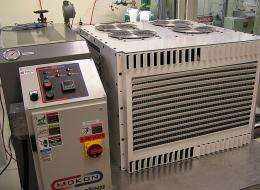
This prototype of a "thermal activated cooling system" has been developed by engineers at Oregon State University, and promises important new advances in energy efficiency by using wasted heat. (Photo courtesy of Oregon State University)
With the completion of a successful prototype, engineers at Oregon State University have made a major step toward addressing one of the leading problems in energy use around the world today the waste of half or more of the energy produced by cars, factories and power plants.
New technology is being developed at OSU to capture and use the low-to-medium grade waste heat that's now going out the exhaust pipe of millions of automobiles, diesel generators, or being wasted by factories and electrical utilities.
The potential cost savings, improved energy efficiency and broad application of such technology is enormous, experts say. The new systems now being perfected at OSU should be able to use much of that waste heat either in cooling or the production of electricity.
A prototype device has been finished to demonstrate the efficacy of this technology, and the findings just published in Applied Thermal Engineering, a professional journal.
"This could become a very important new energy source and way to improve energy efficiency," said Hailei Wang, a research associate in the School of Mechanical, Industrial and Manufacturing Engineering at OSU. "The prototype shows that these systems work as well as we expected they would."
More than half of the heat generated by industrial activities is now wasted, Wang said, and even very advanced electrical power plants only convert about 40 percent of the energy produced into electricity. The internal combustion engines of automobiles are even worse they generally operate around 25-40 percent conversion efficiency. The very function of an automobile radiator is to dissipate wasted heat.
Various approaches have been attempted, and are sometimes used, to capture and use at least some of that waste heat to produce cooling. The new system being developed at OSU may do that as, or more efficiently than past approaches, be more portable, and also have one major advantage the ability to also produce electricity.
It's called a "thermally activated cooling system" that gains much of its efficiency by using extraordinarily small microchannels which help to better meet the performance, size and weight challenges. It effectively combines a vapor compression cycle with an "organic Rankine cycle," an existing energy conversion technology.
The new prototype completed at OSU succeeded in turning 80 percent of every kilowatt of waste heat into a kilowatt of cooling capability. Researchers say the conversion efficiency wouldn't be nearly as high if the goal is to produce electricity about 15-20 percent but it's still much better than the current approach, which is to waste the energy potential of all of the heat.
"This technology would be especially useful if there's a need to have cooling systems where heat is being wasted," Wang said. "That's one reason the research has been supported by the Department of Defense, because they see it being used to provide needed air conditioning for electronics and other purposes when they are using generators in the field."
However, the OSU scientists said that may be just the beginning. Factories often produce enormous amounts of wasted heat in their operations. The systems could also be incorporated into alternative energy technologies such as solar or geothermal, scientists say, in addition to fossil fuel use.
Conceptually, it should also be possible for such systems to be used in hybrid automotive technology, taking waste heat from the gasoline engine and using it not only for air conditioning but also to help recharge the battery that powers the vehicle, Wang said.
Continued research will be needed to perfect the technology and adapt it to different uses, the scientists said.
The work takes advantage of OSU's advanced programs in microchannel technology, a key focus of the Microproducts Breakthrough Institute operated by OSU and the Pacific Northwest National Laboratory. This study was co-authored by Rich Peterson, an OSU professor of mechanical engineering, expert in thermal sciences and energy systems, and associate director of the Microproducts Breakthrough Institute.
"There continues to be significant potential for reducing energy consumption and greenhouse gas emission by improving overall energy efficiency for various energy systems," the scientists said in their study. "One route toward satisfying both paths is to develop technology able to recover waste heat that would be otherwise rejected to the atmosphere without usage."
More information: http://ir.library. … e/1957/21679
Provided by
Oregon State University
-
From lemons to lemonade: Reaction uses carbon dioxide to make carbon-based semiconductor,
32 comments
-
Thioridazine kills cancer stem cells in human while avoiding toxic side-effects of conventional cancer treatments,
3 comments
-
SpaceX private rocket blasts off for space station (Update),
42 comments
-
Climate scientists say they have solved riddle of rising sea,
31 comments
-
SpaceX capsule has 'new car' smell, astronauts say (Update),
2 comments
-
Need a rigid insulation material???
11 hours ago
-
magnets or EMF in car bumpers to protect from fender bender
May 26, 2012
-
length of wire in a coil of known dimensions?
May 25, 2012
-
India Engineering Powerhouse
May 25, 2012
-
electromagnet core dereference between hard and soft iron
May 25, 2012
-
Measuring water pressure in an open tank
May 24, 2012
- More from Physics Forums - General Engineering
More news stories
Browser wars flare in mobile space
The browser wars are heating up again, but this time the fight is for dominance of the mobile Internet.
4 hours ago |
5 / 5 (1) |
2
Probability of contamination from severe nuclear reactor accidents is higher than expected: study
Catastrophic nuclear accidents such as the core meltdowns in Chernobyl and Fukushima are more likely to happen than previously assumed. Based on the operating hours of all civil nuclear reactors and the number ...
Technology / Energy & Green Tech
May 22, 2012 |
3.6 / 5 (21) |
56
|
SpotterRF debuts Radar Backpack Kit (w/ Video)
(Phys.org) -- SpotterRF has announced a special radar backpack kit designed to enhance situational awareness for soldiers on the ground. The company says its special radar is designed for warfighters as part ...
HyperSolar shows dirty water no barrier to power world
(Phys.org) -- The Santa Barbara, California, company, HyperSolar, is set to transparently share the ups and downs of its research experiences toward the companys ultimate vision, successfully producing ...
Tesla to launch electric sedan in US on June 22
Tesla Motors said Tuesday it would begin deliveries of "the world's first premium electric sedan" on June 22, slightly ahead of schedule.
Technology / Energy & Green Tech
May 22, 2012 |
4.5 / 5 (11) |
18
Nvidia trumpets Tegra 3 phone design wins for 2012
(Phys.org) -- Nvidias competitive war paint has a name, Tegra 3. On the heels of Nvidia announcements about lowering costs of its Tegra 3 processors and Nvidia-enabled tablets running Android Ice Cream ...
Scientist: Evolution debate will soon be history
(AP) -- Richard Leakey predicts skepticism over evolution will soon be history. Not that the avowed atheist has any doubts himself.
Dell tablet leak: 10.1-inch display, two-battery choice
(Phys.org) -- Headline after headline talks about vendors tablets in the wings as likely number-one contenders for the iPad. Such claims have justifiably been taken with a grain of salt, considering ...
Keep food safety in mind this memorial day weekend
(HealthDay) -- Picnics, parades and cookouts are as much a part of Memorial Day weekend as tributes to the United States' war veterans.
Social welfare cuts ultimately come with heavy price, researchers say
(Phys.org) -- Slashing government funding for Medicaid, food stamps and other programs that serve the poor while politically popular with some lawmakers and many conservatives may do more harm ...
Is a classical electrodynamics law incompatible with special relativity?
(Phys.org) -- The laws of classical electromagnetism that were developed in the 19th century are the same laws that scientists use today. They include Maxwell’s four equations along with the Lorentz la ...
Jun 10, 2011
Rank: 2.5 / 5 (4)
BTW, cant you just slap a sterling engine to the radiator and produce power from the heat that way?
Jun 10, 2011
Rank: 2.8 / 5 (4)
Unfortunately, you can't directly turn heat into electricity efficiently. You can, however, use heat to generate electricity indirectly, in fact this is the basis for almost all forms of energy production (nuclear power plants use fission to heat up water and create steam, which then turns a turbine which powers a generator, etc.) and the same process applies to coal, etc.
So, unfortunately, you have to create a Ruth Goldberg machine to go from heat to electricity. There are other ways of using excess heat (as described in this article and several others) to create more efficient systems.
Jun 10, 2011
Rank: 2 / 5 (2)
Jun 10, 2011
Rank: 3.4 / 5 (5)
True, but the output is extremely small (even when connected with several other thermocouples to make a "thermopile") usually measured in the millivolt range. They are mainly used in measuring devices, or lower mass, far-reaching satellites, where the temperature difference between the two sides of the thermocouple are extreme. The amount of electricity produced is proportional to the temperature difference.
Jun 10, 2011
Rank: 3.3 / 5 (4)
That phrase is a bit awkward, unless someone has found a way to befuddle the arbitors of reality and trick thermodynamics. ;-)
I suspect that what was meant is that from each kW of waste energy, .8 kW can be "recovered" via that prototype?
Jun 10, 2011
Rank: not rated yet
Good catch, that should be corrected.
Jun 10, 2011
Rank: 5 / 5 (1)
http://www.physor...ser.html
http://www.physor...tor.html
Jun 10, 2011
Rank: 5 / 5 (1)
http://www.physor...als.html
-I like the possibility of sucking heat out of the air directly for air conditioning.
Jun 10, 2011
Rank: 1.5 / 5 (2)
There is no difference between a thermocouple and a thermoelectric generator. In the case of the TEG, its been engineered to maximized power output. So Krundoloss the answer is yes there is such a material but practical limitations make its implementation limited to special applications such as deep space probes. A great deal of research money is going into improving this class of materials to address the same needs mentioned in this article.
Jun 10, 2011
Rank: not rated yet
Jun 11, 2011
Rank: 3 / 5 (2)
Jun 11, 2011
Rank: not rated yet
http://www.scipub...-624.pdf
Jun 11, 2011
Rank: 1 / 5 (2)
On a plane to British Columbia, I sat next to an engineer who
worked for a Canadian petroleum company. After a couple of scotches, he told me about his friend in Saudi Arabia who had gotten 80 mpg's from his Ford pickup truck. He then sheepishly admitted that the jet engine , like the one outside our window, was designed to be inefficient. That was in 1976.
Jun 12, 2011
Rank: 5 / 5 (1)
I like the reference to Ruth Goldberg. Her machines were always more practical than those of her better known husband, Rube Goldberg. LOL.
Jun 13, 2011
Rank: not rated yet
Haha yeah I meant Rube, I have no idea why I put Ruth, his wife was named Irma.
Jun 18, 2011
Rank: not rated yet
yeah i herd the illuminati put a little device in every engine that reduces its efficiency from 200% to just 20%.
Jun 19, 2011
Rank: not rated yet