Conservation of genetic structure in lake salmonids affected by hydropower regulation, release of fish and hybrids
June 28, 2011

Conservation of genetic structure in lake salmonids affected by hydropower regulation, release of fish and hybrids

Enlarge

The negative effects of releasing fish and the possible fragmentation of natural fish stocks in connection with hydropower regulations may be fewer than at first feared.

Jens Wollebæk's doctoral thesis shows that the genetic structure of established stocks of wild trout and charr is only affected to a small extent by human intervention in the study area.

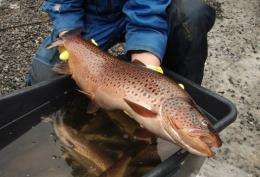
Released fish often have a different genetic structure to that of wild fish and can pose a threat to the natural, genetic structure of wild . By means of DNA analyses, Wollebæk has studied genetic variation in trout and charr living in two mountain reservoirs in the county of Buskerud, Norway. Since 1919, the ecosystem has been greatly affected by hydropower regulations and the subsequent release of large numbers of trout. In addition, an unintended colonisation of charr and minnows has occurred.

Released trout accounted for nearly 30% of the sexually mature fish in the reservoirs and it was assumed that the prolonged use of non-indigenous and previously released fish in hatcheries posed a risk to the genetic integrity of wild fish. However, it appears that maintain their natural, genetic structure, principally due to the high mortality of indigenous and released hybrids and to the fact that released fish do not migrate when spawning. Wollebæk's research shows that the genetic material of natural fish stocks is most affected by natural gene flow between nearby, wild substocks of trout within comparable habitats in the reservoirs studied.

Variations in water flow impinge on the life history strategy of the trout and charr to a greater extent than migration barriers introduced by humans. Nevertheless, the reproductive behavior of trout and charr has changed since the introduction of charr and minnows. Wollebæk's thesis reveals the rate and degree of change in the of both trout and charr.

Indigenous stocks of lake trout and growing, reproductive barriers between populations of charr established in stable habitats during the last century point to the capacity of salmonids to survive and adapt to changing environmental conditions. Wollebæk's doctoral thesis shows how genetic and ecological variation builds a foundation for selection and is a decisive factor in the establishment of alien species and the preservation of reproductive barriers. For this reason, both genetic and ecological criteria should be taken into account when managing stocks and regulating watercourses for hydropower purposes.

Cand.scient. Jens Wollebæk defended his doctoral thesis on 27th June 2011 at The Norwegian School of Veterinary Science. The thesis is entitled: ”Gene flow resilience in alpine lake salmonids: a conservation perspective.”

Provided by Norwegian School of Veterinary Science search and more info website


Rank not rated yet
Relevant PhysicsForums posts

More news stories

Scientist: Evolution debate will soon be history

(AP) -- Richard Leakey predicts skepticism over evolution will soon be history. Not that the avowed atheist has any doubts himself.

Biology / Evolution

created 16 hours ago | popularity 3.3 / 5 (17) | comments 48

More plant species responding to global warming than previously thought

(Phys.org) -- Far more wild plant species may be responding to global warming than previous large-scale estimates have suggested.

Biology / Ecology

created May 22, 2012 | popularity 4.6 / 5 (14) | comments 18 | with audio podcast

Thousands of shellfish found dead in Peru

Thousands of crustaceans were found dead off the coast of Lima following the mystery mass death of dolphins and pelicans, the Peruvian Navy said Friday.

Biology / Ecology

created May 26, 2012 | popularity 4.8 / 5 (4) | comments 7

For monogamous sparrows, it doesn't pay to stray (but they do it anyway)

It's quite common for a female song sparrow to stray from her breeding partner and mate with the male next door, but a new study shows that sleeping around can be costly.

Biology / Plants & Animals

created May 22, 2012 | popularity 5 / 5 (2) | comments 7 | with audio podcast

Study uncovers secret to speedy burrowing by razor clams

(Phys.org) -- If you look at a razor burrowing clam sitting in a bucket, you’d never guess that it could burrow itself down into the soil, much less do it with any speed. Razor clams look like fat straws, ...

Biology / Plants & Animals

created May 25, 2012 | popularity 1 / 5 (1) | comments 3 | with audio podcast report


Nvidia trumpets Tegra 3 phone design wins for 2012

(Phys.org) -- Nvidia’s competitive war paint has a name, Tegra 3. On the heels of Nvidia announcements about lowering costs of its Tegra 3 processors and Nvidia-enabled tablets running Android Ice Cream ...

Browser wars flare in mobile space

The browser wars are heating up again, but this time the fight is for dominance of the mobile Internet.

Dell tablet leak: 10.1-inch display, two-battery choice

(Phys.org) -- Headline after headline talks about vendors’ tablets in the wings as likely number-one contenders for the iPad. Such claims have justifiably been taken with a grain of salt, considering ...

Keep food safety in mind this memorial day weekend

(HealthDay) -- Picnics, parades and cookouts are as much a part of Memorial Day weekend as tributes to the United States' war veterans.

Social welfare cuts ultimately come with heavy price, researchers say

(Phys.org) -- Slashing government funding for Medicaid, food stamps and other programs that serve the poor – while politically popular with some lawmakers and many conservatives – may do more harm ...

Is a classical electrodynamics law incompatible with special relativity?

(Phys.org) -- The laws of classical electromagnetism that were developed in the 19th century are the same laws that scientists use today. They include Maxwell’s four equations along with the Lorentz la ...