Super lasers in Europe? You bet
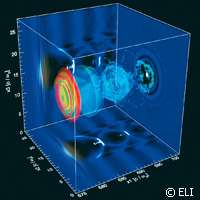
Gaining and maintaining a strong foothold in the European and global technology markets is high on the EU agenda. Helping meet this goal is the ELI ('Extreme light infrastructure') project, which clinched EUR 6 million under the Research Infrastructures budget line of the EU's Seventh Framework Programme (FP7) to build a laser of intensity sufficient to rip photons into electron-positron pairs.
A total of four initial high-powered lasers will be built in eastern Europe; three will be built initially, with the fourth one scheduled for a later date. The first super laser, to be located near the Czech capital city of Prague, will achieve exawatt class, making it around 100 times more powerful than what is currently available.
The project partners point out that ELI's primary goal is to serve as a research tool. This type of super laser could play a crucial role in the development of new cancer diagnosis and treatments, and could help fuel our understanding of molecular biology and nanoscience. It could also be used to resolve myriad issues that weigh heavily on the minds of environmentalists, like how to handle nuclear waste.
Sources in the Czech Republic are quoted as saying that the ELI laser was a tough deal to get since five countries were pushing to bring it to their part of the world.
The Czech Republic, however, will become a strong player in the field of optic and photonic research thanks to the ELI project. In the last decade, this EU Member State has hosted Precision Automated Laser Signals (PALS), which is one of the most sophisticated laser systems across Europe.
Under the plan, the super laser will start running within the next four years in Dolni Brezany, a town located south of Prague. It will operate using very short pulses of significantly high-energy particle and radiation beams.
Hungary and Romania are set to be the next locations for the super lasers. Sources say that each project will specialise in diverse research areas. But all projects will lead to the construction of the fourth super laser, which will have double the power of the three lasers. This fourth super laser will yield up to 200 petawatts per hour, which experts say is the theoretical limit for lasers.
Sources say the project's overall price tag will total EUR 700 million. ELI brings together almost 40 research and academic institutions from 13 EU Member States. Coordinated by the Centre National de la Recherche Scientifique in France, ELI comprises three branches: 1) ultra-high field science that explores laser-matter interaction in an energy range where relativistic laws could become null and void; 2) attosecond laser science, which is designed to conduct a temporal investigation of electron dynamics in atoms, molecules, plasmas and solids at the attosecond scale; and 3) high-energy beam science that focuses on the development and use of dedicated beam lines with ultra short pulses of high-energy radiation and pulses reaching nearly the speed of light.
Experts from Bulgaria, the Czech Republic, Germany, Greece, Spain, France, Italy, Lithuania, Hungary, Poland, Portugal, Romania and the United Kingdom are making major contributions to this project.
More information: http://www.extreme … tructure.eu/
Provided by CORDIS
-
From lemons to lemonade: Reaction uses carbon dioxide to make carbon-based semiconductor,
32 comments
-
Thioridazine kills cancer stem cells in human while avoiding toxic side-effects of conventional cancer treatments,
3 comments
-
SpaceX private rocket blasts off for space station (Update),
42 comments
-
Climate scientists say they have solved riddle of rising sea,
31 comments
-
Research team claims to have found evidence Lake Cheko is impact crater for Tunguska Event,
18 comments
-
distribution of molecules throughout the atmosphere
1 hour ago
-
The Global Positioning System !
2 hours ago
-
A Question relating Power
3 hours ago
-
Writing a book so im learning about things, i have some general questions please read
5 hours ago
-
Question about induced E field.
6 hours ago
-
Charging a capacitor in a tesla coil
6 hours ago
- More from Physics Forums - General Physics
More news stories
Is a classical electrodynamics law incompatible with special relativity?
(Phys.org) -- The laws of classical electromagnetism that were developed in the 19th century are the same laws that scientists use today. They include Maxwell’s four equations along with the Lorentz la ...
Landmark calculation clears the way to answering how matter is formed
(Phys.org) -- An international collaboration of scientists, including Thomas Blum, associate professor of physics, is reporting in landmark detail the decay process of a subatomic particle called a kaon ...
May 25, 2012 |
4.2 / 5 (21) |
47
|
Lying in wait for WIMPs: Researchers seek to dramatically increase sensitivity of Large Underground Xenon detector
Although it's invisible, dark matter accounts for at least 80 percent of the matter in the universe. No one knows what it is, but most scientists would bet on weakly interacting massive particles, or WIMPs.
May 23, 2012 |
4 / 5 (7) |
15
|
Hawaii lab turns laser-powered bubbles into microrobots
(Phys.org) -- A team of scientists from the University of Hawaii are working on microrobots created from bubbles of air in a saline solution. The bubbles take on their title of robots as a laser ...
Sound increases the efficiency of boiling
Scientists at the Georgia Institute of Technology achieved a 17-percent increase in boiling efficiency by using an acoustic field to enhance heat transfer. The acoustic field does this by efficiently removing vapor bubbles ...
May 24, 2012 |
5 / 5 (2) |
2
Browser wars flare in mobile space
The browser wars are heating up again, but this time the fight is for dominance of the mobile Internet.
Nvidia trumpets Tegra 3 phone design wins for 2012
(Phys.org) -- Nvidias competitive war paint has a name, Tegra 3. On the heels of Nvidia announcements about lowering costs of its Tegra 3 processors and Nvidia-enabled tablets running Android Ice Cream ...
Scientist: Evolution debate will soon be history
(AP) -- Richard Leakey predicts skepticism over evolution will soon be history. Not that the avowed atheist has any doubts himself.
Dell tablet leak: 10.1-inch display, two-battery choice
(Phys.org) -- Headline after headline talks about vendors tablets in the wings as likely number-one contenders for the iPad. Such claims have justifiably been taken with a grain of salt, considering ...
SpotterRF debuts Radar Backpack Kit (w/ Video)
(Phys.org) -- SpotterRF has announced a special radar backpack kit designed to enhance situational awareness for soldiers on the ground. The company says its special radar is designed for warfighters as part ...
SpaceX capsule has 'new car' smell, astronauts say (Update)
SpaceX's Dragon cargo vessel smells like a new car, said astronauts at the International Space Station after opening the hatches Saturday following the spacecraft's landmark mission to the orbiting lab.
May 18, 2011
Rank: 5 / 5 (1)