Sugar synthesis hits the sweet spot
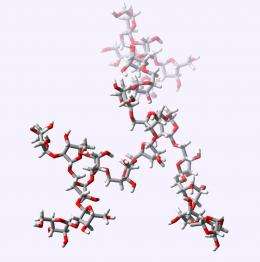
Figure 1: The compound Araf22 is a key component of the tuberculosis bacterium’s protective cell wall. Credit: 2011 Akihiro Ishiwata
A new strategy for synthesizing the kind of complex molecules that certain bacteria use to build their protective cell walls has been developed by Akihiro Ishiwata and Yukishige Ito from the RIKEN Advanced Science Institute in Wako, Japan. The strategy applies to Mycobacterium tuberculosis, the causative agent of tuberculosis (TB), so it could lead to much-needed new medicines to combat the spread of multi-drug-resistant strains of the pathogen.
Disrupting the formation of the cell wall of M. tuberculosis is already a proven strategy for treating TB, with several of the current front-line drugs working in this way. However, the cell wall skeleton is a complex, highly branched structure, and its biosynthesis is not yet fully understood.
According to Ito, the compound he and Ishiwata madea sugar-based structure known as the arabinan motif (Araf22) (Fig.1)should be a useful biological probe, helping to unravel cell wall biosynthesis. Perhaps more importantly, however, the success of their strategy suggests that larger, more complex cell wall components could be made in the same way.
Sugar-based compounds are notoriously difficult to make. Sugars are bristling with reactive alcohol groups, so molecules made from more than 20 sugar units pose a significant synthetic challenge. Nevertheless, Ishiwata and Ito succeeded in clipping together the branching chain of 22 sugar units needed to make Araf22.
Their strategy involved synthesizing small sub-structures of the mycobacterial cell wall skeleton and building from there. To make the compound, they conceptually broke down Araf22s structure into several simpler fragments, chemically synthesized those fragments, and then clipped them together to make Araf22. This aspect of the strategy has been applied before, but Ishiwata and Ito built the fragments such that they clipped together at linear rather than branching points in their structure.
The researchers strategy makes the individual fragments more difficult to build, but it makes the coupling process much more efficient. Crucially, that means the strategy should work just as well as a way to make even larger and more complex components of the cell wall.
One of the main points of this work is for us to show the way to construct the more complex compounds, says Ishiwata. We are now planning to synthesize more complex but structurally reliable glycans of cell wall skeletons for biological studies. However, such compounds could even prove to be useful drugs in themselves, if they are able to disrupt the cellular machinery responsible for mycobacterial cell wall biosynthesis.
More information: Ishiwata A. & Ito Y. Synthesis of docosasaccharide arabinan motif of mycobacterial cell wall. Journal of the American Chemical Society 133, 22752291 (2011)
Provided by
RIKEN
-
From lemons to lemonade: Reaction uses carbon dioxide to make carbon-based semiconductor,
32 comments
-
Thioridazine kills cancer stem cells in human while avoiding toxic side-effects of conventional cancer treatments,
3 comments
-
SpaceX private rocket blasts off for space station (Update),
42 comments
-
Climate scientists say they have solved riddle of rising sea,
31 comments
-
Research team claims to have found evidence Lake Cheko is impact crater for Tunguska Event,
18 comments
-
What's the rule to covalent character
2 hours ago
-
Schwartz reagent-- NMR/MS/IR
20 hours ago
-
High school chemistry EEI
May 25, 2012
-
oxidation of I- by KMnO4
May 25, 2012
-
Inversion temp
May 25, 2012
-
Hybridization of SnCl3 -
May 25, 2012
- More from Physics Forums - Chemistry
More news stories
New CO2-removing catalyst can take the heat
(Phys.org) -- The current method of removing the greenhouse gas carbon dioxide (CO2) from the flues of coal-fired power plants uses so much energy that no one bothers to use it. So says Roger Aines, principal ...
May 24, 2012 |
5 / 5 (7) |
7
|
High-speed method to aid search for solar energy storage catalysts
Eons ago, nature solved the problem of converting solar energy to fuels by inventing the process of photosynthesis.
May 25, 2012 |
5 / 5 (3) |
4
|
Researchers demonstrate possible primitive mechanism of chemical info self-replication
(Phys.org) -- When scientists think about the replication of information in chemistry, they usually have in mind something akin to what happens in living organisms when DNA gets copied: a double-stranded molecule ...
May 25, 2012 |
5 / 5 (4) |
2
|
Building a better solar panel -- one molecule at a time
(Phys.org) -- One of the fundamental building blocks in modern chemistry, an organometallic chemical compound called ferrocene, has never been structurally defined - until now.
May 25, 2012 |
5 / 5 (3) |
0
|
Discarded data may hold the key to a sharper view of molecules
(Phys.org) -- There's nothing like a new pair of eyeglasses to bring fine details into sharp relief. For scientists who study the large molecules of life from proteins to DNA, the equivalent of new lenses have come in the ...
May 24, 2012 |
4.7 / 5 (3) |
0
|
Browser wars flare in mobile space
The browser wars are heating up again, but this time the fight is for dominance of the mobile Internet.
Nvidia trumpets Tegra 3 phone design wins for 2012
(Phys.org) -- Nvidias competitive war paint has a name, Tegra 3. On the heels of Nvidia announcements about lowering costs of its Tegra 3 processors and Nvidia-enabled tablets running Android Ice Cream ...
Scientist: Evolution debate will soon be history
(AP) -- Richard Leakey predicts skepticism over evolution will soon be history. Not that the avowed atheist has any doubts himself.
Dell tablet leak: 10.1-inch display, two-battery choice
(Phys.org) -- Headline after headline talks about vendors tablets in the wings as likely number-one contenders for the iPad. Such claims have justifiably been taken with a grain of salt, considering ...
SpotterRF debuts Radar Backpack Kit (w/ Video)
(Phys.org) -- SpotterRF has announced a special radar backpack kit designed to enhance situational awareness for soldiers on the ground. The company says its special radar is designed for warfighters as part ...
SpaceX capsule has 'new car' smell, astronauts say (Update)
SpaceX's Dragon cargo vessel smells like a new car, said astronauts at the International Space Station after opening the hatches Saturday following the spacecraft's landmark mission to the orbiting lab.