Silver ionic liquids are powerful solvents for oil industry
May 17, 2011 by Agatha Bardoel
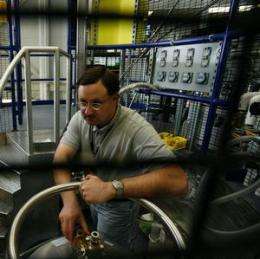
To get a better understanding of these silver compound ionic liquids, Eugene Mamontov, lead instrument scientist on BASIS, the Backscattering Spectrometer at ORNL’s Spallation Neutron Source, used quasielastic neutron scattering to probe the diffusion dynamics at the microscale that characterize these new solvents. Photo by Charlie Brooks
(PhysOrg.com) -- The separation of olefins and paraffin, two hydrocarbon compounds in petroleum waste streams, is a heavy expense for the petrochemical industry. The existing technology consumes a lot of energy because the olefin-paraffin pairs have similar boiling and evaporation properties, making it difficult and costly to separate them. Companies are looking for techniques that reduce energy consumption and that economically recycle such waste streams.
New research at Oak Ridge National Laboratory shows that olefins can be separated from paraffin efficiently and economically using silver complex-based ionic liquids. Room temperature ionic liquids are a promising class of novel materialssalts that are molten at or near room temperature. They are made up of ions rather than molecules. Ionic liquids do not easily evaporate, making them potentially recyclable and environmentally friendly solvents.
There are more than 400 ionic liquids that have been commercialized. The wide variety of materials that can be used to make them enables scientists to choose the ones best suited for a research project. These materials have a wide range of potential applications in the chemical industry, including in the separation of petroleum by-products in the oil industry.
This work builds on recent investigations into a membrane technology that makes it easier to transport olefins out of a waste stream. In this hybrid olefin-paraffin separation method, silver or copper ions are used to bind to olefin to form an ionic liquid. The silver or copper ions then act as carriers for the unwanted and transfer them through the membranes. Two of this new class of silver compound ionic liquids are currently under study.
To get a better understanding of these silver compound ionic liquids, scientists used quasielastic neutron scattering, or QENS, on BASIS, the Backscattering Spectrometer at ORNL's Spallation Neutron Source. QENS can probe the diffusion dynamics at the microscale that characterize these new solvents. Subsequent analysis of the scattering data points to three distinct components in the mechanism that transports the olefins.
The room-temperature ionic liquids for separating petroleum by-products have low vapor pressure (they evaporate only at very high temperatures), high thermal stability, and both positive and negative ions move freely through them. The researchers investigated the usefulness of these metal bearing solvents for the extraction and membrane separation of inorganic, organic, and gaseous species; for sensing volatile organic vapors; and for synthesizing novel materials.
A key feature of these new solvents is that the silver ions are incorporated as integral components of the ionic liquid at the molecular level. They are very stable and the silver content is several orders of magnitude higher than that of conventional liquid- or polymer-supported membranes, which makes it easier to drive the olefins through the membrane. In the current work, QENS neutron scattering provides fundamental insight into the olefin transport that cannot be obtained through other characterization techniques.
The QENS analysis shows that in the temperature range of 300 to 340 K, three dynamic components are present in the silver compound ionic liquid solvents and can be described in the microscopic transport on the pico- to nanosecond timescale. These occur in both the new solvents. The findings are similar to those found in a study of an ionic liquid developed earlier. This suggests that the three dynamic components found by neutron scattering may be a common feature of the ionic liquids' microscopic dynamics and are likely related to a fundamental lack of order in these materials at the nanoscale.
Provided by
Oak Ridge National Laboratory
-
From lemons to lemonade: Reaction uses carbon dioxide to make carbon-based semiconductor,
32 comments
-
Thioridazine kills cancer stem cells in human while avoiding toxic side-effects of conventional cancer treatments,
3 comments
-
SpaceX private rocket blasts off for space station (Update),
42 comments
-
Climate scientists say they have solved riddle of rising sea,
31 comments
-
Research team claims to have found evidence Lake Cheko is impact crater for Tunguska Event,
18 comments
-
What's the rule to covalent character
1 hour ago
-
Schwartz reagent-- NMR/MS/IR
20 hours ago
-
High school chemistry EEI
May 25, 2012
-
oxidation of I- by KMnO4
May 25, 2012
-
Inversion temp
May 25, 2012
-
Hybridization of SnCl3 -
May 25, 2012
- More from Physics Forums - Chemistry
More news stories
Researchers demonstrate possible primitive mechanism of chemical info self-replication
(Phys.org) -- When scientists think about the replication of information in chemistry, they usually have in mind something akin to what happens in living organisms when DNA gets copied: a double-stranded molecule ...
May 25, 2012 |
5 / 5 (4) |
2
|
High-speed method to aid search for solar energy storage catalysts
Eons ago, nature solved the problem of converting solar energy to fuels by inventing the process of photosynthesis.
May 25, 2012 |
5 / 5 (3) |
4
|
Building a better solar panel -- one molecule at a time
(Phys.org) -- One of the fundamental building blocks in modern chemistry, an organometallic chemical compound called ferrocene, has never been structurally defined - until now.
May 25, 2012 |
5 / 5 (3) |
0
|
New CO2-removing catalyst can take the heat
(Phys.org) -- The current method of removing the greenhouse gas carbon dioxide (CO2) from the flues of coal-fired power plants uses so much energy that no one bothers to use it. So says Roger Aines, principal ...
May 24, 2012 |
5 / 5 (7) |
7
|
Discarded data may hold the key to a sharper view of molecules
(Phys.org) -- There's nothing like a new pair of eyeglasses to bring fine details into sharp relief. For scientists who study the large molecules of life from proteins to DNA, the equivalent of new lenses have come in the ...
May 24, 2012 |
4.7 / 5 (3) |
0
|
Nvidia trumpets Tegra 3 phone design wins for 2012
(Phys.org) -- Nvidias competitive war paint has a name, Tegra 3. On the heels of Nvidia announcements about lowering costs of its Tegra 3 processors and Nvidia-enabled tablets running Android Ice Cream ...
Browser wars flare in mobile space
The browser wars are heating up again, but this time the fight is for dominance of the mobile Internet.
Dell tablet leak: 10.1-inch display, two-battery choice
(Phys.org) -- Headline after headline talks about vendors tablets in the wings as likely number-one contenders for the iPad. Such claims have justifiably been taken with a grain of salt, considering ...
Scientist: Evolution debate will soon be history
(AP) -- Richard Leakey predicts skepticism over evolution will soon be history. Not that the avowed atheist has any doubts himself.
SpaceX capsule has 'new car' smell, astronauts say (Update)
SpaceX's Dragon cargo vessel smells like a new car, said astronauts at the International Space Station after opening the hatches Saturday following the spacecraft's landmark mission to the orbiting lab.
Of mice and mental models: Neuroscientific implications of risk-optimized behavior in the mouse
(Medical Xpress) -- Regardless of an organism’s biological complexity, every encephalized animal continuously makes under-informed behavioral choices that can have serious consequences. Despite its ubiquity, ...