Quantum simulation with light: Frustrations between photon pairs
May 5, 2011

Quantum simulation with light: Frustrations between photon pairs

Enlarge

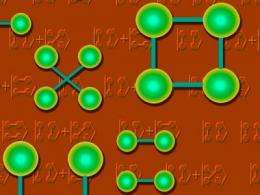
This is an illustration of pairs in a quantum mechanical system. Credit: Felice Frankel

Researchers of the University of Vienna used a quantum mechanical system in the laboratory to simulate complex many-body systems. This experiment promises future quantum simulators enormous potential insights into unknown quantum phenomena.

Researchers from the Vienna Center for Quantum Science and Technology at the University of Vienna and the Institute of and at the Austrian Academy of Sciences used a quantum in the laboratory to simulate complex many-body systems. This experiment, which is published in , promises future quantum simulators enormous potential insights into unknown .

Already the behavior of relatively small quantum systems cannot be calculated because quantum states contain much more information than their classical counter-parts. However, if another quantum system is used to simulate the quantum system of interest, then answers about the properties of the complex quantum system can be obtained.

When is a quantum system frustrated?

Currently, many international groups are focusing their research on frustrated quantum systems, which have been conjectured to explain high-temperature superconductivity. A quantum system is frustrated if competing requirements cannot be satisfied simultaneously. The Viennese research group realized for the first time an experimental quantum simulation, where the frustration regarding the "pairing" of correlations was closely investigated.

Using two pairs of entangled photons, a frustrated quantum system could be simulated that consists of four particles. "Just the recent development of our quantum technology allows us to not only rebuild other quantum systems, but also to simulate its dynamics" says Philip Walther (University of Vienna). "Now we can prepare quantum states of individual photons to gain insights into other ", explains Xiao-song Ma (Austrian Academy of Sciences).Therefore, two in polarization entangled photons exhibit in many ways the same quantum physical properties as for example electrons in matter.

Conflict over partnerships

The research team of international scientists from China, Serbia, New Zeeland and Austria prepared single photons that were facing the conflict over partnerships between each other. Each photon can establish a single bond to only one partner exclusively, but wants to get correlated with several partners – obviously this leads to frustration. As a result, the quantum system uses "tricks" that allow quantum fluctuations that different pairings can coexist as superposition.

The work of the Viennese group underlines that quantum simulations are a very good tool for calculating quantum states of matter and are thus opening the path for the investigation of more complex systems.

More information: Xiao-song Ma, Borivoje Dakic, William Naylor, Anton Zeilinger & Philip Walther, Quantum simulation of the wavefunction to probe frustrated Heisenberg spin systems, Nature Physics 7, 399-405 (2011) doi:10.1038/nphys1919

Provided by University of Vienna search and more info website

4.3 /5 (8 votes)  

Filter


Move the slider to adjust rank threshold, so that you can hide some of the comments.


Display comments: newest first

that_guy
May 05, 2011

Rank: not rated yet
I'm really not even going to pretend that I even have a full surface understanding of what they are talking about with frustrated photons. My only suggestion is to pair them up with some slut photons and see if that helps.
Rank 4.3 /5 (8 votes)
Relevant PhysicsForums posts
  • eyeglasses with smallest chromatic abberation
    created1 hour ago
  • Linear momentum converted to angular momentum?!
    created1 hour ago
  • Physics laboratory project - bumpers/crash tests
    created1 hour ago
  • How to open a winebottle with a shoe
    created1 hour ago
  • magnetic field from stream of protons
    created11 hours ago
  • Force on a particle constrained to move on the surface of a sphere
    created12 hours ago
  • More from Physics Forums - Classical Physics

More news stories

Is a classical electrodynamics law incompatible with special relativity?

(Phys.org) -- The laws of classical electromagnetism that were developed in the 19th century are the same laws that scientists use today. They include Maxwell’s four equations along with the Lorentz la ...

Physics / General Physics

created May 24, 2012 | popularity 4.7 / 5 (15) | comments 40 | with audio podcast feature

Landmark calculation clears the way to answering how matter is formed

(Phys.org) -- An international collaboration of scientists, including Thomas Blum, associate professor of physics, is reporting in landmark detail the decay process of a subatomic particle called a kaon – ...

Physics / General Physics

created May 25, 2012 | popularity 4.2 / 5 (21) | comments 47 | with audio podcast

Lying in wait for WIMPs: Researchers seek to dramatically increase sensitivity of Large Underground Xenon detector

Although it's invisible, dark matter accounts for at least 80 percent of the matter in the universe. No one knows what it is, but most scientists would bet on weakly interacting massive particles, or WIMPs.

Physics / General Physics

created May 23, 2012 | popularity 4 / 5 (7) | comments 15 | with audio podcast

Hall effect at the speed of light: How can you demonstrate relativistic effects with your mobile phone?

The relativistic Hall effect describing objects rotating at speeds comparable with the speed of light has been reported.

Physics / General Physics

created May 21, 2012 | popularity 4.3 / 5 (3) | comments 8

Cloak of invisibility: Engineers use plasmonics to create an invisible photodetector

A team of engineers at Stanford and the University of Pennsylvania has for the first time used "plasmonic cloaking" to create a device that can see without being seen - an invisible machine that detects light. It is the first ...

Physics / General Physics

created May 21, 2012 | popularity 4.8 / 5 (16) | comments 7 | with audio podcast


Browser wars flare in mobile space

The browser wars are heating up again, but this time the fight is for dominance of the mobile Internet.

Scientist: Evolution debate will soon be history

(AP) -- Richard Leakey predicts skepticism over evolution will soon be history. Not that the avowed atheist has any doubts himself.

Dell tablet leak: 10.1-inch display, two-battery choice

(Phys.org) -- Headline after headline talks about vendors’ tablets in the wings as likely number-one contenders for the iPad. Such claims have justifiably been taken with a grain of salt, considering ...

SpotterRF debuts Radar Backpack Kit (w/ Video)

(Phys.org) -- SpotterRF has announced a special radar backpack kit designed to enhance situational awareness for soldiers on the ground. The company says its special radar is designed for warfighters as part ...

SpaceX capsule has 'new car' smell, astronauts say (Update)

SpaceX's Dragon cargo vessel smells like a new car, said astronauts at the International Space Station after opening the hatches Saturday following the spacecraft's landmark mission to the orbiting lab.

Thousands of shellfish found dead in Peru

Thousands of crustaceans were found dead off the coast of Lima following the mystery mass death of dolphins and pelicans, the Peruvian Navy said Friday.