Risking one's neck for better grog: Mutinies reveal tipping points for collective unrest
Films depicting the 1787 mutiny aboard the British ship HMS Bounty show sailors living cheek by jowl, being forced to dance, enduring storm-ridden Cape of Good Hope crossings to satisfy the ship captain's ego and being flogged for trivial reasons.
We may not think that these harsh conditions have much relevance today. But mutinies continue to occur, especially in the armed forces of developing nations. And mutinies have similarities to other types of rebellions, including worker strikes, riots, prison rebellions and political uprisings.
University of Washington sociologists are studying naval records of mutinies as a way to see how modern-day ill-treatment toward subordinates can lead to violence.
"We know that 18th century sailors had lots of grievances, but usually they were not severe enough to cause a rebellion," said Steven Pfaff, UW associate professor of sociology. "Our study looks at what tips the balance from putting up with grievances to risking execution for mutiny."
Pfaff and Michael Hechter, a former UW sociology professor and now a professor of global studies at Arizona State University, along with UW undergraduate sociology students, are studying ship logs and court martial records from the British Royal Navy to learn what factors disrupted social order.
In June, Pfaff and Hechter will present a portion of their findings during the Mutiny and Maritime Radicalism in the Age of Revolution conference at the International Institute of Social History in Amsterdam, Netherlands.
The work is funded by the U.S. Air Force Office of Scientific Research and by the Harry Frank Guggenheim Foundation, which funds research on violence, aggression and dominance.
The sociologists are focusing on Royal Navy mutinies from 1740-1820, a period in which Great Britain achieved global dominance on the shoulders of her navy.
"During that time, there were about 70 cases in which sailors were able to take over ships for a period of time," said Pfaff, an expert on collective action – how groups of people work together toward a common goal. Previously, he's studied collective action in the context of religion, social movements and political revolutions, such as mass protests following the collapse of communism in Eastern Europe.
"I have generally found that people do not act irrationally when they protest, even when the costs of engaging in collective action are potentially very high – as with mutiny," Pfaff said. "Usually they are acting in hopes of redressing specific kinds of grievances."
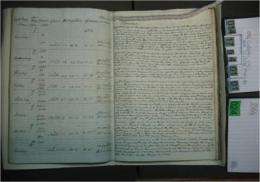
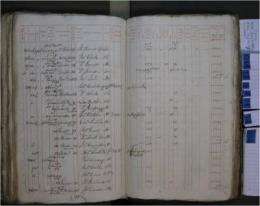
Working with Moira Bracknell, an expert in maritime history at the University of Exeter, Pfaff has made two trips to England to look through meticulous, hand-written ship logs and muster books kept by naval officers while at sea. He records the demographics of the ship´s crew, the age and size of the ship, whether the ship was at sea during war or peace, how long the ship had been at sea and the number of sailors aboard due to impressments – forced recruitment commonly used in that era.
Pfaff also looks at how well the ship is governed – the number of accidents aboard, adequacy of rations and amount of booty captured from enemy ships – and takes note of quality of life measures, such as severity of punishments, the extent of reduced rations, sicknesses and spoiled food.
In many cases, Pfaff finds that mutinies emerged because of unpaid and delinquent wages or excessive punishment.
Safety concerns were also a factor. Seamen aboard the Camilla near Jamaica in 1783, for instance, refused to sail because smallpox had killed several men, worsening a shortage of seamen on an understaffed ship. They argued that they could not sail without more men because if a squall – or a hurricane – set in, they would not be able to handle the ship.
Sometimes there were seemingly trivial reasons for mutiny:
- Watered-down grog aboard the Defiance in 1795,
- Poor quality beef aboard the Berwick in 1794,
- Ragged clothes on the Crown in 1764, and
- Lack of shore leave for sailors on the Orion in 1794.
Another seemingly odd reason for rebellion occurred in 1793 aboard the Minerva as it returned from the East Indies. Captain Whitby insisted the men exercise by fiddle-dancing, be quiet when above deck and forbade them from swearing – a cherished practice of seamen of the era.
Pfaff said that the episode on the Minerva was a mild case of mutiny and was settled peacefully. The Minerva mutiny is also an example of a common thread Pfaff finds for motivations to rebel: violation of naval conventions.
"It was a rough equilibrium most of the time," he said of life on board. Many times sailors expected officers to "look the other way in matters of petty deviance." And seamen were willing to endure a lot if they believed that their officers were fair, competent and protective of their welfare.
Studying the size and age of the ships gives Pfaff a sense of the sailors' abilities to plan and coordinate usurpation – no small feat in such cramped quarters or in the face of supervising officers and armed marine guards.
"It's a small community and hard to hide," Pfaff said of life aboard a ship. Would-be mutineers "would have to persuade someone to instigate the mutiny, knowing that ringleaders would be punished more severely."
By studying court-martial documents from mutiny trials, Pfaff finds that oaths were a common way to ensure solidarity in advance of an uprising. "Since the oaths were themselves illegal and potentially punishable by hanging, the willingness to take an oath was a credible signal that one´s shipmates were reliable," he said.
Unlike the well-known mutiny on the Bounty, in which mutineers took over the ship and set the captain adrift in a small boat with his supporters, most mutinies were more like worker strikes.
Pfaff calls these "voice" mutinies, after a distinction made by the famous economist Albert Hirschman. Voice mutinies occurred in about two thirds of the more than 60 mutinies Pfaff has studied so far.
"In voice mutinies, sailors wanted to improve their circumstances and make their conditions better," he said.
Now Pfaff and his research team are trying to understand the precise conditions that tipped a restive crew toward rebellion and what inspired some seamen to risk the most by becoming mutiny ringleaders. Pfaff and UW undergraduate researchers are coding data from hundreds of ships´ records from ships with mutinies and – as a control group – ships that did not have mutinies. Then the researchers will perform statistical analyses to isolate the factors that increased the odds of mutiny.
Provided by University of Washington


