Interactive teaching methods double learning in undergraduate physics class
May 12, 2011

Study: It's not teacher, but method that matters (AP)

Enlarge

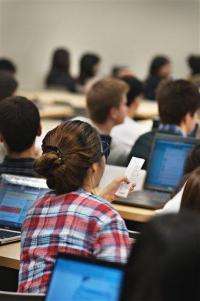
This undated handout photo, taken in 2010, provided by the University of British Columbia shows an unidentified student at the University of British Columbia using an interactive clicker in a classroom. A study by Nobel Prize winning physicist Carl Wieman at the university found that students learned better from inexperienced teachers using an interactive method _ including the clicker _ than a veteran professor giving a traditional lecture. Student answers to questions and quizzes are displayed instantly on the professor’s presentation. (University of British Columbia)

(PhysOrg.com) -- Interactive teaching methods significantly improved attendance and doubled both engagement and learning in a large physics class, according to a University of British Columbia study published today in Science.

Led by Louis Deslauriers, a post-doctoral researcher at UBC's Carl Wieman Science Education Initiative (CWSEI), the study compared the amount of learning experienced when taught – in three hours over one week – by traditional lecture and by using interactive activities based on research in cognitive psychology and physics education.

The research team found that students in the interactive class were nearly twice as engaged as their counterparts in the traditional class. Students from the experimental class uniformly scored nearly twice as well in a test designed to determine their grasp of complex physics concepts (average score 74 per cent vs. 41 per cent, with random guessing producing a score of 23 per cent). Attendance in the interactive class also increased by 20 per cent during the experiment.

"There is overwhelming evidence how much teaching pedagogy based on cognitive psychology and education research can improve science education," says co-author Carl Wieman. "This study further shows that we can achieve individual attention without individual interaction, and that even in a large class, the positive effects of a tutor or apprenticeship model can be achieved by using evidence-based teaching methods."

Wieman is Associate Director for Science of the White House Office of Science and Technology Policy. He was involved with the study last year before going on leave from UBC and the University of Colorado at Boulder (CU).

"In addition to the objective measurements of engagement, attendance and test scores, we also surveyed students and found that these teaching methods generated a lot of excitement in class – which makes for a great learning environment," says Deslauriers, lead author of the study.

In the study, two classes of an undergraduate physics course with approximately 270 students each were taught by highly-rated, professors with decades of experience. In the second-to-last week of the second semester, the instructor of one of the classes was replaced by Deslauriers and Ellen Schelew, a master's student in the Department of Physics at UBC. Deslauriers and Schelew had been trained by Wieman and other CWSEI researchers in interactive, evidence-based teaching methods but otherwise had little teaching experience beyond serving as teaching assistants.

During the experimental week, Deslauriers and Schelew gave no formal lecturing but guided students through a series of activities that had previously been shown to enhance learning, such as paired and small-group discussions and active learning tasks, which included the use of remote-control "clickers" to provide feedback for in-class questions. Pre-class reading assignments and quizzes were also given to ensure students were prepared to discuss course material upon arrival in class.

This video is not supported by your browser at this time.

"These activities require more work from the students, but the students report that they feel they are learning more and are more vested in their own ," says co-author Schelew.

"This study is designed specifically to gauge the impact of interactive teaching methods in a large undergraduate physics class, and the results present a very 'clean' comparison to the traditional lecture method," says Wieman.

Provided by University of British Columbia search and more info website

4.5 /5 (8 votes)  

Filter


Move the slider to adjust rank threshold, so that you can hide some of the comments.


Display comments: newest first

gmurphy
May 12, 2011

Rank: 5 / 5 (1)
Outstanding, one of the last great unexplored frontiers is the human mind and any country which can exploit the resources in that domain to it's fullest potential will surely thrive.
Lost_BiomedE
May 12, 2011

Rank: not rated yet
As long as the use of the clicker based quizzing is used for teaching vs. scoring it will likely be a boon. Unfortunately, I know, all too well, how much professors do not understand the difference between teaching and evaluating.
Recovering_Human
May 12, 2011

Rank: 5 / 5 (2)
Is anyone who has had to sit through ordinary college lectures even remotely surprised? It was always outright disturbing to me that seemingly the only evidence of the existence of post-industrial technology was that a cell phone would occasionally go off.
Jaeherys
May 12, 2011

Rank: 5 / 5 (1)
I personally love clickers. They can break the first to ask a question barrier which can really get the whole class talking about the lecture in a way that is more interactive with the profs. It makes the class feel smaller in some way, not to mention less formal and daunting.

You always get those profs (I'll label them the anti-interactive folk) that try to "scare" you into either dropping the course now or say that only half of you will pass, blah blah blah, but does it really help?

The most memorable courses have been the ones where the profs are engaged with the students, joking around here and there, and using whatever tools they have to help people succeed.

If every class was to be more like was shown, I know I would not have to force myself to attend some lectures...

As I am getting tired of the "I don't care about you" profs and "I'm just here to read my bit and get out". Clickers are a way for those types of profs to ease into actually interacting with a class.
mjesfahani
May 13, 2011

Rank: not rated yet
That's excellent, I like this kind of learning and teaching very much. at least, you have time to think more.
Rank 4.5 /5 (8 votes)
Relevant PhysicsForums posts
  • Consumption rivalry
    createdMay 25, 2012
  • Bilateral trade between all countries
    createdMay 24, 2012
  • Is the economic foundation of social media in jeopardy?
    createdMay 20, 2012
  • Psychology: Rosenthal and Hawthorne Effect
    createdMay 15, 2012
  • Is GDP and National Income the Same Thing?
    createdMay 13, 2012
  • Difference between hourly wage and real GDP per hour worked?
    createdMay 12, 2012
  • More from Physics Forums - Social Sciences

More news stories

Social welfare cuts ultimately come with heavy price, researchers say

(Phys.org) -- Slashing government funding for Medicaid, food stamps and other programs that serve the poor – while politically popular with some lawmakers and many conservatives – may do more harm ...

Other Sciences / Social Sciences

created May 24, 2012 | popularity 4.2 / 5 (15) | comments 126

Ancient Bethlehem seal unearthed in Jerusalem

Israeli archaeologists have discovered a 2,700-year-old seal that bears the inscription "Bethlehem," the Israel Antiquities Authority announced Wednesday, in what experts believe to be the oldest artifact ...

Other Sciences / Archaeology & Fossils

created May 23, 2012 | popularity 3.5 / 5 (14) | comments 23

Oldest Jewish archaeological evidence on the Iberian Peninsula

German archaeologists of the Friedrich Schiller University Jena found one of the oldest archaeological evidence so far of Jewish Culture on the Iberian Peninsula at an excavation site in the south of Portugal, ...

Other Sciences / Archaeology & Fossils

created May 25, 2012 | popularity 4.3 / 5 (4) | comments 12

Dollars and sense: Why are some people morally against tax?

As the U.S. presidential election campaigns heat up, the economic debate is dominated by bailouts, austerity and, inevitably, taxation. Now a new study published in Symbolic Interaction asks why tax is such an important issue ...

Other Sciences / Social Sciences

created May 23, 2012 | popularity 3 / 5 (2) | comments 12

Oldest art even older

New dates from Geißenklösterle Cave in Southwest Germany document the early arrival of modern humans and early appearance of art and music.

Other Sciences / Archaeology & Fossils

created May 24, 2012 | popularity 5 / 5 (2) | comments 6


Nvidia trumpets Tegra 3 phone design wins for 2012

(Phys.org) -- Nvidia’s competitive war paint has a name, Tegra 3. On the heels of Nvidia announcements about lowering costs of its Tegra 3 processors and Nvidia-enabled tablets running Android Ice Cream ...

Browser wars flare in mobile space

The browser wars are heating up again, but this time the fight is for dominance of the mobile Internet.

Scientist: Evolution debate will soon be history

(AP) -- Richard Leakey predicts skepticism over evolution will soon be history. Not that the avowed atheist has any doubts himself.

Dell tablet leak: 10.1-inch display, two-battery choice

(Phys.org) -- Headline after headline talks about vendors’ tablets in the wings as likely number-one contenders for the iPad. Such claims have justifiably been taken with a grain of salt, considering ...

SpotterRF debuts Radar Backpack Kit (w/ Video)

(Phys.org) -- SpotterRF has announced a special radar backpack kit designed to enhance situational awareness for soldiers on the ground. The company says its special radar is designed for warfighters as part ...

SpaceX capsule has 'new car' smell, astronauts say (Update)

SpaceX's Dragon cargo vessel smells like a new car, said astronauts at the International Space Station after opening the hatches Saturday following the spacecraft's landmark mission to the orbiting lab.