Iceland volcano eruption all but over: experts
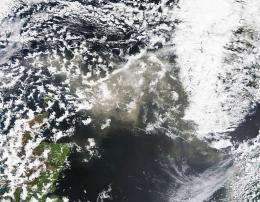
The eruption of Iceland's Grimsvoetn volcano has tailed off and its ash plume has almost disappeared, experts and officials said on Wednesday, refusing though to declare the flight-disrupting incident closed.
"The plume is very low, a couple of hundred meters," or 600-700 feet, Urdur Gunnarsdottir, a spokeswoman for the civil crisis management agency told AFP after a midday (1200 GMT) update.
The remaining plume appeared mainly to comprise steam, not ash, she said.
"It's much reduced, but there is still ... danger of occasional explosions or a puff coming up," she said, adding: "I don't think we want to pronounce it dead until it's dead."
Iceland's most active volcano, located at the heart of its biggest glacier, Vatnajoekull, in the southeast, began erupting Saturday, spewing a column of smoke and ash as high as 20 kilometres (12 miles) into the air.
It was the most dramatic start to an eruption in a century by Grimsvoetn, which erupted nine times between 1922 and 2004.
But the plume quickly declined to between 10 and 15 kilometres on Sunday, fell to around five kilometres on Tuesday morning and to just two kilometres by Tuesday evening, according to official measurements.
Icelandic authorities have stressed that a low-level eruption could continue for weeks and on Wednesday urged people to stay at a safe distance.
Icelandic Prime Minister Johanna Sigurdardottir said, though, "the worst is over" and cleaning up the thick ashy smothering could begin.
Iceland, which suffered a deep economic crisis after major banks went belly-up in 2008, "has been struck by a natural disaster," Sigurdardottir said.
"The government is already preparing a number of measures to assist residents, clean up the areas affected by volcanic ash, and return farming and other economic pursuits to normal," she said.
The road past the glacier was reopened late Tuesday for the first time since the eruption began, police said.
And in the small village of Kirkjubaejarklausur, at the edge of the glacier, most of the brown-grey dust that had blanketed it for days was gone Wednesday and life appeared to be getting back to normal.
Ash briefly closed Iceland's main airport overnight and caused disruptions to some air travel in Europe in Wednesday, especially Germany, which saw brief airspace closures and some 450 flight cancellations.
But the closures were due to old ash, Gunnarsdottir said.
"There has not been any ash emitted into higher altitudes for 24 hours at least. It is the ash emitted for the first 36 hours of the eruption that is causing the problem."
Just over a year ago, ash spewing from another volcano, Eyjafjoell, caused the biggest aerial shutdown in Europe since World War II, affecting more than 100,000 flights and eight million passengers.
But Eyjafjoell's plume never exceeded 10 kilometres.
According to an official calculation, Grimsvoetn spewed out more ash into the atmosphere in the first 24 hours of its eruption than Eyjafjoell did over 40 days.
In Paris, French vulcanologist Patrick Allard said the fact there had been two eruptions little more than a year apart did not mean volcanoes were becoming more active, in Iceland or globally.
"It's a coincidence," said Allard, a specialist at the Institute of the Physics of the Globe in Paris (IPGP). "These eruptions are separate from each other. They were produced by two volcanoes which have their own magma system and are more than 200 kilometres apart."
Allard warned, though, of the risk of a violent eruption of the volcano Hekla, about some 60 kilometres northwest of Eyjafjoell.
For the last 60 years, Hekla has sprung into life every 10 years or so. Its last burst was in 2000, "and it is now showing pre-eruption signs," Allard said.
(c) 2011 AFP


