Big clue to future climate change in small plants
May 19, 2011

Big clue to future climate change in small plants

Enlarge

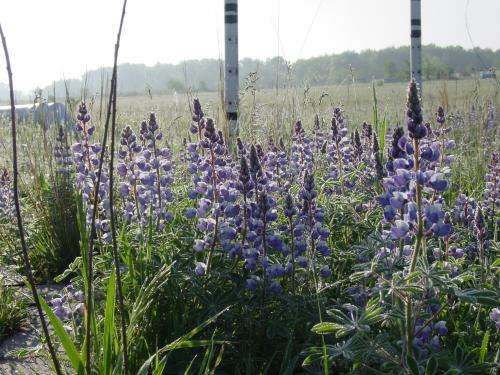
A wild lupine blooms at NSF's Cedar Creek Long-Term Ecological Research site in Minnesota. Credit: BioCON Experiment/NSF Cedar Creek LTER Site

Yarrow, it's called, this flowering plant also known as "little feather" for the shape of its leaves. Prized as a garden plant that repels unwanted insects while attracting beneficial ones, it also improves soil quality and is used in many herbal medicines.

Now yarrow--and 12 other grassland species, including Indian grass, thimbleweed and wild lupine--may have a larger role, scientists have found: as players in Earth's .

Researchers from the University of Wisconsin-Eau Claire and University of Minnesota-Twin Cities conducted an 11-year experiment with 13 plant species common in U.S. Midwestern states.

The scientists added extra carbon dioxide (CO2) to the plants' environment to discover how--in the higher carbon dioxide world of global warming--the plants would respond.

The results suggest that plants' capacity to absorb extra carbon from the atmosphere as CO2 levels rise may be less than expected.

The findings are published in the current issue of the journal .

Big clue to future climate change in small plants
Enlarge

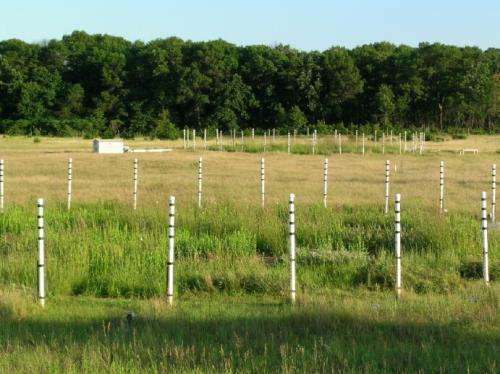
Two 20-meter-diameter BioCON study rings are shown, each containing two-meter by two-meter plots. Credit: BioCON Experiment/NSF Cedar Creek LTER Site

"They have major implications for models of future climate," says Peter Reich, a forest ecologist at the University of Minnesota and co-author of the paper. "Current state-of-the-art climate models assume that vegetation will soak up much of the extra CO2 we put into the air from fossil fuel burning."

But the new results, says biologist Tali Lee of the University of Wisconsin-Eau Claire and first author of the paper, "show that the capacity of some terrestrial ecosystems to absorb the extra CO2 may be less than the models assume."

That means that today's carbon cycle models likely underpredict the pace of increase of future CO2 levels, and therefore the pace of climate change, say Lee, Reich and Susan Barrott of the University of Minnesota, also a co-author of the paper.

"What this all boils down to," says Reich, "is that the world could warm even faster than we thought."

"Generalities about plant responses to global change have often proved elusive," says Henry Gholz, program director in the National Science Foundation's (NSF) Division of Environmental Biology, which funded the research.
Big clue to future climate change in small plants

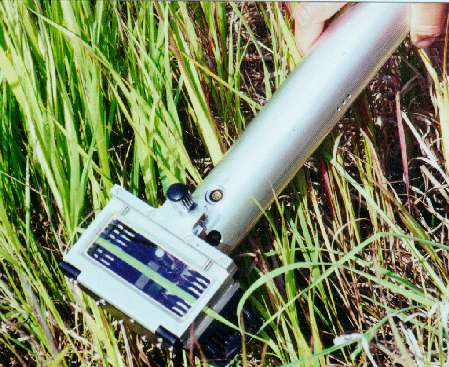
The portable carbon dioxide gas exchange system measures grass leaf photosynthesis. Credit: BioCON Experiment/NSF Cedar Creek LTER Site

"Now we have convincing evidence that the photosynthesis of typical grassland species will not respond as we had thought," says Gholz. "The cautionary implications for global are clear."

The researchers measured gas exchange rates of the 13 grassland species over 11 years using free-air CO2 enrichment at 180 parts per million, or ppm, above ambient CO2 levels. Their work is part of the BioCON experiment in Minnesota. 

The experiment is located at NSF's Cedar Creek Long-Term Ecological Research (LTER) site, one of 26 such NSF LTER sites around the world. 

BioCON consists of 371 two-meter by two-meter plots, arranged in six circular areas or "rings," each 20 meters in diameter and containing 61, 62, or 63 plots. Sixteen species of perennial prairie species, native or naturalized to the Cedar Creek area, are planted there.

Some BioCON plots are enriched with added CO2 and nitrogen, while others are not.

The 11 years of exposure produced consistent increases in leaf photosynthesis in the 13 species studied, compared with plants grown at ambient CO2 concentrations.

But those increases are, on average, at rates of about 10 percent. Previous similar studies at other locations had found results of some 25 percent.

The new findings are independent of the supply of nitrogen, which acts as a fertilizer for the plants.

"Carbon cycle models that assume and thereby simulate long-lived strong enriched CO2 stimulation of photosynthesis [greater than 25 percent] for all of Earth's terrestrial ecosystems," state the scientists in their paper, "should be viewed with a great deal of caution."

When it comes to how plants will respond in a higher-CO2 world, says Reich, "we need to take a much closer look."

Provided by National Science Foundation search and more info website

Filter


Move the slider to adjust rank threshold, so that you can hide some of the comments.


Display comments: newest first

lengould100
May 19, 2011

Rank: not rated yet
Strange to head an article titled "Yarrow" with a picture of Lupines. Agreed the article, many modern plants (including many food sources such as corn (maize) and sugar cane) use C4 photosynthesis which doesn't benefit much from increased CO2, and in fact looses its main competitive advantage.

http://onlinelibr...74.x/pdf
NotParker
May 19, 2011

Rank: 2 / 5 (4)
I'm more interested in food crops. Its good to know the extra CO2 has a really good chance of increasing our food production.
lengould100
May 19, 2011

Rank: not rated yet
C4 photosynthesis contributes about a quarter of the primary productivity on the planet, and a large fraction of the primary production humans consume either directly as plant material or indirectly via animal products is derived from C4 crops and pasture grasses.

mememine69
May 19, 2011

Rank: 1.8 / 5 (4)
The thousands of consensus scientists can study the effects of something that hasnt happened yet for another 25 years, or forever, it still wont make the climate change crisis true. Yes we DO study the projected effects of climate change on the planet. There is billions donated to scientists by politicians who make it look like they are doing something for you, liberal and conservative. So the scientists are busy studying and speculating what the heating effects will look like. But just as there are tropical fossils under the ice, calling all bad weather our fault, gives the social psychotics of witch burning, omen worship, paganism, superstition and sacrificing virgins, a new meaner brother by the name of climate change.
Vendicar_Decarian
May 19, 2011

Rank: 2.3 / 5 (3)
If the unusual weather in the U.S. and the rest of the world isn't proof of the non-existence of Global Climate Change, then I don't know what is.
Rank 4 /5 (8 votes)
Relevant PhysicsForums posts

More news stories

SpaceX capsule has 'new car' smell, astronauts say (Update)

SpaceX's Dragon cargo vessel smells like a new car, said astronauts at the International Space Station after opening the hatches Saturday following the spacecraft's landmark mission to the orbiting lab.

Space & Earth / Space Exploration

created 23 hours ago | popularity 4.5 / 5 (21) | comments 2

Australia hails surprise super-telescope decision

Australia has hailed a surprise decision giving it a role in a radio telescope project aimed at revolutionising astronomy, vowing to draw on its decades of experience in space science.

Space & Earth / Astronomy

created 23 hours ago | popularity 5 / 5 (4) | comments 2

Astronomers seize last chance in lifetime for Venus Transit

Astronomers are gearing for one the rarest events in the Solar System: an alignment of Earth, Venus and the Sun that will not be seen for another 105 years.

Space & Earth / Astronomy

created 23 hours ago | popularity 5 / 5 (3) | comments 2

Astronauts enter world's 1st private supply ship

(AP) -- Space station astronauts floated into the Dragon on Saturday, a day after its heralded arrival as the world's first commercial supply ship.

Space & Earth / Space Exploration

created 23 hours ago | popularity 5 / 5 (6) | comments 0

Sophisticated simulations predict future warming

The chances of our planet being hit by a global warming of 3 degrees Celsius by 2050 is as likely as it being hit by an increase of 1.4 degrees, new research shows. Presented in the journal Nature Geoscience, the British study ...

Space & Earth / Earth Sciences

created May 22, 2012 | popularity 4.4 / 5 (9) | comments 51


Nvidia trumpets Tegra 3 phone design wins for 2012

(Phys.org) -- Nvidia’s competitive war paint has a name, Tegra 3. On the heels of Nvidia announcements about lowering costs of its Tegra 3 processors and Nvidia-enabled tablets running Android Ice Cream ...

Browser wars flare in mobile space

The browser wars are heating up again, but this time the fight is for dominance of the mobile Internet.

Scientist: Evolution debate will soon be history

(AP) -- Richard Leakey predicts skepticism over evolution will soon be history. Not that the avowed atheist has any doubts himself.

Dell tablet leak: 10.1-inch display, two-battery choice

(Phys.org) -- Headline after headline talks about vendors’ tablets in the wings as likely number-one contenders for the iPad. Such claims have justifiably been taken with a grain of salt, considering ...

SpotterRF debuts Radar Backpack Kit (w/ Video)

(Phys.org) -- SpotterRF has announced a special radar backpack kit designed to enhance situational awareness for soldiers on the ground. The company says its special radar is designed for warfighters as part ...

Thousands of shellfish found dead in Peru

Thousands of crustaceans were found dead off the coast of Lima following the mystery mass death of dolphins and pelicans, the Peruvian Navy said Friday.