Titanium oxide doped with cobalt produces magnetic properties at room temperature
(PhysOrg.com) -- Spintronics — also known as magnetoelectronics — may replace electronics as the medium of choice for computer memory. The discovery of a mechanism that produces permanent magnets at room temperature, without any external influence, may soon improve the design of spintronic devices. Takumi Ohtsuki from the RIKEN SPring-8 Center, Harima and his colleagues in Japan, made the discovery in a class of material called a dilute ferromagnetic oxide.
Ferromagnetism is the mechanism responsible for making some materials magnetic without any external influence. In a ferromagnet, the axes about which a majority of the electrons spin are all parallel, but the underlying cause for this alignment is not always clear. A dilute ferromagnetic oxide is an oxide material doped with a small amount of a transition metal, which represents a marriage between magnetic materials and those used in electronics. Crucially, and unlike the ferromagnetic-semiconductors, dilute ferromagnetic oxides remain in a ferromagnetic state at room temperature.
Some materials have ferromagnetic constituents but exhibit no magnetism. However, some ferromagnets consist of substances that, on their own, are nonmagnetic. A full understanding of this enigma is vital for designing efficient spintronic devices and requires determining which electrons, or other type of charge carrier in a material, mediate the ferromagnetism. To resolve this question in dilute ferromagnetic oxides, Ohtsuki and his co-workers examined one commonly used example: cobalt-doped titanium dioxide (Co:TiO2). “Several mechanisms have been suggested for the origin of ferromagnetism in Co:TiO2, but no firm conclusion has been established,” says Ohtsuki.
The researchers used a powerful material characterization technique known as x-ray photoemission spectroscopy. A beam of x-rays, in this case from the SPring-8 synchrotron radiation facility, excited electrons from the sample of Co:TiO2. “The number of excited electrons versus their kinetic energies provided detailed information about the atomic composition and electronic state of the material,” explains Ohtsuki.
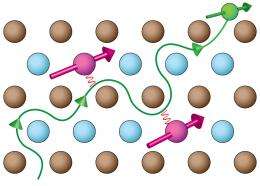
Ohtsuki and his team established that ferromagnetism is mediated by the electrons in the third shell—so-called 3d electrons—of the titanium ions (Fig. 1), a mechanism that has never been considered as a possibility by scientists before. The titanium 3d electrons align the spin of the cobalt atoms as they travel through the material.
The team’s discovery enhances the likelihood that dilute ferromagnetic oxides will be used as spintronic devices. “Our results have proven that magnetism and conductivity are correlated in Co:TiO2 thin films,” explains Ohtsuki. “This could make them applicable to magnetic random access memory (MRAM) or spin transistors.”
More information: Ohtsuki, T., et al. Role of Ti 3d carriers in mediating the ferromagnetism of Co:TiO2 anatase thin films. Physical Review Letters 106, 047602 (2011). prl.aps.org/abstract/PRL/v106/i4/e047602
Provided by RIKEN


