Scientists make magnetic new graphene discovery
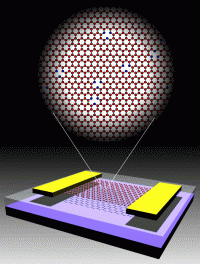
Schematic of a graphene transistor showing graphene (red), gold electrodes (yellow), silicon dioxide (clear) and silicon substrate (black). Inset shows the graphene lattice with vacancy defects. Vacancies (missing atoms) are shown surrounded by blue carbon atoms.
(PhysOrg.com) -- University of Maryland researchers have discovered a way to control magnetic properties of graphene that could lead to powerful new applications in magnetic storage and magnetic random access memory.
The finding by a team of Maryland researchers, led by Physics Professor Michael S. Fuhrer of the UMD Center for Nanophysics and Advanced Materials is the latest of many amazing properties discovered for graphene.
A honeycomb sheet of carbon atoms just one atom thick, graphene is the basic constituent of graphite. Some 200 times stronger than steel, it conducts electricity at room temperature better than any other known material (a 2008 discovery by Fuhrer, et. al). Graphene is widely seen as having great, perhaps even revolutionary, potential for nanotechnology applications. The 2010 Nobel Prize in physics was awarded to scientists Konstantin Novoselov and Andre Geim for their 2004 discovery of how to make graphene.
In their new graphene discovery, Fuhrer and his University of Maryland colleagues have found that missing atoms in graphene, called vacancies, act as tiny magnets -- they have a "magnetic moment." Moreover, these magnetic moments interact strongly with the electrons in graphene which carry electrical currents, giving rise to a significant extra electrical resistance at low temperature, known as the Kondo effect. The results appear in the paper "Tunable Kondo effect in graphene with defects" published this month in Nature Physics.
The Kondo effect is typically associated with adding tiny amounts of magnetic metal atoms, such as iron or nickel, to a non-magnetic metal, such as gold or copper. Finding the Kondo effect in graphene with vacancies was surprising for two reasons, according to Fuhrer.
"First, we were studying a system of nothing but carbon, without adding any traditionally magnetic impurities. Second, graphene has a very small electron density, which would be expected to make the Kondo effect appear only at extremely low temperatures," he said.
The team measured the characteristic temperature for the Kondo effect in graphene with vacancies to be as high as 90 Kelvin, which is comparable to that seen in metals with very high electron densities. Moreover the Kondo temperature can be tuned by the voltage on an electrical gate, an effect not seen in metals. They theorize that the same unusual properties of that result in graphene's electrons acting as if they have no mass also make them interact very strongly with certain kinds of impurities, such as vacancies, leading to a strong Kondo effect at a relatively high temperature.
Fuhrer thinks that if vacancies in graphene could be arranged in just the right way, ferromagnetism could result. "Individual magnetic moments can be coupled together through the Kondo effect, forcing them all to line up in the same direction," he said.
"The result would be a ferromagnet, like iron, but instead made only of carbon. Magnetism in graphene could lead to new types of nanoscale sensors of magnetic fields. And, when coupled with graphene's tremendous electrical properties, magnetism in graphene could also have interesting applications in the area of spintronics, which uses the magnetic moment of the electron, instead of its electric charge, to represent the information in a computer.
"This opens the possibility of 'defect engineering' in graphene - plucking out atoms in the right places to design the magnetic properties you want," said Fuhrer.
More information: http://www.nature. … hys1962.html
Provided by
University of Maryland
-
From lemons to lemonade: Reaction uses carbon dioxide to make carbon-based semiconductor,
32 comments
-
Thioridazine kills cancer stem cells in human while avoiding toxic side-effects of conventional cancer treatments,
3 comments
-
SpaceX private rocket blasts off for space station (Update),
42 comments
-
Climate scientists say they have solved riddle of rising sea,
31 comments
-
Research team claims to have found evidence Lake Cheko is impact crater for Tunguska Event,
18 comments
-
distribution of molecules throughout the atmosphere
55 minutes ago
-
The Global Positioning System !
2 hours ago
-
A Question relating Power
3 hours ago
-
Writing a book so im learning about things, i have some general questions please read
5 hours ago
-
Question about induced E field.
6 hours ago
-
Charging a capacitor in a tesla coil
6 hours ago
- More from Physics Forums - General Physics
More news stories
In nanorod crystal growth, nanoparticles seen as artificial atoms
In the growth of crystals, do nanoparticles act as "artificial atoms" forming molecular-type building blocks that can assemble into complex structures? This is the contention of a major but controversial theory ...
May 24, 2012 |
4.8 / 5 (6) |
0
|
First direct observation of oriented attachment in nanocrystal growth
Berkeley Lab researchers have reported the first direct observation of nanoparticles undergoing oriented attachment, the critical step in biomineralization and the growth of nanocrystals. A better understanding ...
May 24, 2012 |
4.7 / 5 (3) |
0
|
Dopant gives graphene solar cells highest efficiency yet
(Phys.org) -- By taking advantage of graphenes favorable electrical and optical properties, and then adding an organic dopant, researchers have achieved the highest power conversion efficiency yet for ...
Synthetic nano-waste does not disappear
(Phys.org) -- Tiny particles of cerium oxide do not burn or change in the heat of a waste incineration plant. They remain intact on combustion residues or in the incineration system, as a new study by Swiss ...
Nanotechnology / Bio & Medicine
May 25, 2012 |
5 / 5 (2) |
1
|
'Metamaterials,' quantum dots show promise for new technologies
(Phys.org) -- Researchers are edging toward the creation of new optical technologies using "nanostructured metamaterials" capable of ultra-efficient transmission of light, with potential applications including ...
May 24, 2012 |
5 / 5 (7) |
1
|
Nvidia trumpets Tegra 3 phone design wins for 2012
(Phys.org) -- Nvidias competitive war paint has a name, Tegra 3. On the heels of Nvidia announcements about lowering costs of its Tegra 3 processors and Nvidia-enabled tablets running Android Ice Cream ...
Browser wars flare in mobile space
The browser wars are heating up again, but this time the fight is for dominance of the mobile Internet.
Dell tablet leak: 10.1-inch display, two-battery choice
(Phys.org) -- Headline after headline talks about vendors tablets in the wings as likely number-one contenders for the iPad. Such claims have justifiably been taken with a grain of salt, considering ...
Scientist: Evolution debate will soon be history
(AP) -- Richard Leakey predicts skepticism over evolution will soon be history. Not that the avowed atheist has any doubts himself.
SpaceX capsule has 'new car' smell, astronauts say (Update)
SpaceX's Dragon cargo vessel smells like a new car, said astronauts at the International Space Station after opening the hatches Saturday following the spacecraft's landmark mission to the orbiting lab.
Of mice and mental models: Neuroscientific implications of risk-optimized behavior in the mouse
(Medical Xpress) -- Regardless of an organism’s biological complexity, every encephalized animal continuously makes under-informed behavioral choices that can have serious consequences. Despite its ubiquity, ...
Apr 14, 2011
Rank: 5 / 5 (4)
Apr 14, 2011
Rank: 5 / 5 (3)
You are thinking inside the box. To me the most important property of graphene is its biocompatibility. In a few years getting a new phone will involve pulling the old one out from under your scalp, and putting a new one in.* The phone will connect with your brain through TMI (transcranial magnetic induction) so making a biocompatible ferromagnet is a big deal.
* A few years after that, it will all be done with nanomachines. Take a pill and wait a few minutes. ;-)
Apr 14, 2011
Rank: 2 / 5 (4)
So basicly you're saying humanity will turn into the Borg...
I mean, if half the people get implants and become super-humans, the other half will be forced to do the same to compete in whatever job market remains, seeing as how androids will do all the menial tasks anyway...
So what is your vision of the future? A capitalistic Borg, instead of the Communistic Borg of Star Trek?
Which is worse, I wonder?
Apr 14, 2011
Rank: 4 / 5 (4)
Apr 14, 2011
Rank: 1 / 5 (1)
Inside of compressed electrons their repulsive forces are compensating mutually, so that the electrons are moving freely with ballistic transport in fast waves, i.e. they're behaving like much lighter particles or even superconductor.
At the opposite case the motion of every electron requires the drift of many other electrons in perpendicular direction, which are doing place for its motion and which are the source of strong internal magnetic field connected with such motion. Such material is called a heavy fermion material.
Apr 14, 2011
Rank: 1 / 5 (1)
Are they not able to produce scientific advances anymore?
Apr 14, 2011
Rank: 1 / 5 (1)
But at the moment, when some atom is physically removed from graphene lattice, the exactly the opposite situation occurs. Such place will get an excess of electrons from outside and it will behave like piece of of heavy fermion material. The hole in atom lattice is actually behaving like the relative donor of electrons ("anti-hole" of electrons) there.
Whereas in semiconductor physics the "hole" concept denotes the local lack of negatively charged electrons, in this case the hole in atom lattice introduces the lack of positively charged atom nuclei - so that these two "hole" concepts shouldn't be confused mutually: they're of exactly opposite effects.
Apr 14, 2011
Rank: not rated yet
Well, you have to figure in Star Trek different types of aliens have different types of mental abilities, so the Borg believe they benefit from enslaving all life to aquire all knowledge and attributes.
They also only assimilate species which they believe have some quality or tecnology that makes them "relevant" or worthy. So for example, they will totally ignore a species that appears to have no advanced technology.
And to answer your question, no, actually, in the series, the Borg do a lot of "inventing" on their own in addition to what they steal and assimilate from others.
My point was I don't think that's a good way to go for humanity.
Apr 14, 2011
Rank: 1 / 5 (1)
Stone tools is one thing, but implanting machines in our brains is quite another.
You are talking about, eventually, the total lack of any privacy whatsoever, even in your own mind.
Imagine what hackers, or the government, or corporations will do when they figure out how to control your implants, for example.
Imagine if everyone knew everything you've ever done, or thought about doing.
Apr 14, 2011
Rank: 3 / 5 (2)
Apr 14, 2011
Rank: 1 / 5 (1)
Apr 14, 2011
Rank: not rated yet
some inside of the box thinking for you
personal information storage that resides on your person literally... imagine having a harddrive that lives inside of you - recording all you biorythms coupled with blood chemistry analysis - your body would be constantly monitoring itself and updating your physicians database on your heart rate, hormone levels, odd chemical signatures in your blood... there are cancers that can be determined by a few blood tests -- well the second you begin to go down that road you doctor calls you in to confirm and you have a quick out patient surgery to remove the tumor growth that because you caught it 3 days in development is reall really small and there you go.
How about recording your daily life -- if we could ever learn to 'read' the sensory data the eyes and ears take in then we could record an entire life -- NOT sure if that is desirable - but 80% homicides and rapes would now lead to convictions.
I have a lot of other ideas
Apr 14, 2011
Rank: not rated yet
Can every computer be hacked -- no -- is every computer vunerable -- yes
I have a few puters i keep off of any network - they are only hackable by physical manipulation - you have to come into my house and touch the machine
There are computer netowrks out there that are pretty much unhackable because of restrictionof knowledge -- in college i worked on a Dod project that dealt with a secure resource - the protocol for online manipulation of that resource was known by very few people -- so most attacks on said resource was driven by people with inside knowledge -- so very hard to attack
My point is not everything HAS to be networked -- and if the resource is very important - such as access to something that interacts with your body directly - then obscure protocols that require levels of access to even learn help deter criminal activity
Apr 14, 2011
Rank: 5 / 5 (1)
I'll tell you what's worse. Assuming because of some arbitrary notion in your mind that only half of the people will have it. It's typical us-versus-them technophobia. I see that this will be as accessible to everyone who is born as getting slapped on the bottom when you pop out. For all we know, the nano-tech will get passed straight from the mother to the child while it is in the womb, granting other health and mental benefits to newborns.
Apr 14, 2011
Rank: 5 / 5 (1)
Wow, let's assume the worst for the future because somebody in Hollywood took some tidbits from culture and used it to make a boogeyman for the good guys to fight in a TV series. I'm not that worried because, worst case, if we do turn into the Borg, we'll be the baddest asses in our galaxy. Whoopee doo.
How about we give equal time to the good things that can happen as well as the cheesy cliche'd sci-fi memes floating around.
Apr 15, 2011
Rank: not rated yet
But what about us? Good news and bad news...
Apr 15, 2011
Rank: not rated yet
Personal computers hooked to the Internet 24/7 give you some idea of what things will be like. Those who are willing to devote the time and energy to being secure, will basically be secure. They will occasionally get infected, but as long as the problem is detected early, and treated quickly, they will remain themselves.
On the other hand tomorrow's (heck it is pretty much tomorrow already) equivalent of unprotected sex will be unprotected data sharing. I've already heard many "hard luck" stories from people who trusted their spouses with their passwords. After all they share everything else, right? If you do, don't be surprised when some day you find your life in shreds--porn e-mailed to your friends and co-workers--and boss.
Apr 16, 2011
Rank: not rated yet
We embrace new technology and are empowered by it.
We adapt to new threats and protect ourselves from them.
Resistance is futile.
Apr 16, 2011
Rank: not rated yet