Google grew from Stanford engineering, and the relationship continues to provide answers to tough problems
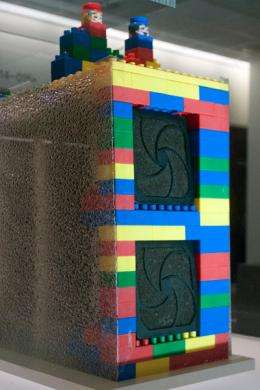
Visitors to the new Huang Engineering Center, home of the Stanford School of Engineering, may see a whimsical structure built of brightly colored Lego blocks, translucent plastic and packaging tape. Tucked inside are several bulky hard drives and a logic board.
This oddly un-engineered construction is the first Google server, created by Sergey Brin and Larry Page when they were graduate students at Stanford's School of Engineering in the 1990s. They built it in an audacious quest to catalog and analyze the World Wide Web.
Today, what began as a graduate project has become one of the world's best-recognized companies and a case study of the tight relationship between Stanford University and many private companies throughout Silicon Valley.
By Google's own estimate, about 1,300 Stanford graduates are employed at Google, including Marissa Mayer, now vice president of location and local services.
Her story begins in the summer of 1999 at the height of the dot-com boom. Mayer, then a computer science graduate student, sat weighing job offers when she opened a recruiting email from a tiny startup. She had heard about the company from Professor Eric Roberts, so she decided to go in for an interview.
In Google's office above a bike shop on University Avenue in Palo Alto, Mayer met with the founders and employee No. 1, Craig Silverstein, also a Stanford doctoral student. They grilled Mayer on the engineering required to apply artificial intelligence and other techniques to improve Internet search. Impressed by the tough questions, Mayer thought it was a great opportunity to stretch herself professionally, and to learn.
"I realized I would learn more trying to build this vision of search … than I would succeeding somewhere else, even if we failed at Google," she said in recounting her decision during a 2010 keynote speech to hundreds of fellow alumni at the School of Engineering's eDay event.
Thirteen years after Brin and Page left Stanford to found Google, an insatiable curiosity and a desire to tackle big problems continue to sustain an especially close relationship between the company and the university, particularly in computer science and the School of Engineering. The result is a steady flow of people and ideas between Stanford's campus in Palo Alto and Google's campus in Mountain View, just a few miles away.
"[Stanford Engineering] is a very strong, mutually beneficial partner in innovation," said Alfred Spector, Google's vice president of research and special initiatives and a Stanford computer science alumnus. "It's a very deep relationship. It is consistent with the Engineering School's and the Computer Science Department's long-term understanding that these fields don't exist at the university in a vacuum, but as part of the greater ecosystem."
Stanford Engineering Dean Jim Plummer sees it much the same way: "The many interactions and collaborations between Google and Stanford engineers advance information technology in interesting ways. In a little more than a decade, Google has grown from startup to being an important partner for developing new ideas in a wide spectrum of engineering areas."
Ever-expanding information
Google was an ambitious idea from the start in 1997 when it was born in the Stanford Digital Libraries Project, recalled computer science Professor Terry Winograd. He was Larry Page's adviser and a co-investigator of the libraries project with Professor Hector Garcia-Molina.
"They were going to crawl a really large number of places on the web," Winograd said. "Over a period of months it became clear they really could do the engineering and the crawling to have a better web search engine than those that existed at the time. They could produce better results and they could do the computation necessary."
A key innovation was Brin's and Page's "PageRank" algorithm that calculated the relevance of a given page to the user's query. PageRank factored relevance in part based on the number of other pages that linked to the given page. In essence, the students theorized that in the same way frequently cited scientific papers are considered more important, frequently cited web pages would be more important, too.
The founders began their enterprise in 1998 with the support of advisers and Stanford computer science professors like Winograd, Garcia-Molina, Jeff Ullman and the late Rajeev Motwani, as well as business guidance and investment from computer science Professor David Cheriton and alumnus and Sun Microsystems co-founder Andreas Von Bechtolsheim.
Google has become not only the dominant company in web search, but has also made major strides in digitizing information in the physical world and geographic products such as Google Earth, Google Maps and StreetView. In acquiring YouTube, Google became a major clearinghouse of online videos. Gmail is the email vendor of choice for millions, and Google's Android is now a ubiquitous smart-phone operating system.
The company's breadth and scale have led to vast research interests, opening new doors for interaction with Stanford faculty and students. Over the last decade, Spector noted, Google has supported roughly 40 projects at Stanford in a wide variety of technology areas (Internet commerce, algorithms, social networking, mobile systems, and high-throughput computing and communications) and even social sciences, such as political science and Internet law.
Among the projects Google is supporting now, Spector said, is the Clean Slate Design for the Internet, a sweeping endeavor led by electrical engineering and computer science Professor Nick McKeown to rethink the infrastructure of inter-computer and inter-network as well as mobile Internet communications. Given that every query submitted to Google is handled by a "cloud" of servers distributed widely across the Internet and, as Mayer pointed out in her eDay speech, it's all done in about 0.2 seconds, Google is intensely curious about wringing greater performance out of networks.
Another current project, led by electrical engineering and computer science Associate Professor Christos Kozyrakis, seeks advances to make computing more energy-efficient. Assistant Professor Fei-Fei Li, on the other hand, has Google's support for a project analyzing the content of images.
Google's support for the school is not always directed to a specific technology problem. In 2009, the company gave $2.5 million to endow a School of Engineering professorship in memory of Motwani, who died in an accident. Computer science Professor Daphne Koller is the first to hold the professorship, which is designated for faculty members who, like Motwani, are developing fundamental technologies with important applications.
In yet another partnership, Google co-sponsored the Stanford Racing Team's efforts to develop a fully autonomous, self-driving robot car to win the Defense Department's urban driving contest in 2007.
Google has since hired members of the racing team. Computer science and electrical engineering Professor Sebastian Thrun, for instance, who led the effort, is now at Google. Google currently has a fleet of autonomous vehicles that have logged hundreds of thousands of miles on major California roads with little human intervention.
While an autonomous car is unlikely to become a Google product, the company has been able to directly apply Stanford innovations in other products. StreetView, for instance, a component of Google Maps that offers users panoramic views of city streets, is rooted in Stanford's CityBlock project, led by computer science and electrical engineering Professor Marc Levoy.
"Both of my students working on CityBlock started working for Google when they graduated," Levoy said. "One of them, Augusto Román, still works on StreetView at Google."
Power of the people
Román is hardly alone as a former Stanford student now at Google.
"Most [professors] have PhD graduates who work at Google, not to mention former undergraduate and master's students with whom we also keep in touch," said Jennifer Widom, chair of the Computer Science Department.
Stanford professors often spend sabbaticals at the company and, Spector added, the company also brought in at least 100 Stanford students as interns during a recent three-year period. Widom said students in her program prize Google internships, which can deeply influence a student's education.
One of Winograd's students, David Akers, turned his internship into his dissertation topic. He began developing software that would track when users were having trouble with computer applications. His software captured the steps the user had taken just before and after, and packaged them for usability experts to analyze.
"Faculty are not taking a step back or looking short-term if they get involved with what Google is doing," Widom said. "It's not hard to form a collaboration. They have a lot of smart people there who aren't afraid to tackle hard problems."
Provided by Stanford University


