Google founder hopes to prove he's ready to be CEO
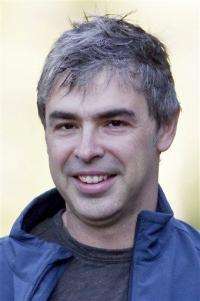
(AP) -- Google co-founder Larry Page is known for his vision, passion and intelligence.
Yet there is a fair amount of concern that Page's other known traits - his aloofness, rebellious streak and affinity for pursuing wacky ideas - might lead the company astray. Page takes over as CEO on Monday as fast-rising rivals and tougher regulators threaten Google's growth.
Investors used to Google Inc.'s consistency in exceeding financial targets worry that new leadership will bring more emphasis on long-term projects that take years to pay off. And many people still aren't sure he has enough management skills to steer the Internet's most powerful company.
Page already has learned that smarts alone won't make him a great leader. Although Page impressed Google's early investors with his ingenuity, they still insisted that he step down in 2001 as Google's first CEO. He turned over the job to Eric Schmidt, a veteran executive who began working in Silicon Valley in the early 1980s while Page was still in grammar school.
Page's admirers say that at 38, he is more mature and less apt to be chronically late to meetings or tune out of conversations that don't stimulate his intellect - habits that he fell into during his first stint as CEO.
"There are parts of being CEO that don't fit Larry's personality," said Craig Silverstein, the first employee that Page and Google's other founder, Sergey Brin, hired when they started the company in 1998. "You wear a lot of different hats when you're CEO. Some of them are very interesting to Larry and some of them, presumably, are less interesting."
True to his taciturn form, Page hasn't said much publicly since Google made its stunning announcement in January that he will replace Schmidt as CEO. Google said Page wasn't available for an interview.
Page, though, has left little doubt about his top priority: to dissolve the bureaucracy and complacency that accompanied the company's rapid transformation into a 21st-century empire. Google is expected to end the year with more than 30,000 employees and $35 billion in annual revenue.
In Page's mind, the 13-year-old company needs to return to thinking and acting like a feisty startup. Rising Internet stars such as Facebook, Twitter and Groupon, all less than 8 years old, are developing products that could challenge Google and make its dominance of Internet search less lucrative.
Page has drawn comparisons to two high-tech geniuses who are even more accomplished: Microsoft Corp. co-founder Bill Gates and Apple Inc. co-founder Steve Jobs. Like those two pioneers in personal technology, Page invented and cultivated a product that changed the world.
But Page has yet to match them in this respect: as CEOs, Gates and Jobs brought out the best in the companies that they created, delighting stockholders as their investments soared.
Page doesn't fit the CEO mold, even by the standards of Silicon Valley's free-wheeling culture. He dropped out of graduate school at Stanford to start Google and doesn't have a business degree.
Science and technology, though, seems to be in his DNA even though he grew up in Michigan, where automobiles rule.
His late father, Carl, was a computer scientist and pioneer in artificial intelligence, and his mother taught computer programming. Page began working on personal computers when he was just 6 years old in 1979, when home computers were a rarity. The geeky impulses carried into his adulthood, leading him to once build an inkjet printer out of Legos.
Page relishes challenging the status quo and encourages his employees to do so, too. Those who know Page suspect he picked up the anti-establishment mindset as a boy who attended Montessori schools, which discourage structured curricula and encourage independent activities.
Page has wanted to control his own destiny - and legacy - since reading a biography of the inventor Nikola Tesla before he was even in high school. Tesla wasn't rewarded or widely recognized for his breakthroughs in X-ray, wireless communications and electricity. Page didn't want that to happen to him as an entrepreneur.
For that reason, Page embraced the chance to be Google's CEO when the company started in a rented garage not far from the company's current headquarters in Mountain View, Calif. It also helps explain why he and Brin created a separate class of stock with greater voting power so they and Schmidt could remain in charge after the company went public in 2004. Page's stake in Google has made him one of the world's wealthiest people with an estimated fortune of $20 billion.
Although the contours of his personality and background are known quantities, Page remains an enigmatic figure on Wall Street.
To some, he remains best known for uncompromising idealism, reflected in his embrace of his company's "Don't Be Evil" motto and his pledge to never cater to investors' desire for ever-rising quarterly earnings at the expense of long-term investments.
Page already raised concerns by pushing Google into renewable energy and robotic cars. Those who know him say he has discussed even more far-flung projects behind closed doors.
"Sometimes his ideas are just way out there and you're kind of like, 'Wow, that came out of left field,'" said Ethan Anderson, a former Google product manager who now runs Redbeacon, a startup that operates a search engine for finding neighborhood businesses.
Uncertainty about whether Page will be as interested as Schmidt in appeasing Wall Street has contributed to a 6 percent drop in Google's stock price since the CEO change was announced Jan. 20. The technology-driven Nasdaq index has added 3 percent during that time.
BGC Financial analyst Colin Gillis doesn't believe it's a coincidence that Google revealed it would hire more than 6,200 employees this year - a 25 percent boost, and the most in its history - less than a week after it announced Page's comeback as CEO.
"Don't be surprised if Google's spending goes up, even it means its earnings per share might go down," Gillis said.
Page's supporters believe Google's current market value of about $190 billion will climb even higher under his leadership. That would mirror what happened after Jobs finally got his chance to run Apple in 1997 after a decade in exile. Since then, Apple has brought out the iconic iPod, iPhone and iPad devices and created more than $300 billion in shareholder wealth.
But the returns of company founders haven't always been triumphant. Consider Yahoo Inc. co-founder Jerry Yang's second stint as CEO from June 2007 to January 2009. Yahoo's stock fell 56 percent during that period, larger than the 41 percent drop for Nasdaq. Unlike the rest of the Nasdaq, Yahoo shares aren't close to rebounding to their June 2007 levels.
Hoping to smooth the transition to a new CEO, Google is keeping Schmidt, 55, in a prominent role as executive chairman and chief liaison with lawmakers and regulators around the world. That's an important job as Google faces growing scrutiny over its ambitions to use its dominance in search to enter new markets. Brin, 37, intends to focus on long-term projects, leaving Page to manage Google's daily operations.
"I am quite convinced that this change will result in faster decision-making, better success for the business and ultimately greater value for the shareholders," Schmidt told The Associated Press after Google announced its shake-up in January.
In the past, the three made key decisions by committee, though Schmidt was the one responsible as CEO. Schmidt guided Google through an uninterrupted stretch of prosperity that has topped the performances of other technology trailblazers, including Apple and Microsoft, at similar stages of their corporate lives.
Page is better prepared to be CEO after a decade as Schmidt's apprentice, said Douglas Merrill, who worked with both executives before leaving Google in 2008 as vice president of engineering.
"Larry has grown over time," Merrill said. "He has learned how to make projects work. He has learned how to make sure things happen on time and in a predictable fashion. Larry is a sort of a learning machine."
©2010 The Associated Press. All rights reserved. This material may not be published, broadcast, rewritten or redistributed.


