Bacterial genome may hold answers to mercury mystery
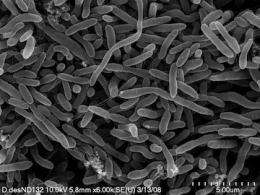
A bacterium called Desulfovibrio desulfuricans strain ND132 can transform elemental mercury into methylmercury, a human neurotoxin.
A newly sequenced bacterial genome from a team led by the Department of Energy's Oak Ridge National Laboratory could contain clues as to how microorganisms produce a highly toxic form of mercury.
Methylmercury, a potent human neurotoxin, appears in the environment when certain naturally occurring bacteria transform inorganic mercury into its more toxic cousin. Few bacterial species are capable of this conversion, and exactly how the transformation takes place has been a matter of debate for decades.
"What is not known are the genes or the proteins that allow these bacteria to mediate the transformation," said ORNL's Steven Brown, who led a research team to sequence the genome of a bacterium in the Desulfovibrio genus that is capable of methylating mercury.
The new genome, sequenced at the California-based DOE Joint Genome Institute (JGI) and published in the Journal of Bacteriology, lays the foundation for future research to examine the little understood mechanisms behind the production of methylmercury.
Desulfovibrio desulfuricans strain ND132 is an organism that thrives in sediments and soils without oxygen the places in lakes, streams and wetlands where mercury contamination is converted to methylmercury. It is representative of a group of organisms that "breathe" sulfate instead of oxygen and are largely responsible for mercury methylation in nature.
"This is the first Desulfovibrio genome that will methylate mercury that's been published," Brown said. "Now that we have this resource, we can take a comparative approach and look at what is different between the bacteria that can methylate mercury and those that are unable to."
The introduction of mercury into the environment primarily stems from its use in industrial processes and from the burning of fossil fuels. Although industry and regulators have worked to minimize the release of mercury, there is a legacy of mercury pollution in aquatic environments worldwide. Understanding the fundamental science behind the production of methylmercury could eventually help mitigate and reduce the impacts of mercury pollution.
"Mercury is a global contaminant of concern," Brown said. "We hope that some of the lessons we learn from these studies will be applicable to many sites. If we can identify the genes involved in mercury methylation, we hope to go to the local environment and understand more about the function and the ecology of the organisms and their gene products that mediate this transformation."
More information: The study was published as "Genome Sequence of the Mercury Methylating Strain Desulfovibrio desulfuricans ND132."
Provided by
Oak Ridge National Laboratory
-
From lemons to lemonade: Reaction uses carbon dioxide to make carbon-based semiconductor,
32 comments
-
Thioridazine kills cancer stem cells in human while avoiding toxic side-effects of conventional cancer treatments,
3 comments
-
SpaceX private rocket blasts off for space station (Update),
42 comments
-
Climate scientists say they have solved riddle of rising sea,
30 comments
-
Research team claims to have found evidence Lake Cheko is impact crater for Tunguska Event,
18 comments
-
What would stain as translucent on light-coloured fabric?
10 hours ago
-
How do I identify different bacteria on culture plates?
20 hours ago
-
Why Do Dogs do Strange things...
May 25, 2012
-
What does exophillic and endophillic mean in terms of mosquito and their control?
May 24, 2012
-
Semen stains glows under black lights (uv light)?
May 23, 2012
-
Question on Human Chromosome 2
May 23, 2012
- More from Physics Forums - Biology
More news stories
Scientist: Evolution debate will soon be history
(AP) -- Richard Leakey predicts skepticism over evolution will soon be history. Not that the avowed atheist has any doubts himself.
9 hours ago |
3.4 / 5 (8) |
21
Thousands of shellfish found dead in Peru
Thousands of crustaceans were found dead off the coast of Lima following the mystery mass death of dolphins and pelicans, the Peruvian Navy said Friday.
19 hours ago |
4.8 / 5 (4) |
6
More plant species responding to global warming than previously thought
(Phys.org) -- Far more wild plant species may be responding to global warming than previous large-scale estimates have suggested.
May 22, 2012 |
4.6 / 5 (14) |
18
|
Totally rad: Scientists create rewritable digital data storage in DNA
(Phys.org) -- Scientists from Stanford's Department of Bioengineering have devised a method for repeatedly encoding, storing and erasing digital data within the DNA of living cells.
May 21, 2012 |
4.9 / 5 (17) |
11
|
For monogamous sparrows, it doesn't pay to stray (but they do it anyway)
It's quite common for a female song sparrow to stray from her breeding partner and mate with the male next door, but a new study shows that sleeping around can be costly.
May 22, 2012 |
5 / 5 (1) |
7
|
Dell tablet leak: 10.1-inch display, two-battery choice
(Phys.org) -- Headline after headline talks about vendors tablets in the wings as likely number-one contenders for the iPad. Such claims have justifiably been taken with a grain of salt, considering ...
SpotterRF debuts Radar Backpack Kit (w/ Video)
(Phys.org) -- SpotterRF has announced a special radar backpack kit designed to enhance situational awareness for soldiers on the ground. The company says its special radar is designed for warfighters as part ...
SpaceX capsule has 'new car' smell, astronauts say (Update)
SpaceX's Dragon cargo vessel smells like a new car, said astronauts at the International Space Station after opening the hatches Saturday following the spacecraft's landmark mission to the orbiting lab.
Astronomers seize last chance in lifetime for Venus Transit
Astronomers are gearing for one the rarest events in the Solar System: an alignment of Earth, Venus and the Sun that will not be seen for another 105 years.
Keep food safety in mind this memorial day weekend
(HealthDay) -- Picnics, parades and cookouts are as much a part of Memorial Day weekend as tributes to the United States' war veterans.
Australia hails surprise super-telescope decision
Australia has hailed a surprise decision giving it a role in a radio telescope project aimed at revolutionising astronomy, vowing to draw on its decades of experience in space science.