AMS particle detector heads for the International Space Station
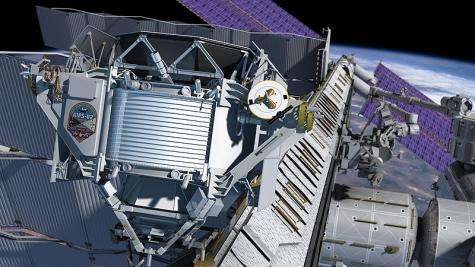
A computer generated image showing AMS-02 mounted to the ISS S3 Upper Inboard Payload Attach Site. Image: NASA
(PhysOrg.com) -- The AMS particle detector will take off on 29 April 2011 at 21.47 CEST onboard the very last mission of the space Shuttle Endeavour. AMS, the Alpha Magnetic Spectrometer, will then be installed on the International Space Station from where it will explore the Universe for a period of over 10 years. AMS will address some of the most exciting mysteries of modern physics, looking for antimatter and dark matter in space, phenomena that have remained elusive up to now.
In laboratories like CERN, physicists observe matter and antimatter behaving in an almost identical way. Each matter particle has an equivalent antiparticle, very similar but with opposite charge. When particles of matter and antimatter meet, they annihilate. Matter and antimatter would have been created in equal amounts at the Big Bang, yet today we live in a Universe apparently made entirely of matter. Does nature have a preference for matter over antimatter? One of the main challenges of AMS will be to address this question by searching for single nuclei of antimatter that would signal the existence of large amounts of antimatter elsewhere in the Universe. To achieve this, AMS will track cosmic rays from outer space with unprecedented sensitivity.
"The cosmos is the ultimate laboratory," said Nobel laureate and AMS Spokesperson Samuel Ting. "From its vantage point in space, AMS will explore such issues as Antimatter, Dark Matter and the origin of Cosmic Rays. However, its most exciting objective is to probe the unknown because whenever new levels of sensitivities are reached in exploring an unchartered realm, exciting and unimagined discoveries may be expected."
In the same way that telescopes catch the light from the stars to better understand the Universe, AMS is a particle detector that will track incoming charged particles such as protons, electrons and atomic nuclei that constantly bombard our planet. By studying the flux of these cosmic rays with very high precision, AMS will have the sensitivity to identify a single antinucleus among a billion other particles.
"This is a very exciting moment for basic science," said CERN Director General Rolf Heuer. "We expect interesting complementarities between AMS and the LHC. They look at similar questions from different angles, giving us parallel ways of addressing some of the Universe's mysteries."
AMS may also bring an important contribution to the search for the mysterious dark matter that would account for about 25% of the total mass-energy balance of the Universe. In particular, if dark matter is composed of supersymmetric particles, AMS could detect it indirectly by recording an anomaly in the flux of cosmic rays.
"Never in the history of science have we been so aware of our ignorance," said AMS Deputy Spokesperson Roberto Battiston. "Today we know that we do not know anything about what makes up 95% of our Universe."
AMS is a CERN recognized experiment and as such has benefited from CERN's expertise in integrating large projects, from CERN's vacuum and magnet groups and from test beam facilities for calibrating the detectors. In addition, the Payload Operation Centre (POC) of AMS will open in June 2011 at CERN, very near to the place where the AMS detector was assembled in clean room facilities. From the POC, physicists will be able to run the AMS detector as well as receive and analyse data arriving from the International Space Station.
AMS is the result of a large international collaboration with a major European participation. It is led by Nobel laureate Samuel Ting and involves about 600 researchers from CERN Member States (Denmark, Finland, France, Germany, Italy, the Netherlands, Portugal, Spain, Switzerland) as well as from China, Korea, Mexico, Taiwan, and the United-States.
Provided by CERN
-
From lemons to lemonade: Reaction uses carbon dioxide to make carbon-based semiconductor,
32 comments
-
Thioridazine kills cancer stem cells in human while avoiding toxic side-effects of conventional cancer treatments,
3 comments
-
SpaceX private rocket blasts off for space station (Update),
42 comments
-
Climate scientists say they have solved riddle of rising sea,
30 comments
-
Research team claims to have found evidence Lake Cheko is impact crater for Tunguska Event,
18 comments
-
Writing a book so im learning about things, i have some general questions please read
2 hours ago
-
Question about induced E field.
3 hours ago
-
Charging a capacitor in a tesla coil
3 hours ago
-
Water Rocket
7 hours ago
-
why do trucks have bigger brakes?
11 hours ago
-
Solar Sail Physics - Do they work on a large scale?
12 hours ago
- More from Physics Forums - General Physics
More news stories
Is a classical electrodynamics law incompatible with special relativity?
(Phys.org) -- The laws of classical electromagnetism that were developed in the 19th century are the same laws that scientists use today. They include Maxwell’s four equations along with the Lorentz la ...
Landmark calculation clears the way to answering how matter is formed
(Phys.org) -- An international collaboration of scientists, including Thomas Blum, associate professor of physics, is reporting in landmark detail the decay process of a subatomic particle called a kaon ...
May 25, 2012 |
4.2 / 5 (21) |
47
|
Lying in wait for WIMPs: Researchers seek to dramatically increase sensitivity of Large Underground Xenon detector
Although it's invisible, dark matter accounts for at least 80 percent of the matter in the universe. No one knows what it is, but most scientists would bet on weakly interacting massive particles, or WIMPs.
May 23, 2012 |
4 / 5 (7) |
15
|
Hall effect at the speed of light: How can you demonstrate relativistic effects with your mobile phone?
The relativistic Hall effect describing objects rotating at speeds comparable with the speed of light has been reported.
May 21, 2012 |
4.3 / 5 (3) |
8
Cloak of invisibility: Engineers use plasmonics to create an invisible photodetector
A team of engineers at Stanford and the University of Pennsylvania has for the first time used "plasmonic cloaking" to create a device that can see without being seen - an invisible machine that detects light. It is the first ...
May 21, 2012 |
4.8 / 5 (16) |
7
|
Scientist: Evolution debate will soon be history
(AP) -- Richard Leakey predicts skepticism over evolution will soon be history. Not that the avowed atheist has any doubts himself.
Dell tablet leak: 10.1-inch display, two-battery choice
(Phys.org) -- Headline after headline talks about vendors tablets in the wings as likely number-one contenders for the iPad. Such claims have justifiably been taken with a grain of salt, considering ...
SpotterRF debuts Radar Backpack Kit (w/ Video)
(Phys.org) -- SpotterRF has announced a special radar backpack kit designed to enhance situational awareness for soldiers on the ground. The company says its special radar is designed for warfighters as part ...
SpaceX capsule has 'new car' smell, astronauts say (Update)
SpaceX's Dragon cargo vessel smells like a new car, said astronauts at the International Space Station after opening the hatches Saturday following the spacecraft's landmark mission to the orbiting lab.
Thousands of shellfish found dead in Peru
Thousands of crustaceans were found dead off the coast of Lima following the mystery mass death of dolphins and pelicans, the Peruvian Navy said Friday.
Astronomers seize last chance in lifetime for Venus Transit
Astronomers are gearing for one the rarest events in the Solar System: an alignment of Earth, Venus and the Sun that will not be seen for another 105 years.
Apr 28, 2011
Rank: not rated yet
and if this is going to be in place for ten years that menas the ISS will be there for ten years
Should be good science.
Apr 28, 2011
Rank: not rated yet
Absolutely correct. However, the detector is made of trillions and trillions of atoms, wereas a single antimatter nucleon impact would destroy the atom it hits, as well as maybe a few hundred or thousand atoms around it from collateral damage. as the antimatter events are known to be relatively rare, it shouldn't add significantly to the weathering of the detector.
That said, space is a pretty hostile environment with all those gamma rays, cosmic rays, and antimatter particles flying around. There's a reason why most satellites have a 10-15 year shelf life. The few that stay longer generally need significant servicing (Hubble had 3 or 4 service calls now.)
Should be awesome science :)