Student innovator uses sound waves, T-rays for safer detection of bombs
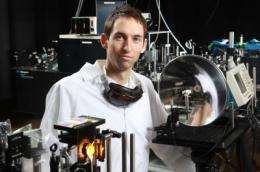
Benjamin Clough is dedicated to making the world a safer place for emergency first responders, police and military personnel, chemical plant employees, and many others. The Rensselaer Polytechnic Institute doctoral student has developed a novel method for extending the distance from which powerful terahertz technology can remotely detect hidden explosives, chemicals, and other dangerous materials.
A student in the Department of Electrical, Computer, and Systems Engineering at Rensselaer, Clough has demonstrated a promising, cost-effective technique that employs sound waves to boost the effective distance of terahertz spectroscopy from a few feet to several meters. For this innovation, Clough has been named the winner of the 2011 $30,000 Lemelson-MIT Rensselaer Student Prize. He is among the four 2011 $30,000 Lemelson-MIT Collegiate Student Prize winners announced today.
"We live in an age of continuous innovation, where technologies come together in unexpected and serendipitous ways. This mash-up culture, where data and applications constantly are being combined to bring value in ways that exercise the imagination, is where many stellar Rensselaer student researchers find their inspiration," said Rensselaer President Shirley Ann Jackson. "Benjamin Clough is a prime example, with his invention of a new method that combines mature audio technology with leading-edge research to extend the operational usefulness of terahertz sensing. We congratulate him, and applaud all of the winners and finalists of the Lemelson-MIT Collegiate Student Prize for innovating a brighter, better future."
Clough is the fifth recipient of the Lemelson-MIT Rensselaer Student Prize. First given in 2007, the prize is awarded annually to a Rensselaer senior or graduate student who has created or improved a product or process, applied a technology in a new way, redesigned a system, or demonstrated remarkable inventiveness in other ways.
"The Lemelson-MIT Collegiate Student Prize winners have shown their potential to invent broadly and bring new innovations into the world," said Joshua Schuler, executive director of the Lemelson-MIT Program. "These inventive achievements, and the students' creativity, persistence, and overall collaboration, must be celebrated at the collegiate level."
For videos and photos of Clough and other award finalists, please visit: www.eng.rpi.edu/lemelson
Watch a video on Clough's innovation at: http://www.youtube.com/watch?v=UKVp_buMH7s
Eavesdropping on Terahertz Waves
With his project, titled "Terahertz Enhanced Acoustics," Clough has developed a method to circumvent one of the major fundamental limitations of remote terahertz spectroscopy.
The Rensselaer Center for Terahertz Research is one of the most active groups worldwide to apply terahertz wave technology for security and defense applications. Sensors using terahertz waves can penetrate packaging materials or clothing and identify the unique terahertz "fingerprints" of many hidden materials. Terahertz waves, or T-rays, occupy a large segment of the electromagnetic spectrum between the infrared and microwave bands. Unlike X-rays and microwaves, T-rays pose no known health threat to humans.
A key practical limitation of terahertz technology, however, is that it only works over short distances. Naturally occurring moisture in air absorbs terahertz waves, weakening the signal and sensing capabilities. This distance limitation is not ideal for applications in bomb or hazardous material detection, where the human operator wants to be as far away as possible from the potential threat.
Clough's patent-pending solution to this problem is a new method for using sound waves to remotely "listen" to terahertz signals from a distance. Focusing two laser beams into air creates small bursts of plasma, which in turn create terahertz pulses. Another pair of lasers is aimed near the target of interest to create a second plasma for detecting the terahertz pulses after they have interacted with the material. This detection plasma produces acoustic waves as it ionizes the air. Clough discovered that by using a sensitive microphone to "listen" to the plasma, he could detect terahertz wave information embedded in these sound waves. This audio information can then be converted into digital data and instantly checked against a library of known terahertz fingerprints, to determine the chemical composition of the mystery material.
So far, Clough has successfully demonstrated the ability to use acoustics to identify the terahertz fingerprints from several meters away. He has separately demonstrated plasma acoustic detection from 11 meters, limited only by available lab space. Along with the increased distance from the potentially hazardous material, an additional advantage is that his system does not require a direct line of sight to collect signals, as the microphone can still capture the audio information. Potential applications of Clough's invention include environmental monitoring of atmospheric conditions, monitoring smokestack emissions, inspecting suspicious packages, or even detecting land mines – all from a safe distance.
For additional information on terahertz research at Rensselaer, visit: http://news.rpi.edu/update.do?artcenterkey=2748
Determined Innovator and Engineer
Clough joined Rensselaer as a doctoral student in 2007 as a member of the research group of Xi-Cheng Zhang, the J. Erik Jonsson Professor of Science at Rensselaer and director of the university's Center for Terahertz Research. In his time at the Institute, Clough has presented his findings at several international conferences, and the details of his work have been published in peer-reviewed journals including Optics Letters and Physical Review E.
"There is no doubt Ben is one of the most brilliant students I have ever worked with. He continues to prove, time and again, his remarkable creativity and innovative thinking," said Zhang, who is Clough's academic adviser. "Ben's idea for the sonic detection of terahertz takes the global T-ray community in a new and very promising direction. I am delighted at his success, and congratulate him on this outstanding recognition."
A National Science Foundation Integrative Graduate Education and Research Traineeship (IGERT) fellow, Clough is deeply committed to his research activities. He received the Rensselaer Founders Award of Excellence in 2009, as well as the Rensselaer NSF IGERT Best Presenter Award in 2010.
Hailing from Albuquerque, N.M., Clough grew up immersed in science and technology. He inherited a love of research from his father, a retired chemist, and a strong work ethic from his mother, a retired professor of nursing. Along with his parents, Clough's wife, Kara, and older sister, Sandy, are overjoyed that he won the 2011 Lemelson-MIT Rensselaer Student Prize.
Clough said the idea for his prize-winning innovation struck him while relaxing on the beach in Mexico during a winter vacation with his family.
Following graduation, Clough said he plans to pursue his passion for science and engineering at a national laboratory where he can gain experience in a fast-paced research and development environment. He said he hopes to apply his broad interdisciplinary background in electrical engineering and physics to continue to explore the boundaries of current technology.
Lemelson-MIT Collegiate Student Prizes
In addition to Clough's pioneering work, the other winners of the annual Lemelson-MIT Collegiate Student Prize were announced today at their respective universities:
- Lemelson-MIT Caltech Student Prize winner Guoan Zheng developed an on-chip, inexpensive microscopy imaging technology with many potential applications, including improved diagnostics for malaria and other blood-borne diseases in the developing world and rapid screening of new drugs.
- Lemelson-MIT Illinois Student Prize winner Scott Daigle developed a system that utilizes automatic gear shifting to reduce the efforts exerted by wheelchair operators. Daigle's company, IntelliWheels Inc., has an entire suite of products to improve the everyday actions of wheelchair users.
- Lemelson-MIT Student Prize winner Alice A. Chen developed an assortment of innovations with promising drug development implications, including a humanized mouse with a tissue-engineered human liver designed to bridge a gap between laboratory animal studies and clinical trials.
Provided by Rensselaer Polytechnic Institute


