A small quantum leap: New switching device could help build ultrafast quantum Internet
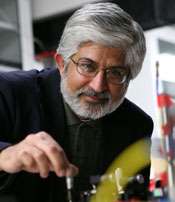
Prem Kumar
(PhysOrg.com) -- Northwestern University researchers have developed a new switching device that takes quantum communication to a new level. The device is a practical step toward creating a network that takes advantage of the mysterious and powerful world of quantum mechanics.
The researchers can route quantum bits, or entangled particles of light, at very high speeds along a shared network of fiber-optic cable without losing the entanglement information embedded in the quantum bits. The switch could be used toward achieving two goals of the information technology world: a quantum Internet, where encrypted information would be completely secure, and networking superfast quantum computers.
The device would enable a common transport mechanism, such as the ubiquitous fiber-optic infrastructure, to be shared among many users of quantum information. Such a system could route a quantum bit, such as a photon, to its final destination just like an e-mail is routed across the Internet today.
The research -- a demonstration of the first all-optical switch suitable for single-photon quantum communications -- is published by the journal Physical Review Letters.
"My goal is to make quantum communication devices very practical," said Prem Kumar, AT&T Professor of Information Technology in the McCormick School of Engineering and Applied Science and senior author of the paper. "We work in fiber optics so that as quantum communication matures it can easily be integrated into the existing telecommunication infrastructure."
The bits we all know through standard, or classical, communications only exist in one of two states, either "1" or "0." All classical information is encoded using these ones and zeros. What makes a quantum bit, or qubit, so attractive is it can be both one and zero simultaneously as well as being one or zero. Additionally, two or more qubits at different locations can be entangled -- a mysterious connection that is not possible with ordinary bits.
Researchers need to build an infrastructure that can transport this "superposition and entanglement" (being one and zero simultaneously) for quantum communications and computing to succeed.
The qubit Kumar works with is the photon, a particle of light. A photonic quantum network will require switches that don't disturb the physical characteristics (superposition and entanglement properties) of the photons being transmitted, Kumar says. He and his team built an all-optical, fiber-based switch that does just that while operating at very high speeds.
To demonstrate their switch, the researchers first produced pairs of entangled photons using another device developed by Kumar, called an Entangled Photon Source. "Entangled" means that some physical characteristic (such as polarization as used in 3-D TV) of each pair of photons emitted by this device are inextricably linked. If one photon assumes one state, its mate assumes a corresponding state; this holds even if the two photons are hundreds of kilometers apart.
The researchers used pairs of polarization-entangled photons emitted into standard telecom-grade fiber. One photon of the pair was transmitted through the all-optical switch. Using single-photon detectors, the researchers found that the quantum state of the pair of photons was not disturbed; the encoded entanglement information was intact.
"Quantum communication can achieve things that are not possible with classical communication," said Kumar, director of Northwestern's Center for Photonic Communication and Computing. "This switch opens new doors for many applications, including distributed quantum processing where nodes of small-scale quantum processors are connected via quantum communication links."
More information: The title of the paper is "Ultrafast Switching of Photonic Entanglement." http://prl.aps.org/
Provided by
Northwestern University
-
From lemons to lemonade: Reaction uses carbon dioxide to make carbon-based semiconductor,
32 comments
-
Thioridazine kills cancer stem cells in human while avoiding toxic side-effects of conventional cancer treatments,
3 comments
-
SpaceX private rocket blasts off for space station (Update),
42 comments
-
Climate scientists say they have solved riddle of rising sea,
30 comments
-
Research team claims to have found evidence Lake Cheko is impact crater for Tunguska Event,
18 comments
-
magnetic field from stream of protons
7 hours ago
-
Force on a particle constrained to move on the surface of a sphere
8 hours ago
-
Force in a magnetic coupling
18 hours ago
-
Sign of scalar product in electric potential integral?
May 26, 2012
-
Heat engines: how can we yield work?
May 25, 2012
-
Work done by us on the spring
May 25, 2012
- More from Physics Forums - Classical Physics
More news stories
Landmark calculation clears the way to answering how matter is formed
(Phys.org) -- An international collaboration of scientists, including Thomas Blum, associate professor of physics, is reporting in landmark detail the decay process of a subatomic particle called a kaon ...
May 25, 2012 |
4.4 / 5 (20) |
47
|
Is a classical electrodynamics law incompatible with special relativity?
(Phys.org) -- The laws of classical electromagnetism that were developed in the 19th century are the same laws that scientists use today. They include Maxwell’s four equations along with the Lorentz la ...
Lying in wait for WIMPs: Researchers seek to dramatically increase sensitivity of Large Underground Xenon detector
Although it's invisible, dark matter accounts for at least 80 percent of the matter in the universe. No one knows what it is, but most scientists would bet on weakly interacting massive particles, or WIMPs.
May 23, 2012 |
4 / 5 (7) |
15
|
Hall effect at the speed of light: How can you demonstrate relativistic effects with your mobile phone?
The relativistic Hall effect describing objects rotating at speeds comparable with the speed of light has been reported.
May 21, 2012 |
4.3 / 5 (3) |
8
Cloak of invisibility: Engineers use plasmonics to create an invisible photodetector
A team of engineers at Stanford and the University of Pennsylvania has for the first time used "plasmonic cloaking" to create a device that can see without being seen - an invisible machine that detects light. It is the first ...
May 21, 2012 |
4.8 / 5 (16) |
7
|
Scientist: Evolution debate will soon be history
(AP) -- Richard Leakey predicts skepticism over evolution will soon be history. Not that the avowed atheist has any doubts himself.
Dell tablet leak: 10.1-inch display, two-battery choice
(Phys.org) -- Headline after headline talks about vendors tablets in the wings as likely number-one contenders for the iPad. Such claims have justifiably been taken with a grain of salt, considering ...
SpotterRF debuts Radar Backpack Kit (w/ Video)
(Phys.org) -- SpotterRF has announced a special radar backpack kit designed to enhance situational awareness for soldiers on the ground. The company says its special radar is designed for warfighters as part ...
SpaceX capsule has 'new car' smell, astronauts say (Update)
SpaceX's Dragon cargo vessel smells like a new car, said astronauts at the International Space Station after opening the hatches Saturday following the spacecraft's landmark mission to the orbiting lab.
Thousands of shellfish found dead in Peru
Thousands of crustaceans were found dead off the coast of Lima following the mystery mass death of dolphins and pelicans, the Peruvian Navy said Friday.
Keep food safety in mind this memorial day weekend
(HealthDay) -- Picnics, parades and cookouts are as much a part of Memorial Day weekend as tributes to the United States' war veterans.
Mar 11, 2011
Rank: not rated yet
Mar 11, 2011
Rank: not rated yet
More importantly, quantum information is unique in its value and behavior. This technology begins to lay the groundwork for future quantum collaboration and information sharing. Quantum computing is itself tremendously more efficient than binary systems and often cannot be rendered into conventional terms. So you need this kind of quantum communication to maintain integrity.
The short of it is: Quantum computers are faster and smarter. A quantum internet might, in theory, follow in the same vein.
Mar 14, 2011
Rank: not rated yet
Its about the switch. Its the switching speed that is the bottleneck, or the slowest part of the system. The article is about a new SWITCHING device.