Physicists grow micro-machines from carbon

BYU physicists made this tiny logo as a demonstration of their technique for growing stable structures from carbon nanotubes.
(PhysOrg.com) -- A Brigham Young University physics student and his professor had some fun with their new method of growing tiny machines from carbon molecules.
Weve seen some creative ways of making tiny BYU logos before, like engraving these nano-sized letters in silica and shaping these even smaller letters from DNA strands. But growing a nano-logo? Thats probably a first on campus.
Here is how BYU physics professor Robert Davis and his student Taylor Wood do it: They start by patterning the carbon seeds of the logo onto an iron plate. Next they send heated gas flowing across the surface, and a forest of carbon nano-tubes springs up.
Its a really fragile structure at this point blowing on it or touching it would destroy it, Davis said. We developed a process to coat and strengthen the tubes so that we can make microstructures that have practical applications.
Another student, Jun Song, used the process to make devices that quickly and neatly separate the various chemicals contained in a solution. The technique is detailed by the BYU physicists in a new study published in the scientific journal Advanced Functional Materials.
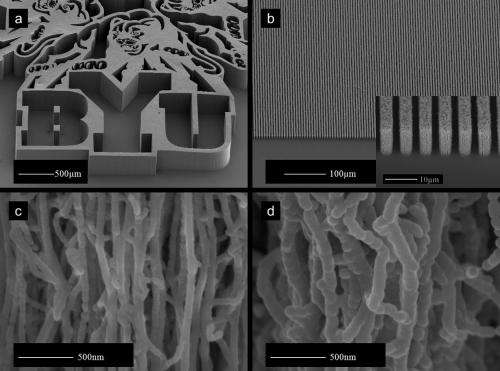
As demonstrated in the paper, their approach using carbon nanotubes is more precise than current chemical separation methods because it gives more control over the channels that the fluids flow through. Thats why the company US Synthetic purchased the commercial rights from BYU.
Designing little logos and separating chemicals isnt all the BYU researchers are doing, either. Theyre also building several kinds of micro-machines including actuators, switches and humidity-detecting cantilevers. Next on their agenda is to create filtration devices.
The technology is moving in a lot of directions, said Davis.
More information: http://onlinelibra … 851/abstract
Provided by
Brigham Young University
-
From lemons to lemonade: Reaction uses carbon dioxide to make carbon-based semiconductor,
32 comments
-
Thioridazine kills cancer stem cells in human while avoiding toxic side-effects of conventional cancer treatments,
3 comments
-
SpaceX private rocket blasts off for space station (Update),
42 comments
-
Climate scientists say they have solved riddle of rising sea,
30 comments
-
Research team claims to have found evidence Lake Cheko is impact crater for Tunguska Event,
18 comments
-
microstructure of titanium
8 hours ago
-
Steam in My Espresso Machine
14 hours ago
-
Density question
May 24, 2012
-
Mass transport originating from a point source at a solid gas interface
May 22, 2012
-
Ammonia dispersion in Air
May 22, 2012
-
Multi Choice Help
May 21, 2012
- More from Physics Forums - Materials & Chemical Engineering
More news stories
Dopant gives graphene solar cells highest efficiency yet
(Phys.org) -- By taking advantage of graphenes favorable electrical and optical properties, and then adding an organic dopant, researchers have achieved the highest power conversion efficiency yet for ...
Nanomedicine: Quantum dots appear safe in pioneering study on primates
A pioneering study to gauge the toxicity of quantum dots in primates has found the tiny crystals to be safe over a one-year period, a hopeful outcome for doctors and scientists seeking new ways to battle diseases ...
Nanotechnology / Bio & Medicine
May 20, 2012 |
4.3 / 5 (3) |
8
|
In nanorod crystal growth, nanoparticles seen as artificial atoms
In the growth of crystals, do nanoparticles act as "artificial atoms" forming molecular-type building blocks that can assemble into complex structures? This is the contention of a major but controversial theory ...
May 24, 2012 |
4.8 / 5 (6) |
0
|
First direct observation of oriented attachment in nanocrystal growth
Berkeley Lab researchers have reported the first direct observation of nanoparticles undergoing oriented attachment, the critical step in biomineralization and the growth of nanocrystals. A better understanding ...
May 24, 2012 |
4.7 / 5 (3) |
0
|
Synthetic nano-waste does not disappear
(Phys.org) -- Tiny particles of cerium oxide do not burn or change in the heat of a waste incineration plant. They remain intact on combustion residues or in the incineration system, as a new study by Swiss ...
Nanotechnology / Bio & Medicine
May 25, 2012 |
5 / 5 (2) |
1
|
Dell tablet leak: 10.1-inch display, two-battery choice
(Phys.org) -- Headline after headline talks about vendors tablets in the wings as likely number-one contenders for the iPad. Such claims have justifiably been taken with a grain of salt, considering ...
Scientist: Evolution debate will soon be history
(AP) -- Richard Leakey predicts skepticism over evolution will soon be history. Not that the avowed atheist has any doubts himself.
SpotterRF debuts Radar Backpack Kit (w/ Video)
(Phys.org) -- SpotterRF has announced a special radar backpack kit designed to enhance situational awareness for soldiers on the ground. The company says its special radar is designed for warfighters as part ...
SpaceX capsule has 'new car' smell, astronauts say (Update)
SpaceX's Dragon cargo vessel smells like a new car, said astronauts at the International Space Station after opening the hatches Saturday following the spacecraft's landmark mission to the orbiting lab.
Keep food safety in mind this memorial day weekend
(HealthDay) -- Picnics, parades and cookouts are as much a part of Memorial Day weekend as tributes to the United States' war veterans.
Thousands of shellfish found dead in Peru
Thousands of crustaceans were found dead off the coast of Lima following the mystery mass death of dolphins and pelicans, the Peruvian Navy said Friday.

Mar 09, 2011
Rank: 5 / 5 (1)
And Bob_B, while I agree with you that the school is retarded in its moral stance, I don't really think that affects building machines out of carbon nanotubes. Actually, this seems like a really good concept. Maybe the student just went there because they gave him a scholarship or something. (I may have a more open mind to this though, since I was put in a Catholic high school, and just smiled to myself when they taught anything religious). Perhaps I'm projecting myself into this kid, or perhaps since he's well down the science route he would feel the same way I do.
Mar 09, 2011
Rank: 5 / 5 (1)
Yeah, they're pretty off. But then again, most religions are. Most religions say no sex before marriage. That's why I became an atheist. Well, that and I just wanted to sin all I wanted without responsibility. At least that's what theists tell me.
Mar 10, 2011
Rank: not rated yet