Deep-sea volcanoes don't just produce lava flows, they also explode
March 28, 2011

Deep-sea volcanoes don't just produce lava flows, they also explode!

Enlarge

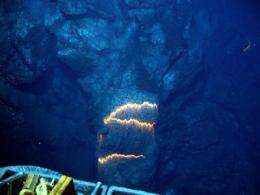
This images shows bands of glowing magma from submarine volcano. Credit: NOAA/National Science Foundation

Most deep-sea volcanoes produce effusive lava flows rather than explosive eruptions, both because the levels of magmatic gas tend to be low, and because the volcanoes are under a lot of pressure from the surrounding water. But by using an ion microprobe, Christoph Helo, a PhD student in McGill's Department of Earth and Planetary Sciences, has now proved that explosive eruptions can also occur.

Between 75 and 80 per cent of all on Earth takes place at deep-sea, mid-ocean ridges. Most of these volcanoes produce effusive rather than explosive eruptions, both because the levels of magmatic gas (which fuel the explosions and are made up of a variety of components, including, most importantly CO2) tend to be low, and because the volcanoes are under a lot of pressure from the surrounding water.

Over about the last 10 years however, have nevertheless speculated, based on the presence of in certain sites, that explosive eruptions can also occur in deep-sea volcanoes.

But no one has been able to prove it until now.

By using an ion microprobe, Christoph Helo, a PhD student in McGill's Department of Earth and Planetary Sciences, has now discovered very high concentrations of CO2 in droplets of magma trapped within crystals recovered from volcanic ash deposits on Axial on the Juan de Fuca Ridge, off the coast of Oregon.

These entrapped droplets represent the state of the magma prior to eruption. As a result, Helo and fellow researchers from McGill, the Monterey Bay Aquarium Research Institute, and the Woods Hole Oceanographic Institution, have been able to prove that explosive eruptions can indeed occur in deep-sea volcanoes. Their work also shows that the release of CO2 from the deeper mantle to the Earth's atmosphere, at least in certain parts of mid-ocean ridges, is much higher than had previously been imagined.

Given that mid-ocean ridges constitute the largest volcanic system on Earth, this discovery has important implications for the global carbon cycle which have yet to be explored.

More information: For an abstract of the article: http://www.nature. … geo1104.html

Provided by McGill University search and more info website

4.3 /5 (6 votes)  

Filter


Move the slider to adjust rank threshold, so that you can hide some of the comments.


Display comments: newest first

aennen
Mar 28, 2011

Rank: 2.5 / 5 (8)
Omg another source of CO2 we better work on making valcanoes carbon neutral. I cant believe our science community hasnt factored in, or understand, the mid-ocean ridges and its impacts/influences... omg.
neiorah
Mar 29, 2011

Rank: 4.3 / 5 (6)
Come on, this is the natural source of CO2. The stuff we need to worry about is the stuff we make or our civilized way of life produces.
Rank 4.3 /5 (6 votes)
Relevant PhysicsForums posts

More news stories

SpaceX capsule has 'new car' smell, astronauts say (Update)

SpaceX's Dragon cargo vessel smells like a new car, said astronauts at the International Space Station after opening the hatches Saturday following the spacecraft's landmark mission to the orbiting lab.

Space & Earth / Space Exploration

created 14 hours ago | popularity 4.5 / 5 (19) | comments 0

Australia hails surprise super-telescope decision

Australia has hailed a surprise decision giving it a role in a radio telescope project aimed at revolutionising astronomy, vowing to draw on its decades of experience in space science.

Space & Earth / Astronomy

created 14 hours ago | popularity 5 / 5 (3) | comments 1

Astronomers seize last chance in lifetime for Venus Transit

Astronomers are gearing for one the rarest events in the Solar System: an alignment of Earth, Venus and the Sun that will not be seen for another 105 years.

Space & Earth / Astronomy

created 14 hours ago | popularity 5 / 5 (1) | comments 0

Astronauts enter world's 1st private supply ship

(AP) -- Space station astronauts floated into the Dragon on Saturday, a day after its heralded arrival as the world's first commercial supply ship.

Space & Earth / Space Exploration

created 14 hours ago | popularity 5 / 5 (5) | comments 0

Dragon arrives at space station in historic 1st (Update 2)

The privately bankrolled Dragon capsule made a historic arrival at the International Space Station on Friday, triumphantly captured by astronauts wielding a giant robot arm.

Space & Earth / Space Exploration

created May 25, 2012 | popularity 5 / 5 (10) | comments 19


Dell tablet leak: 10.1-inch display, two-battery choice

(Phys.org) -- Headline after headline talks about vendors’ tablets in the wings as likely number-one contenders for the iPad. Such claims have justifiably been taken with a grain of salt, considering ...

Scientist: Evolution debate will soon be history

(AP) -- Richard Leakey predicts skepticism over evolution will soon be history. Not that the avowed atheist has any doubts himself.

SpotterRF debuts Radar Backpack Kit (w/ Video)

(Phys.org) -- SpotterRF has announced a special radar backpack kit designed to enhance situational awareness for soldiers on the ground. The company says its special radar is designed for warfighters as part ...

Thousands of shellfish found dead in Peru

Thousands of crustaceans were found dead off the coast of Lima following the mystery mass death of dolphins and pelicans, the Peruvian Navy said Friday.

Keep food safety in mind this memorial day weekend

(HealthDay) -- Picnics, parades and cookouts are as much a part of Memorial Day weekend as tributes to the United States' war veterans.

Family history of Alzheimer's affects functional connectivity

(HealthDay) -- Cognitively normal individuals with a family history of late-onset Alzheimer's disease (AD) may display lower resting state functional connectivity in the default mode network (DMN) of the brain, ...