NASA's Stardust spacecraft completes comet flyby, sending photos back to Earth
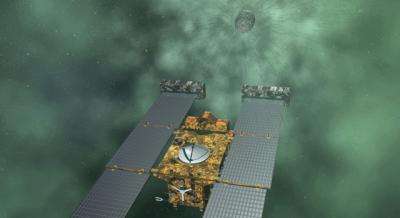
Artist's concept of NASA's Stardust-NExT mission, which will fly by comet Tempel 1 on Feb. 14, 2011. Image credit: NASA/JPL-Caltech/LMSS
(PhysOrg.com) -- Mission controllers at NASA's Jet Propulsion Laboratory, Pasadena, Calif., watched as data downlinked from the Stardust spacecraft indicated it completed its closest approach with comet Tempel 1.
An hour after closest approach, the spacecraft turned to point its large, high-gain antenna at Earth. It is expected that images of the comet's nucleus collected during the flyby will be received on Earth starting at about midnight California time (3 a.m. EST on Tuesday, Feb. 15).
Preliminary data already transmitted from the spacecraft indicate the time of closest approach was about 8:39 p.m. PST (11:39 p.m. EST), at a distance of 181 kilometers (112 miles) from Tempel 1.
This is a bonus mission for the comet chaser, which previously flew past comet Wild 2 and returned samples from its coma to Earth. During this bonus encounter, the plan called for the spacecraft to take images of the comet's surface to observe what changes occurred since a NASA spacecraft last visited. (NASA's Deep Impact spacecraft executed an encounter with Tempel 1 in July 2005).
Mission controllers at NASA's Jet Propulsion Laboratory, Pasadena, Calif., have begun receiving the first of 72 anticipated images of comet Tempel 1 taken by NASA's Stardust spacecraft.
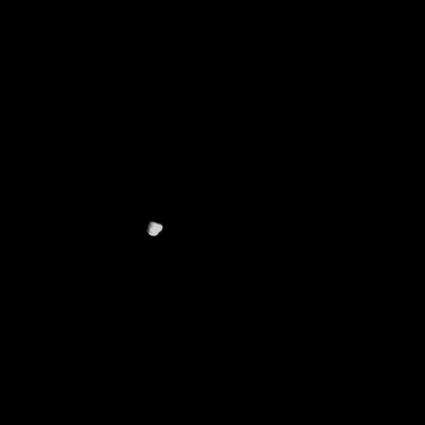
Image credit: NASA/JPL-Caltech/Cornell
NASA's Stardust-NExT mission transmitted the first image it took during its approach to comet Tempel 1 at 8:35 p.m. PST (11:35 p.m. EST) on Feb. 14, 2011, from a distance of approximately 2,462 kilometers (1,530 miles). The comet was first visited by NASA's Deep Impact mission in 2005.Stardust-NExT is a low-cost mission that will expand the investigation of comet Tempel 1 initiated by NASA's Deep Impact spacecraft. JPL, a division of the California Institute of Technology in Pasadena, manages Stardust-NExT for NASA's Science Mission Directorate, Washington, D.C. Lockheed Martin Space Systems, Denver, built the spacecraft and manages day-to-day mission operations.
More information: For more information about Stardust-NExT, visit: http://stardustnex … jpl.nasa.gov
Provided by
JPL/NASA
-
From lemons to lemonade: Reaction uses carbon dioxide to make carbon-based semiconductor,
31 comments
-
Thioridazine kills cancer stem cells in human while avoiding toxic side-effects of conventional cancer treatments,
3 comments
-
SpaceX private rocket blasts off for space station (Update),
42 comments
-
Climate scientists say they have solved riddle of rising sea,
30 comments
-
Research team claims to have found evidence Lake Cheko is impact crater for Tunguska Event,
18 comments
-
revamping general concept and cosmological principle
May 25, 2012
-
Transiting Exoplanet Light Curve
May 25, 2012
-
Math behind Theoretical Physics
May 24, 2012
-
Do we know whats at the center of galaxies yet?
May 23, 2012
-
Structure of the Milky Way?
May 20, 2012
-
What would it take to terraform Pluto and Charon?
May 19, 2012
- More from Physics Forums - General Astronomy
More news stories
SpaceX capsule has 'new car' smell, astronauts say (Update)
SpaceX's Dragon cargo vessel smells like a new car, said astronauts at the International Space Station after opening the hatches Saturday following the spacecraft's landmark mission to the orbiting lab.
Space & Earth / Space Exploration
14 hours ago |
4.5 / 5 (19) |
0
Australia hails surprise super-telescope decision
Australia has hailed a surprise decision giving it a role in a radio telescope project aimed at revolutionising astronomy, vowing to draw on its decades of experience in space science.
14 hours ago |
5 / 5 (3) |
1
Astronomers seize last chance in lifetime for Venus Transit
Astronomers are gearing for one the rarest events in the Solar System: an alignment of Earth, Venus and the Sun that will not be seen for another 105 years.
14 hours ago |
5 / 5 (1) |
0
Astronauts enter world's 1st private supply ship
(AP) -- Space station astronauts floated into the Dragon on Saturday, a day after its heralded arrival as the world's first commercial supply ship.
Space & Earth / Space Exploration
14 hours ago |
5 / 5 (5) |
0
Dragon arrives at space station in historic 1st (Update 2)
The privately bankrolled Dragon capsule made a historic arrival at the International Space Station on Friday, triumphantly captured by astronauts wielding a giant robot arm.
Space & Earth / Space Exploration
May 25, 2012 |
5 / 5 (10) |
19
Dell tablet leak: 10.1-inch display, two-battery choice
(Phys.org) -- Headline after headline talks about vendors tablets in the wings as likely number-one contenders for the iPad. Such claims have justifiably been taken with a grain of salt, considering ...
Scientist: Evolution debate will soon be history
(AP) -- Richard Leakey predicts skepticism over evolution will soon be history. Not that the avowed atheist has any doubts himself.
SpotterRF debuts Radar Backpack Kit (w/ Video)
(Phys.org) -- SpotterRF has announced a special radar backpack kit designed to enhance situational awareness for soldiers on the ground. The company says its special radar is designed for warfighters as part ...
Thousands of shellfish found dead in Peru
Thousands of crustaceans were found dead off the coast of Lima following the mystery mass death of dolphins and pelicans, the Peruvian Navy said Friday.
Keep food safety in mind this memorial day weekend
(HealthDay) -- Picnics, parades and cookouts are as much a part of Memorial Day weekend as tributes to the United States' war veterans.
Family history of Alzheimer's affects functional connectivity
(HealthDay) -- Cognitively normal individuals with a family history of late-onset Alzheimer's disease (AD) may display lower resting state functional connectivity in the default mode network (DMN) of the brain, ...

Feb 18, 2011
Rank: not rated yet
I read his book titled Sunstroke awhile back and agree with Kagan that the U.S. should land a couple astronauts on an asteroid as soon as possible to determine the best method of diverting one from Earth, since they have more impact power than comets due to their density. Aerospace giant Lockheed-Martin has already developed the hardware and strategy for accomplishing this mission and should be given the green light immediately. The asteroidal impact clock is ticking...