Cluster encounters a natural particle accelerator
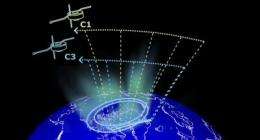
The Cluster C3 and C1 satellite trajectories between 16:55 and 17:15 UT on June 5, 2009. During this period, both satellites were able to send back data about conditions in the auroral acceleration region of Earth's dusk-side aurora. C3 flew through the region at an altitude of about 6,400 km (one Earth radius or RE), while C1 was flying at approximately 9,000 km (1.4 RE) and lagging about five minutes behind. The blue ovals indicate the poleward half of the auroral oval, which is characterized by upward currents in the dusk-side magnetic field. Credit: ESA
(PhysOrg.com) -- ESA's Cluster satellites have flown through a natural particle accelerator just above Earth's atmosphere. The data they collected are unlocking how most of the dramatic displays of the northern and southern lights are generated.
Two of Cluster's four satellites found themselves in a natural particle accelerator above the northern hemisphere on 5 June 2009. The first to cross was satellite C3 at an altitude of 6400 km, followed five minutes later by C1 at 9000 km.
This is the first time that scientists have measured such a region simultaneously using more than one satellite. The readings allow the electrical landscape of the acceleration region to be mapped.
"This is like geography, only instead of the contours being the height of a landscape, they are the electrical potentials that span the region," says Göran Marklund from the Royal Institute of Technology, Stockholm, Sweden.
These electrical potentials act in both uphill and downhill directions, accelerating particles towards and away from Earth, according to their charges.
When particles strike the atmosphere, they create the shimmering curtains of light known as the aurora, or more commonly the northern and southern lights. About two-thirds of the bright auroras are estimated to be produced in this way.
Since 2006, the Cluster satellites have been drifting away from their initial orbits because they are being constantly nudged by the gravity of the Moon and the Sun. Fortuitously, the current orbit occasionally passes through the Auroral Acceleration Region, which spans 4000 km to 12000 km above our planet.
The satellites do not encounter a natural particle accelerator on every orbit. Those responsible for the bright auroras are temporary alignments of the electrical fields around Earth. They are highly variable in altitude and so not always present.
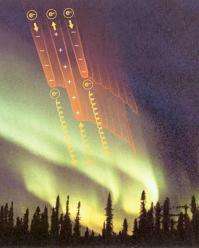
In the auroral acceleration region electrons gain speed and therefore energy. They spiral down and finally hit Earth’s atmosphere. When they collide with the particles of the upper atmosphere they make them fluoresce and produce red and green curtains of light that illuminate long winter nights. Credits: ESA/G. Marklund
This first encounter with a natural particle accelerator associated with a large-scale aurora has proved that they may be stable for at least five minutes. A few more encounters are expected in the near future before Cluster's orbit drifts back out of the region.
"Cluster has now shown us the very heart of the acceleration process responsible for most bright auroras. It has given us our first look at the electrical structure and stability of such an accelerator," says Prof. Marklund.
Such natural particle accelerators pop up ubiquitously throughout the Solar System, especially in the strong magnetic fields of the gas giants Jupiter and Saturn.
The new results from Cluster allow theoreticians to place much tighter constraints on their models of exactly how such accelerators work and give greater insight into the workings of space plasma.
More information: Altitude distribution of the auroral acceleration potential determined from Cluster satellite data at different heights, Marklund, G.T. et al., published 1 February 2011 in Phys. Rev. Lett.
Provided by
European Space Agency
-
From lemons to lemonade: Reaction uses carbon dioxide to make carbon-based semiconductor,
28 comments
-
Thioridazine kills cancer stem cells in human while avoiding toxic side-effects of conventional cancer treatments,
3 comments
-
SpaceX private rocket blasts off for space station (Update),
42 comments
-
Climate scientists say they have solved riddle of rising sea,
30 comments
-
Scotland passes turbine test to harness tidal power,
41 comments
-
why do trucks have bigger brakes?
2 hours ago
-
Solar Sail Physics - Do they work on a large scale?
3 hours ago
-
How should I switch an air conditioner off?
3 hours ago
-
Question about current decay in R-L circuit
4 hours ago
-
Elementary time - how does it work?
6 hours ago
-
How can squinting be used by both a myopic & hyperopic eye?
9 hours ago
- More from Physics Forums - General Physics
More news stories
Landmark calculation clears the way to answering how matter is formed
(Phys.org) -- An international collaboration of scientists, including Thomas Blum, associate professor of physics, is reporting in landmark detail the decay process of a subatomic particle called a kaon ...
May 25, 2012 |
4.6 / 5 (17) |
45
|
Is a classical electrodynamics law incompatible with special relativity?
(Phys.org) -- The laws of classical electromagnetism that were developed in the 19th century are the same laws that scientists use today. They include Maxwell’s four equations along with the Lorentz la ...
Lying in wait for WIMPs: Researchers seek to dramatically increase sensitivity of Large Underground Xenon detector
Although it's invisible, dark matter accounts for at least 80 percent of the matter in the universe. No one knows what it is, but most scientists would bet on weakly interacting massive particles, or WIMPs.
May 23, 2012 |
4.2 / 5 (6) |
15
|
Hall effect at the speed of light: How can you demonstrate relativistic effects with your mobile phone?
The relativistic Hall effect describing objects rotating at speeds comparable with the speed of light has been reported.
May 21, 2012 |
4.3 / 5 (3) |
8
Cloak of invisibility: Engineers use plasmonics to create an invisible photodetector
A team of engineers at Stanford and the University of Pennsylvania has for the first time used "plasmonic cloaking" to create a device that can see without being seen - an invisible machine that detects light. It is the first ...
May 21, 2012 |
4.8 / 5 (16) |
7
|
SpotterRF debuts Radar Backpack Kit (w/ Video)
(Phys.org) -- SpotterRF has announced a special radar backpack kit designed to enhance situational awareness for soldiers on the ground. The company says its special radar is designed for warfighters as part ...
Australia hails surprise super-telescope decision
Australia has hailed a surprise decision giving it a role in a radio telescope project aimed at revolutionising astronomy, vowing to draw on its decades of experience in space science.
Astronomers seize last chance in lifetime for Venus Transit
Astronomers are gearing for one the rarest events in the Solar System: an alignment of Earth, Venus and the Sun that will not be seen for another 105 years.
Thousands of shellfish found dead in Peru
Thousands of crustaceans were found dead off the coast of Lima following the mystery mass death of dolphins and pelicans, the Peruvian Navy said Friday.
SpaceX capsule has 'new car' smell, astronauts say
SpaceX's Dragon cargo vessel smells like a new car, said astronauts at the International Space Station after opening the hatches Saturday following the spacecraft's landmark mission to the orbiting lab.
Family history of Alzheimer's affects functional connectivity
(HealthDay) -- Cognitively normal individuals with a family history of late-onset Alzheimer's disease (AD) may display lower resting state functional connectivity in the default mode network (DMN) of the brain, ...

Feb 03, 2011
Rank: not rated yet