Typical stress response for algae influences photosynthetic productivity
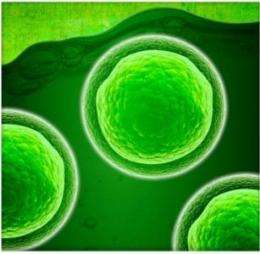
Typical research on blue-green algae, or cyanobacteria, often focuses on pampered conditions that result in a fast, high yield, but such conditions bear little resemblance to what these bacteria face in nature. Scientists from Pacific Northwest National Laboratory (PNNL), Washington University in St. Louis, The Hebrew University of Jerusalem, and Texas Tech University conducted a large-scale analysis of an alga called Synechocystis 6803 under 33 environmental conditions.
The scientists discovered that, regardless of the type of stress or duration, the cyanobacterium immediately activates alternate pathways to acquire carbon and nitrogen, needed for survival. Analysis of these dynamic changes in the proteome provides insights into cellular adaptations to environmental perturbations.
By using this type of large-scale approach, scientists can gain insights into how these important bacteria function in nature. Cyanobacteria are responsible for nearly half of the photosynthesis necessary for sustaining life on earth. They've been studied by hundreds of laboratories over decades, yet many aspects of their physiology remain poorly understood. Better understanding of cyanobacteria will allow engineers to use them more effectively in the generation of renewable, carbon-neutral biofuels.
The team has discovered how these critical bacteria use many proteins and how they respond to varying natural conditions. In this study, they applied large-scale mass spectrometers toward a global proteomic analysisa capability at EMSL, a Department of Energy scientific user facility at PNNL, to produce a high-quality dataset that covers 53 percent of the predicted proteome. This is the most comprehensive protein based functional and quantitative analysis for any photosynthetic organism to date.
More information: Wegener KM, et al. 2010. "Global Proteomics Reveal an Atypical Strategy for Carbon/Nitrogen Assimilation by a Cyanobacterium Under Diverse Environmental Perturbations." Molecular & Cellular Proteomics 9(12):2678-2689. DOI:10.1074/mcp.M110.000109
Provided by
Pacific Northwest National Laboratory
-
From lemons to lemonade: Reaction uses carbon dioxide to make carbon-based semiconductor,
29 comments
-
Thioridazine kills cancer stem cells in human while avoiding toxic side-effects of conventional cancer treatments,
3 comments
-
SpaceX private rocket blasts off for space station (Update),
42 comments
-
Climate scientists say they have solved riddle of rising sea,
30 comments
-
Scotland passes turbine test to harness tidal power,
41 comments
-
What would stain as translucent on light-coloured fabric?
1 hour ago
-
How do I identify different bacteria on culture plates?
11 hours ago
-
Why Do Dogs do Strange things...
May 25, 2012
-
What does exophillic and endophillic mean in terms of mosquito and their control?
May 24, 2012
-
Semen stains glows under black lights (uv light)?
May 23, 2012
-
Question on Human Chromosome 2
May 23, 2012
- More from Physics Forums - Biology
More news stories
Scientist: Evolution debate will soon be history
(AP) -- Richard Leakey predicts skepticism over evolution will soon be history. Not that the avowed atheist has any doubts himself.
57 minutes ago |
5 / 5 (2) |
0
Thousands of shellfish found dead in Peru
Thousands of crustaceans were found dead off the coast of Lima following the mystery mass death of dolphins and pelicans, the Peruvian Navy said Friday.
10 hours ago |
4.8 / 5 (4) |
5
More plant species responding to global warming than previously thought
(Phys.org) -- Far more wild plant species may be responding to global warming than previous large-scale estimates have suggested.
May 22, 2012 |
4.6 / 5 (14) |
18
|
Totally rad: Scientists create rewritable digital data storage in DNA
(Phys.org) -- Scientists from Stanford's Department of Bioengineering have devised a method for repeatedly encoding, storing and erasing digital data within the DNA of living cells.
May 21, 2012 |
4.9 / 5 (16) |
11
|
For monogamous sparrows, it doesn't pay to stray (but they do it anyway)
It's quite common for a female song sparrow to stray from her breeding partner and mate with the male next door, but a new study shows that sleeping around can be costly.
May 22, 2012 |
5 / 5 (1) |
7
|
Dell tablet leak: 10.1-inch display, two-battery choice
(Phys.org) -- Headline after headline talks about vendors tablets in the wings as likely number-one contenders for the iPad. Such claims have justifiably been taken with a grain of salt, considering ...
Keep food safety in mind this memorial day weekend
(HealthDay) -- Picnics, parades and cookouts are as much a part of Memorial Day weekend as tributes to the United States' war veterans.
SpaceX capsule has 'new car' smell, astronauts say (Update)
SpaceX's Dragon cargo vessel smells like a new car, said astronauts at the International Space Station after opening the hatches Saturday following the spacecraft's landmark mission to the orbiting lab.
SpotterRF debuts Radar Backpack Kit (w/ Video)
(Phys.org) -- SpotterRF has announced a special radar backpack kit designed to enhance situational awareness for soldiers on the ground. The company says its special radar is designed for warfighters as part ...
Australia hails surprise super-telescope decision
Australia has hailed a surprise decision giving it a role in a radio telescope project aimed at revolutionising astronomy, vowing to draw on its decades of experience in space science.
Astronomers seize last chance in lifetime for Venus Transit
Astronomers are gearing for one the rarest events in the Solar System: an alignment of Earth, Venus and the Sun that will not be seen for another 105 years.