Smart fences recognize bad airport neighbors
A perimeter-protection system created by a team from the USC Viterbi School of Engineering took Best Paper prize at the IEEE Homeland Security Conference in November 2010, and is now moving to deployment at a Florida airport, while also being considered for further installations by the Transportation Security Administration (TSA).
The USC engineering team led by Alireza Dibazar, assistant professor of computational neural engineering and co-director of the USC Laboratory for Neural Dynamics, presented the prize paper, entitled "Intelligent Acoustic and Vibration Recognition/Alert Systems for Security Breaching Detection, Close Proximity Danger Identification, and Perimeter Protection," to leaders of global science and technology at the conference intended to foster homeland security technology innovation.
According to a summary by Dibazar, this smart sensor system recognizes spatio-temporal sensor patterns of perimeter intrusion "by foot, by fence, and by vehicle for the purpose of protecting remote fenced or virtual perimeters against unauthorized access or terrorist attack on TSA airport property."
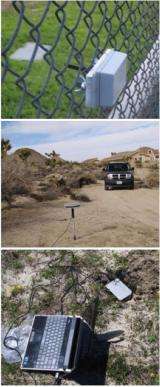
The system's novel approach allows target intrusion sounds to be identified by customers with specific needs. For example, in its use at airports, the sensors were trained to ignore typical fence manipulation (kicking, leaning, shaking) by visitors who gather at at end-of-runway fence lines and watch landings and take-offs. However, the same fence system actively raises alerts if the fence is climbed or if someone attempts to breach the perimeter. In turn, the ground sensors ignore the presence of large jets, but raise alerts for human footsteps in unauthorized areas and can be programmed to either raise alerts or to simply report the presence of vehicles in certain protected areas.
Dibazar notes that "all the sensors slew video cameras to the origin of the intrusion event for threat identification."
The biologically-inspired system builds on previous implementations of computational neuroscience created by team member Theodore W. Berger, Director of the Laboratory for Neural Dynamics, and David Packard Chair in Engineering at the Viterbi School. Berger is also a professor in the school's department of biomedical engineering.
In 2003, Berger used his research in neural processing of information to create SENTRI™, a smart sensor detection system that recognizes the sound of a gunshot – and discriminates gunshots from firecrackers, car backfires, and other similar noises. SENTRI™ is installed on light poles in urban environments and –like the Smart Fence sensors—sends localization data to nearby surveillance cameras to capture the origin of the sound. The SENTRI system, marketed by Tucson-based Safety Dynamics, is currently used by police departments in several cities to reduce crime.
Smart Fence was first tested in the California desert near the Army's 29 Palms testing grounds, and then demonstrated for Naval Command at the Panama City Bay County International Airport in Panama City, FL, in conjunction with the Naval Surface Warfare Center of Panama City. The TSA is currently using this airport as proving grounds for systems to be installed at the first post 9/11 airport construction in the United States. Dibazar summarized system performance as "showing a perfect (100%) identification of unexpected intrusion events, and an average of less than two false positives per week and zero false negatives for recognition of human footsteps.
In addition, no false positives or false negatives were reported by the installed fence sensors for a duration of 45 days of unattended operation, which included several days of seasonal storms."
Another round of tests is scheduled to begin in late February, according to Dibazar. "We are going to install the technology at the new Panama City airport for the purpose of obtaining approval and certification by Naval technology assurance officers to sell the system to the TSA.
Dibazar said the Dallas Fort Worth airport and Randolph Air Force Base in San Antonio, TX are also looking to vet the cutting-edge technology.
Research for this project was generated from Small Business Innovative Research (SBIR) grants from the Office of Naval Research in 2006. When the TSA sponsored an Navy-led initiative to develop new technologies for "intelligent" airport perimeter in 2009, the detection of the sounds and vibrations associated with security breach created by the USC lab was an excellent match. A number of laboratories, including the USC Neural Dynamics facility, responded to the Navy's calls for proposals for advanced technological systems. Prototype testing in 2007 led to the selection of the USC system in 2010 for accelerated development. Research funding came from the Office of Naval Research commercialization pilot program.
Provided by University of Southern California


