Cancer's side effects can be lessened with nanoparticles
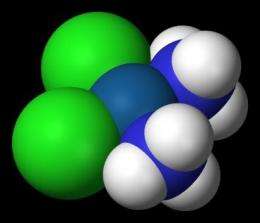
Researchers at MIT and Brigham and Women's Hospital have shown that they can deliver the cancer drug cisplatin much more effectively and safely in a form that has been encapsulated in a nanoparticle targeted to prostate tumor cells and is activated once it reaches its target.
Using the new particles, the researchers were able to successfully shrink tumors in mice, using only one-third the amount of conventional cisplatin needed to achieve the same effect. That could help reduce cisplatin’s potentially severe side effects, which include kidney damage and nerve damage.
In 2008, the researchers showed that the nanoparticles worked in cancer cells grown in a lab dish. Now that the particles have shown promise in animals, the team hopes to move on to human tests.
“At each stage, it’s possible there will be new roadblocks that will come up, but you just keep trying,” says Stephen Lippard, the Arthur Amos Noyes Professor of Chemistry and a senior author of the paper, which appears in the Proceedings of the National Academy of Sciences the week of Jan. 10.
Omid Farokhzad, associate professor at Harvard Medical School and director of the Laboratory of Nanomedicine and Biomaterials at Brigham and Women’s Hospital, is also a senior author of the paper. Shanta Dhar, a postdoctoral associate in Lippard’s lab, and Nagesh Kolishetti, a postdoctoral associate in Farokhzad’s lab, are co-lead authors.
Better delivery
Cisplatin, which doctors began using to treat cancer in the late 1970s, destroys cancer cells by cross-linking their DNA, which ultimately triggers cell death. Despite its adverse side effects, which also include nerve damage and nausea, about half of all cancer patients receiving chemotherapy are taking Cisplatin or other platinum drugs.
Another problem with conventional cisplatin is its relatively short lifetime in the bloodstream. Only about 1 percent of the dose given to a patient ever reaches the tumor cells’ DNA, and about half of it is excreted within an hour of treatment.
To prolong the time in circulation, the researchers decided to encase a derivative of cisplatin in a hydrophobic (water-repelling) nanoparticle. First, they modified the drug, which is normally hydrophilic (water-attracting), with two hexanoic acid units — organic fragments that repel water. That enabled them to encapsulate the resulting prodrug — a form that is inactive until it enters a target cell — in a nanoparticle.
Using this approach, much more of the drug reaches the tumor, because less of the drug is degraded in the bloodstream. The researchers found that the nanoparticles circulated in the bloodstream for about 24 hours, at least 5 times longer than un-encapsulated cisplatin. They also found that it did not accumulate as much in the kidneys as conventional cisplatin.
To help the nanoparticles reach their target, the researchers also coated them with molecules that bind to PSMA (prostate specific membrane antigen), a protein found on most prostate cancer cells.
After showing the nanoparticles’ improved durability in the blood, the researchers tested their effectiveness by treating mice implanted with human prostate tumors. They found that the nanoparticles reduced tumor size as much as conventional cisplatin over 30 days, but with only 30 percent of the dose.
“They have very elegantly showed not just improved efficacy but also decreased toxicity,” says Mansoor Amiji, chair of pharmaceutical sciences at Northeastern University’s Bouvé College of Health Sciences, who was not involved in the research. “With a nanoparticle, you should be able to get higher doses into the patient, so you can have a much better therapeutic result and not worry as much about side effects.”
This type of nanoparticle design could be easily adapted to carry other types of drugs, or even more than one drug at a time, as the researchers reported in a PNAS paper last October. They could also be designed to target tumors other than prostate cancer, as long as those tumors have known receptors that could be targeted. One example is the Her-2 receptor abundant in some types of breast cancer, says Lippard.
The particles tested in this paper are based on the same design as particles developed by Farokhzad and MIT Institute Professor Robert Langer that deliver the cancer drug docetaxel. A Phase I clinical trial to assess those particles began last week, run by BIND Biosciences.
Additional animal testing is needed before the cisplatin-carrying particles can go into human clinical trials, says Farokhzad. “At the end of the day, if the development results are all promising, then we would hope to put something like this in humans within the next three years,” he says.
This story is republished courtesy of MIT News (web.mit.edu/newsoffice/), a popular site that covers news about MIT research, innovation and teaching.
More information: "Targeted delivery of cisplatin prodrug for safer and more effective prostate cancer therapy in vivo," by Shanta Dhar, Nagesh Kolishetti, Stephen J. Lippard, and Omid C. Farokhzad. Proceedings of the National Academy of Sciences, 10, January 2011.
Provided by Massachusetts Institute of Technology


