New theory on the origin of water on Earth
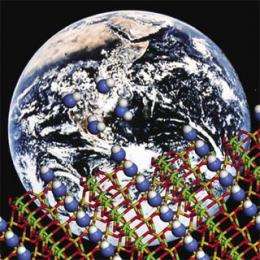
Structure of olivine, a mineral commonly found in interstellar dust clouds, against the Earth
(PhysOrg.com) -- A new theory on the source of terrestrial water has been validated by an international team led by Professor Nora de Leeuw (University College London) using computational research.
Below Professor de Leeuw describes the implications of the breakthrough.
The origin of water on our planet is not only of interest for our understanding of the evolution of our own planet and life thereon, but even more so for the increasing exploration of other planets within our solar system and the discovery of potential planetary systems in other galaxies.
Having spent half a lifetime teaching his students the accepted versions of the origin of our planetary water, which increasingly did not fit the available evidence, Dr Mike Drake at the University of Arizona suggested an alternative hypothesis: that water was already present at the surfaces of interstellar dust grains when they accreted to form our planet. Although this hypothesis fitted with all available evidence, it would only be feasible if the adhesion of water to the dust grains was sufficiently strong to survive the harsh conditions in the interstellar dust clouds where planets form.
Computer simulations by myself and colleagues in UCL, Arizona and Muenster on the adhesion of water to a mineral commonly found in the interstellar dust clouds, show that the kind of highly fractal surfaces found on the interstellar dust grains are indeed suitable for the strong retention of water under the extreme temperatures and pressure conditions prevalent in the accretion disk during planetary formation.
This work thus provides very strong evidence that the new hypothesis as to the delivery of water is correct: water was indeed present at the birth of our planet Earth rather than a latecomer once the planet had been formed.
More information: Paper online: http://pubs.rsc.or … C/C0CC02312D
Provided by
University College London
-
From lemons to lemonade: Reaction uses carbon dioxide to make carbon-based semiconductor,
28 comments
-
Thioridazine kills cancer stem cells in human while avoiding toxic side-effects of conventional cancer treatments,
3 comments
-
SpaceX private rocket blasts off for space station (Update),
41 comments
-
Climate scientists say they have solved riddle of rising sea,
30 comments
-
Scotland passes turbine test to harness tidal power,
40 comments
-
Inversion temp
4 hours ago
-
High school chemistry EEI
11 hours ago
-
oxidation of I- by KMnO4
23 hours ago
-
Invesion temp
May 25, 2012
-
Hybridization of SnCl3 -
May 25, 2012
-
Electrons And Radiation
May 25, 2012
- More from Physics Forums - Chemistry
More news stories
High-speed method to aid search for solar energy storage catalysts
Eons ago, nature solved the problem of converting solar energy to fuels by inventing the process of photosynthesis.
17 hours ago |
5 / 5 (2) |
1
|
From lemons to lemonade: Reaction uses carbon dioxide to make carbon-based semiconductor
(Phys.org) -- A materials scientist at Michigan Technological University has discovered a chemical reaction that not only eats up the greenhouse gas carbon dioxide, it also creates something useful. And, by ...
May 21, 2012 |
4.7 / 5 (88) |
28
|
Researchers demonstrate possible primitive mechanism of chemical info self-replication
(Phys.org) -- When scientists think about the replication of information in chemistry, they usually have in mind something akin to what happens in living organisms when DNA gets copied: a double-stranded molecule ...
May 25, 2012 |
5 / 5 (4) |
2
|
New CO2-removing catalyst can take the heat
(Phys.org) -- The current method of removing the greenhouse gas carbon dioxide (CO2) from the flues of coal-fired power plants uses so much energy that no one bothers to use it. So says Roger Aines, principal ...
May 24, 2012 |
5 / 5 (7) |
7
|
Castor oil: Action mechanism of one of the oldest drugs known to man elucidated
Castor oil is known primarily as an effective laxative; however, it was also used in ancient times with pregnant women to induce labour. Only now have scientists at the Max Planck Institute for Heart and Lung ...
May 21, 2012 |
3 / 5 (2) |
3
|
Transvaginal mesh op restores pelvic organ prolapse at price
(HealthDay) -- Transvaginal mesh (TVM) procedures are effective for anatomical restoration of pelvic organ prolapse (POP), but patients report a worsening of sexual function following surgery, according to ...
Family history of Alzheimer's affects functional connectivity
(HealthDay) -- Cognitively normal individuals with a family history of late-onset Alzheimer's disease (AD) may display lower resting state functional connectivity in the default mode network (DMN) of the brain, ...
SpotterRF debuts Radar Backpack Kit (w/ Video)
(Phys.org) -- SpotterRF has announced a special radar backpack kit designed to enhance situational awareness for soldiers on the ground. The company says its special radar is designed for warfighters as part ...
Travel to high altitudes tied to Crohn's, colitis flare-ups
(HealthDay) -- People with inflammatory bowel disease, which includes Crohn's disease and colitis, may be at increased risk for flare-ups when they fly or travel to high altitudes for skiing or mountain climbing, ...
Thousands of shellfish found dead in Peru
Thousands of crustaceans were found dead off the coast of Lima following the mystery mass death of dolphins and pelicans, the Peruvian Navy said Friday.
Astronomers seize last chance in lifetime for Venus Transit
Astronomers are gearing for one the rarest events in the Solar System: an alignment of Earth, Venus and the Sun that will not be seen for another 105 years.
Dec 03, 2010
Rank: 1 / 5 (2)
Dec 03, 2010
Rank: 1 / 5 (6)
Dec 04, 2010
Rank: not rated yet
Dec 05, 2010
Rank: not rated yet
Where have all the real scientists gone?
Dec 06, 2010
Rank: not rated yet
Dec 06, 2010
Rank: not rated yet