Stanford students create 'do not track' software
December 3, 2010 By Adam Gorlick
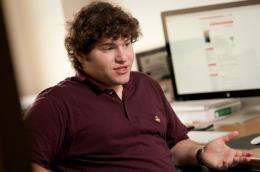
"We always thought Do Not Track was a great technical idea, and it has a real impact that's feasible," said Jonathan Mayer, one of two researchers who created the software.
As a government agency pushes for a "do not track" mechanism to protect online consumer privacy, a pair of Stanford researchers is developing the technology to make it work.
For about four months before Wednesday's release of the Federal Trade Commission's recommendations for increasing Internet privacy, Jonathan Mayer and Arvind Narayanan have been creating software that would let users opt out of third-party web tracking and tell advertisers to stop following them online.
"People get creeped out by some of the advertising that happens online," said Mayer, who is working toward a PhD in computer science and a law degree. "What concerns us is if you're on a site like Amazon and you go looking for shoes, then someone tells a behavioral advertising service that you've been looking for shoes. So the next time you're off on another shopping site, they'll ask if you're still looking for shoes. It feels invasive."
The students' idea for their Do Not Track program is fairly straightforward. Whenever a web browser such as Firefox requests content or sends data using HTTP the protocol that underlies the web it can optionally include extra information called a "header." Do Not Track adds a header that signals the user does not want to be tracked.
The technology can now be installed as an add-on for Firefox, and Mayer and Narayanan are working to make it operate with Chrome. Safari and Internet Explorer do not support their software. Once the add-on is installed, the user doesn't have to do anything else. Each time a website is visited, a do-not-track message is automatically sent.
The students, who have been working with computer science Professor John Mitchell, are also creating ways to configure web servers to honor their code.
Sending businesses and advertisers the message that you don't want to be tracked is one thing. But getting them to respect your privacy is another and it's something that hinges on government enforcement.
"At the end of day, Congress would probably have to pass a law empowering the FTC to enforce this," said Ryan Calo, director of the Consumer Privacy Project for Stanford Law School's Center for Internet and Society. Mayer is a student fellow at the center, and Narayanan a postdoctoral researcher in computer science is a junior affiliate scholar at the center.
"The FTC could also say they are responsible for policing the Internet for deceptive and unfair practices, so if a consumer says he doesn't want to be tracked and you track him, that can be seen as an unfair practice," Calo said. "But to get the proper amount of teeth behind something like this, you really need Congress to act."
The FTC's recommendations contained in a 79-page report that was approved unanimously by the five-member commission are open to public comments through the end of January.
The students already have received attention from Internet companies, behavioral advertisers and government officials, and Mayer and Narayanan will continue weighing in with their ideas for how to best protect privacy for online users.
"We always thought 'Do Not Track' was a great technical idea, and it has a real impact that's feasible," Mayer said. "Now having the FTC say it's a good idea you just can't ask for more than that on a research project."
More information: http://donottrack.us/
Provided by
Stanford University
-
From lemons to lemonade: Reaction uses carbon dioxide to make carbon-based semiconductor,
28 comments
-
Thioridazine kills cancer stem cells in human while avoiding toxic side-effects of conventional cancer treatments,
3 comments
-
SpaceX private rocket blasts off for space station (Update),
41 comments
-
Climate scientists say they have solved riddle of rising sea,
30 comments
-
Scotland passes turbine test to harness tidal power,
40 comments
-
magnets or EMF in car bumpers to protect from fender bender
3 hours ago
-
length of wire in a coil of known dimensions?
20 hours ago
-
India Engineering Powerhouse
May 25, 2012
-
electromagnet core dereference between hard and soft iron
May 25, 2012
-
Measuring water pressure in an open tank
May 24, 2012
-
Question from a non-engineer: Pulley Systems
May 24, 2012
- More from Physics Forums - General Engineering
More news stories
SpotterRF debuts Radar Backpack Kit (w/ Video)
(Phys.org) -- SpotterRF has announced a special radar backpack kit designed to enhance situational awareness for soldiers on the ground. The company says its special radar is designed for warfighters as part ...
Apple CEO Cook gives up $75M in stock dividends
(AP) -- Apple CEO Tim Cook is giving up $75 million in dividends on restricted stock that the company is awarding to all of its employees.
21 hours ago |
1.8 / 5 (4) |
2
Yahoo kills 'Livestand' just 6 months after debut
(AP) -- Yahoo is killing a tablet magazine called Livestand just six months its debut on the iPad.
15 hours ago |
not rated yet |
1
Yahoo! ditches digital newsstand for iPads
Yahoo! shuttered its fledgling digital newsstand for iPads on Friday in what it said was the start of a product purge intended to make the floundering Internet pioneer more nimble.
16 hours ago |
not rated yet |
0
Facebook IPO debacle raises investor dander
The spate of complaints and investigations over the Facebook stock offering suggests big institutions had an edge over small investors, raising questions about the process.
17 hours ago |
not rated yet |
0
Astronauts enter world's 1st private supply ship
(AP) -- Space station astronauts floated into the Dragon on Saturday, a day after its heralded arrival as the world's first commercial supply ship.
Australia hails surprise super-telescope decision
Australia has hailed a surprise decision giving it a role in a radio telescope project aimed at revolutionising astronomy, vowing to draw on its decades of experience in space science.
SpaceX capsule has 'new car' smell, astronauts say
SpaceX's Dragon cargo vessel smells like a new car, said astronauts at the International Space Station after opening the hatches Saturday following the spacecraft's landmark mission to the orbiting lab.
Thousands of shellfish found dead in Peru
Thousands of crustaceans were found dead off the coast of Lima following the mystery mass death of dolphins and pelicans, the Peruvian Navy said Friday.
Astronomers seize last chance in lifetime for Venus Transit
Astronomers are gearing for one the rarest events in the Solar System: an alignment of Earth, Venus and the Sun that will not be seen for another 105 years.
Travel to high altitudes tied to Crohn's, colitis flare-ups
(HealthDay) -- People with inflammatory bowel disease, which includes Crohn's disease and colitis, may be at increased risk for flare-ups when they fly or travel to high altitudes for skiing or mountain climbing, ...
Dec 03, 2010
Rank: not rated yet
Corrected the article for you.
Dec 03, 2010
Rank: 3 / 5 (4)
Dec 05, 2010
Rank: 5 / 5 (1)
Easily said, if one ignores the small detail of first defining "tracking."