National team of scientists peers into the future of stem cell biology
Remarkable progress in understanding how stem cell biology works has been reported by a team of leading scientists, directed by experts at UC Santa Barbara. Their research has been published in the journal Cell Stem Cell.
Stem cell biology is making waves around the world with great hope for the eventual repair of parts of the body. While many scientists see these breakthroughs as viable, there are hurdles that must be overcome, including the worrisome potential for introducing cancer when making a repair to an organ.
Significant interdisciplinary research in stem cells is being performed at UC Santa Barbara, by a team of neurobiologists and physicists, with assistance from scientists at Harvard Medical School, UCLA's Geffen School of Medicine, and the Yale Stem Cell Center.
The paper is a collaboration between biology, physics, and engineering. The two first authors are Pierre Neveu, of the Neuroscience Research Institute (NRI) and UCSB's Kavli Institute of Theoretical Physics (KITP); and Min Jeong Kye, of the NRI, MCDB, UCSB's Center for Stem Cell Biology and Engineering.
An important concept in this research is pluripotency –– the ability of the human embryonic stem cell to differentiate or become almost any cell in the body, explained senior author Kenneth S. Kosik, professor in the Department of Molecular, Cellular & Developmental Biology (MCDB). Kosik is also the Harriman Chair in Neuroscience Research and co-director of the NRI. And, Kosik is a practicing physician specializing in Alzheimer's Disease.
"The beauty and elegance of stem cells is that they have these dual properties," said Kosik. "On the one hand, they can proliferate –– they can divide and renew. On the other hand, they can also transform themselves into any tissue in the body, any type of cell in the body."
Kosik said that scientists have learned that many cells in the body have the potential to become pluripotent cells. "The big engines of change are the transcription factors," said Kosik. "They drive the laboratory procedure by which we can reverse the progression during development from stem cell to differentiated cell and use differentiated cells from our skin to make stem cells."
With human embryonic stem cells, Kosik explained that for some time he and his team have been studying a set of control genes called microRNAs. "To really understand microRNAs, the first step is to remember the central dogma of biology ––DNA is the template for RNA, and RNA is translated to protein. But microRNAs stop at the RNA step and never go on to make a protein."
According to Kosik, it doesn't matter how scientists make or obtain stem cells for research. They can be bona fide human embryonic stem cells (HESC) or induced pluripotent stem cells (IPSC) induced from a skin cell. The microRNA patterns don't "respect" how the cells were made, Kosik said. The team found that all pluripotent stem cells are not identical, but did not differ by how they originated. The scientists found two groups of stem cells, irrespective of origin. MicroRNA profiles proved this.
When looking at microRNA, the overall profile is an extraordinarily good predictor –– maybe the best predictor –– of what type of cell you have. "You could be looking through the microscope at a tumor, and you may not be sure about that tumor," said Kosik. "Maybe the tumor is in the brain, but you don't know whether it is a brain tumor, or a metastasis from somewhere else. You can't always tell exactly what type of cells they are.
"The microRNAs will tell you," said Kosik. "Those profiles can tell you the different types of cancer; they can tell you the different types of cells; they can distinguish stem cells from other cells; and they can distinguish skin cells from brain cells. Those profiles, when you look at them in their totality, offer a unique signature that can inform you as to what type of cell you have. So that's a very important property of these microRNAs."
The scientists looked at 400 different microRNAs in both embryonic and induced pluripotent cells. Humans have approximately 1,000 microRNAs.
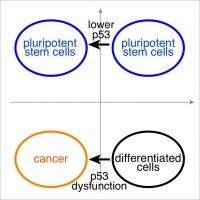
Pluripotent stem cells have some similarity to cancer cells. They are immortal. They self-renew. Tumors keep dividing. So do pluripotent stem cells. "That's their property, self-renewal, proliferation," said Kosik. "And that's what cancer does. How can it be that pluripotent stem cells can self-renew and are not cancer, but cancer cells self-renew and are cancer? Cancer lacks any control over itself. What's the difference?"
The scientists included studies of 40 types of differentiated body cells, in
the microRNA testing. They found that the microRNA was very different in the cancer cells and the differentiated cells. This was not a surprise.
The surprise was that when looking at pluripotent cells, some are more more similar to cancer and others are less similar.
"One of the big problems that people worry about in the use of stem cells for the repair of body parts, is whether or not you are going to be creating cancer," said Kosik. "That's a big worry ¬¬–– one of the major worries. So if we have a way here, and this we don't know yet, but if these microRNA profiles that look like cancer indicate a propensity toward cancer, then that would be very nice to know. But we don't know that yet."
He explained two possibilities: If doctors are going to use stem cells for body repairs, they don't want them to be cancerous, but they do want them to have enough growth potential that they will really make a difference. "So maybe they should look a little bit like cancer," said Kosik. "On the other hand, you don't want them to become a tumor. So maybe you want them to look a little less like cancer. At this point you could make either argument. We just don't know."
Scientists at UCSB will be working on the answers.
Provided by University of California - Santa Barbara


