UNL biochemist probes protein for disease clues
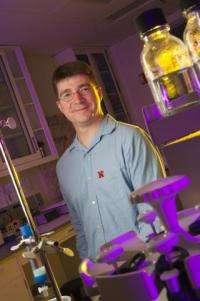
Mark Wilson
(PhysOrg.com) -- Scientists believe they have discovered a common link between such disparate diseases as Parkinson's disease and some types of cancer. Studying these links could lead to advances in combating these and other human diseases.
University of Nebraska-Lincoln biochemist Mark Wilson studies a protein believed to play a critical role in causing mitochondrial abnormalities leading to Parkinson's and some cancers. He's expanding his research with a recent $1.35 million grant from the National Institutes of Health's National Institute of General Medical Sciences.
Scientists now know that inheritable forms of Parkinson's disease develop from mutations in genes found in the mitochondria, the "cellular power plants" that perform a variety of functions within an organism's cells. For example, a genetic mutation that alters the DJ-1 protein disrupts the mitochondria's response to oxidative stress, an imbalance in molecular reactions that can damage cells and lead to diseases such as Parkinson's, Alzheimer's and ALS.
Scientists know that DJ-1 is an essential protein for maintaining the balance between helping cells survive oxidative stress and initiating cell death when cancer would otherwise form. But many questions remain about how it works and the effect of mutations.
Wilson uses X-ray crystallography to determine DJ-1's three-dimensional structure in its normal and mutated forms to better understand how the protein contributes to neurodegenerative diseases.
"The hope is that it will give us the ability to biochemically characterize the pathways that go amiss in these rare forms of Parkinson's," Wilson said. "Cancer and Parkinson's disease don't obviously have a lot in common, but they do have this protein in common. Our hope is that this protein connects a variety of serious human diseases to a common biochemical pathway."
Greater understanding of that pathway and its molecular components may one day lead to treatments against cancer and neurodegenerative diseases, he said.
Provided by
University of Nebraska-Lincoln
-
From lemons to lemonade: Reaction uses carbon dioxide to make carbon-based semiconductor,
28 comments
-
Thioridazine kills cancer stem cells in human while avoiding toxic side-effects of conventional cancer treatments,
3 comments
-
SpaceX private rocket blasts off for space station (Update),
41 comments
-
Climate scientists say they have solved riddle of rising sea,
30 comments
-
Scotland passes turbine test to harness tidal power,
40 comments
-
High school chemistry EEI
1 hour ago
-
oxidation of I- by KMnO4
14 hours ago
-
Invesion temp
17 hours ago
-
Hybridization of SnCl3 -
17 hours ago
-
Electrons And Radiation
21 hours ago
-
Acid Base Theories
May 24, 2012
- More from Physics Forums - Chemistry
More news stories
High-speed method to aid search for solar energy storage catalysts
Eons ago, nature solved the problem of converting solar energy to fuels by inventing the process of photosynthesis.
7 hours ago |
5 / 5 (2) |
1
|
Researchers demonstrate possible primitive mechanism of chemical info self-replication
(Phys.org) -- When scientists think about the replication of information in chemistry, they usually have in mind something akin to what happens in living organisms when DNA gets copied: a double-stranded molecule ...
15 hours ago |
5 / 5 (3) |
2
|
Building a better solar panel -- one molecule at a time
(Phys.org) -- One of the fundamental building blocks in modern chemistry, an organometallic chemical compound called ferrocene, has never been structurally defined - until now.
15 hours ago |
5 / 5 (3) |
0
|
From lemons to lemonade: Reaction uses carbon dioxide to make carbon-based semiconductor
(Phys.org) -- A materials scientist at Michigan Technological University has discovered a chemical reaction that not only eats up the greenhouse gas carbon dioxide, it also creates something useful. And, by ...
May 21, 2012 |
4.7 / 5 (88) |
28
|
New CO2-removing catalyst can take the heat
(Phys.org) -- The current method of removing the greenhouse gas carbon dioxide (CO2) from the flues of coal-fired power plants uses so much energy that no one bothers to use it. So says Roger Aines, principal ...
May 24, 2012 |
5 / 5 (7) |
7
|
Of mice and mental models: Neuroscientific implications of risk-optimized behavior in the mouse
(Medical Xpress) -- Regardless of an organism’s biological complexity, every encephalized animal continuously makes under-informed behavioral choices that can have serious consequences. Despite its ubiquity, ...
Dragon arrives at space station in historic 1st (Update 2)
The privately bankrolled Dragon capsule made a historic arrival at the International Space Station on Friday, triumphantly captured by astronauts wielding a giant robot arm.
Landmark calculation clears the way to answering how matter is formed
(Phys.org) -- An international collaboration of scientists, including Thomas Blum, associate professor of physics, is reporting in landmark detail the decay process of a subatomic particle called a kaon ...
It's in the genes: Research pinpoints how plants know when to flower
Scientists believe they've pinpointed the last crucial piece of the 80-year-old puzzle of how plants "know" when to flower.
Researchers solve structure of human protein critical for silencing genes
In a study published in the journal Cell on May 24, Cold Spring Harbor Laboratory (CSHL) scientists describe the three-dimensional atomic structure of a human protein bound to a piece of RNA that "guides" the pr ...
MIT researchers devise new means to synchronize a group of robots (w/ Video)
(Phys.org) -- For several years, roboticists have been working out ways to get a group of robots to perform synchronized activities as demonstrated most often in dance routines. Its not just about trying ...