Scientists identify antivirus system
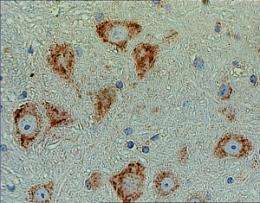
(PhysOrg.com) -- Viruses have led scientists at Washington University School of Medicine in St. Louis to the discovery of a security system in host cells.
Viruses that cause disease in animals beat the security system millennia ago. But now that researchers are aware of it, they can explore the possibility of bringing the system back into play in the fight against diseases such as sudden acute respiratory syndrome (SARS), West Nile virus, dengue and yellow fever.
The findings, published in Nature, solve a 35-year-old mystery that began when National Institutes of Health researcher Bernard Moss, MD, PhD, noticed that poxviruses put chemical "caps" on particular spots in every piece of genetic material transcribed from their DNA. That transcribed material is RNA; to reproduce, viruses need to trick the host cell into making viral proteins from this RNA.
Noting evidence that the host cell puts caps on its own RNA in identical positions, Moss theorized that the caps might be a way for cells to distinguish between their RNA and that of an invader. He guessed the caps might serve as a sort of fake identification badge for the virus' RNA, allowing it to bypass host cell security systems primed to attack any RNA lacking the caps.
Since Moss's study, scientists have learned that some viruses have strategies for stealing RNA caps from host cells and putting them on their own RNA. Several disease-causing viruses have to make their own caps, including:
- poxviruses, which cause smallpox
- flaviviruses, which cause West Nile encephalitis, yellow fever and dengue;
- rhabdoviruses, which cause rabies;
- coronaviruses, which cause SARS;
- reoviruses, which cause mild respiratory distress or diarrhea.
The new paper from the laboratory of senior author Michael S. Diamond, MD, PhD, solves that puzzle and confirms Moss' speculation. The study used a mutant form of the West Nile virus created by Pei-Yong Shi, PhD, now a researcher at the Novartis Institute for Tropical Diseases. The mutant strain can attach the cap that keeps RNA stable but is unable to add the 2' cap. When Diamond, professor of medicine, pathology and immunology, and molecular microbiology at Washington University School of Medicine, infected mice with this mutant virus, it could not cause disease.
Next, scientists injected the mutant virus into mice lacking the receptors for interferons. These proteins are important players in defensive reactions to invading viruses within the cell, a branch of the immune system known as intrinsic immunity. The mutant virus made these mice sick, suggesting that intrinsic immunity stops the mutant viruses in normal mice, and that the 2' cap was helping normal viruses evade this part of the immune system.
Researchers recently identified a gene, IFIT2, that is activated by interferons, has mild antiviral effects against West Nile virus and seems to have potential connections to translation of RNA into proteins. When Diamond turned IFIT2 levels up in cell culture and exposed it to the mutant West Nile virus, the mutant virus could barely replicate. Tests of a mutant poxvirus and a mutant coronavirus that could not attach the 2' cap produced similar results. Knocking out a related gene in mice, IFIT1, allowed the mutant virus to evade intrinsic immunity and cause infection when it was injected into the brain.
"Now that we know what this cap is used for, we can look at the question of whether the human and viral enzymes that put the cap on are sufficiently different," says Diamond. "If they are, we may be able to design inhibitors that prevent viruses from capping their RNA and make it much harder for them to replicate once the intrinsic immune system is activated."
More information: Daffis S, Szretter KJ, Schriewer J, Li J, Youn S, Errett J, Lin T-Y, Schneller S, Zust R, Dong H, Thiel V, Sen GC, Fensterl V, Klimstra WB, Pierson TC, Buller RM, Gale JR M, Shi P-Y, Diamond, MS. 2'0 methylation of the viral mRNA cap evades host restriction by IFIT family members. Nature, Nov. 18, 2010.
Provided by Washington University School of Medicine


