Study reveals the subtle dynamics underpinning how cats drink (w/ Video)
November 11, 2010

Cats show perfect balance even in their lapping (w/ Video)

Enlarge

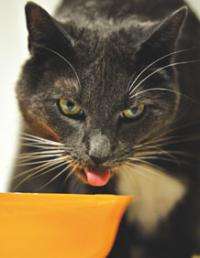
How do cats lap? Roman Stocker's cat Cutta Cutta is about to take a drink. Photo / Pedro Reis, Micaela Pilotto and Roman Stocker

(PhysOrg.com) -- Cat fanciers everywhere appreciate the gravity-defying grace and exquisite balance of their feline friends. But do they know those traits extend even to the way cats lap milk?

Researchers at MIT, Virginia Tech and Princeton University analyzed the way domestic and big cats lap and found that of all sizes take advantage of a perfect balance between two physical forces. The results will be published in the November 11 online issue of the journal Science.

It was known that when they lap, cats extend their tongues straight down toward the bowl with the tip of the tongue curled backwards like a capital "J" to form a ladle, so that the top surface of the tongue actually touches the liquid first. We know this because another MIT engineer, the renowned Doc Edgerton, who first used strobe lights in photography to stop action, filmed a domestic cat lapping milk in 1940.

But recent high-speed videos made by this team clearly revealed that the top surface of the cat's tongue is the only surface to touch the liquid. Cats, unlike dogs, aren't dipping their tongues into the liquid like ladles after all. Instead, the cat's lapping mechanism is far more subtle and elegant. The smooth tip of the tongue barely brushes the surface of the liquid before the cat rapidly draws its tongue back up. As it does so, a column of milk forms between the moving tongue and the liquid's surface. The cat then closes its mouth, pinching off the top of the column for a nice drink, while keeping its chin dry.

This video is not supported by your browser at this time.

The liquid column, it turns out, is created by a delicate balance between gravity, which pulls the liquid back to the bowl, and inertia, which in physics, refers to the tendency of the liquid or any matter, to continue moving in a direction unless another force interferes. The cat instinctively knows just how quickly to lap in order to balance these two forces, and just when to close its mouth. If it waits another fraction of a second, the force of gravity will overtake inertia, causing the column to break, the liquid to fall back into the bowl, and the cat's tongue to come up empty.

While the domestic cat averages about four laps per second, with each lap bringing in about 0.1 milliliters of liquid, the big cats, such as tigers, know to slow down. They naturally lap more slowly to maintain the balance of gravity and inertia.

Analyzing the mechanics

In this research, Roman Stocker of MIT's Department of Civil and Environmental Engineering (CEE), Pedro Reis of CEE and the Department of Mechanical Engineering, Sunghwan Jung of Virginia Tech's Department of Engineering Science and Mechanics, and Jeffrey Aristoff of Princeton's Department of Mechanical and Aerospace Engineering used observational data gathered from high-speed digital videos of domestic cats, including Stocker's family cat, and a range of big cats (tiger, lion and jaguar) from the Boston-area zoos, thanks to a collaboration with Zoo New England's mammal curator John Piazza and assistant curator Pearl Yusuf. And, in what could be a first for a paper published in Science, the researchers also gathered additional data by analyzing existing YouTube.com videos of big cats lapping.

This video is not supported by your browser at this time.

With these videos slowed way down, the researchers established the speed of the tongue's movement and the frequency of lapping. Knowing the size and speed of the tongue, the researchers then developed a mathematical model involving the Froude number, a dimensionless number that characterizes the ratio between gravity and inertia. For cats of all sizes, that number is almost exactly one, indicating a perfect balance.

To better understand the subtle dynamics of lapping, they also created a robotic version of a cat's tongue that moves up and down over a dish of water, enabling the researchers to systematically explore different aspects of lapping, and ultimately, to identify the mechanism underpinning it.

"The amount of liquid available for the cat to capture each time it closes its mouth depends on the size and speed of the . Our research — the experimental measurements and theoretical predictions — suggests that the cat chooses the speed in order to maximize the amount of liquid ingested per lap," said Aristoff, a mathematician who studies liquid surfaces. "This suggests that are smarter than many people think, at least when it comes to hydrodynamics."

Aristoff said the team benefitted from the diverse scientific backgrounds of its members: engineering, physics and mathematics.

This video is not supported by your browser at this time.

The researchers needed to be able to change a cat's lapping speed in order to test their theory. So they developed a robotic version of a cat's tongue — a mechanical column with a 1-inch glass disk at the tip. This device allowed the researchers to study the liquid column for different lapping speeds using a high-speed digital camera. The initial image was taken at 1000 frames per second. The video above is slowed to 15 frames per second. Video / Pedro M. Reis, Sunghwan Jung, Jeffrey M. Aristoff and Roman Stocker

"In the beginning of the project, we weren't fully confident that fluid mechanics played a role in cat's drinking. But as the project went on, we were surprised and amused by the beauty of the fluid mechanics involved in this system," said Jung, an engineer whose research focuses on soft bodies, like fish, and the fluids surrounding them.

The work began three-and-a-half years ago when Stocker, who studies the fluid mechanics of the movements of ocean microbes, was watching his cat lap milk. That cat, eight-year-old Cutta Cutta, stars in the researchers' best videos and still pictures. And like all movie stars (Cutta Cutta means "stars stars" in an Australian aboriginal language), he likes being waited on. With their cameras trained on Cutta Cutta's bowl, Stocker and Reis said they spent hours at the Stocker home waiting on Cutta Cutta … to drink, that is. But the wait didn't dampen their enthusiasm for the project, which very appropriately originated from a sense of curiosity.

"Science allows us to look at natural processes with a different eye and to understand how things work, even if that's figuring out how my cat laps his breakfast," Stocker said. "It's a job, but also a passion, and this project for me was a high point in teamwork and creativity. We did it without any funding, without any graduate students, without much of the usual apparatus that science is done with nowadays."

"Our process in this work was typical, archetypal really, of any new scientific study of a natural phenomenon. You begin with an observation and a broad question, 'How does the cat drink?' and then try to answer it through careful experimentation and mathematical modeling," said Reis, a physicist who works on the mechanics of soft solids. "To us, this study provides further confirmation of how exciting it is to explore the scientific unknown, especially when this unknown is something that's part of our everyday experiences."

Besides their obvious enthusiasm for the work itself, the researchers are also delighted that it builds on Edgerton's 1940 film of the cat lapping. That film appeared as part of an MGM-released movie called "Quicker'n a Wink," which won an Academy Award in 1941. Reis and Stocker say they're moving on to other collaborations closer to their usual areas of research. But their feline friend Cutta Cutta might have Oscar hopes.

Provided by Massachusetts Institute of Technology search and more info website

4.3 /5 (29 votes)  

Filter


Move the slider to adjust rank threshold, so that you can hide some of the comments.


Display comments: newest first

NickFun
Nov 11, 2010

Rank: 1.6 / 5 (7)
Why do I find this kind of science painfully dull? Maybe it's just me...
Rydog
Nov 11, 2010

Rank: not rated yet
One of our cats dips his whole chin in to drink. Why not analyze the physics of that?
GaryB
Nov 11, 2010

Rank: not rated yet
Our cat likes to drink straight from the faucet.
JIMBO
Nov 11, 2010

Rank: 1 / 5 (10)
Congrats Physorg writers ! You have not sunk to an unprecedented LOW in science writing. No physicist CARES about cats lapping or dogs shaking. Maybe you should write for Vet news ? This crap is worth no one's time. If you worked for me, you would get a pink slip tomorrow.
Mandan
Nov 12, 2010

Rank: 5 / 5 (8)
NickFun/JIMBO-- DON'T READ IT THEN!!

I happened to find this article fascinating, and perfectly acceptable science. In fact, I think it is an excellent example of

"the principle of optimization, [which is the] idea, gaining ever wider traction among researchers, that certain key features of the natural world have been honed by evolution to the highest possible peaks of performance, the legal limits of what Newton, Maxwell, Pauli, Planck et Albert will allow." http://www.nytime...emc=a210

I myself once had a very good friend, who happened to be a cat, and he regularly dipped his right paw into his water bowl, toe pads up, then brought it to his mouth to drink as we would out of our cupped hand. He occasionally scooped his dry food up and ate it in the same fashion.

Fascinating and quite informative SCIENTIFIC research, physorg.com. Thank you.
LivaN
Nov 12, 2010

Rank: 4 / 5 (2)
"We did it without any funding, without any graduate students, without much of the usual apparatus that science is done with nowadays."


I wonder why?
CarolinaScotsman
Nov 12, 2010

Rank: 5 / 5 (7)
"We did it without any funding, without any graduate students, without much of the usual apparatus that science is done with nowadays."


I wonder why?


Simple curiosity, the foundation of all science.
lengould100
Nov 12, 2010

Rank: 5 / 5 (1)
Most interesting to me is the evolutionary side of it.. how far natural selection will go to optimize a means for a furry-faced whiskered animal to drink without getting its face wet. I wonder why nature didn't simply develop the thumb bones of the cats into a folding drinking cup, or some other system requiring a lot less physics? (I assure you, I'm not promoting Intelligent Design or any such nonsense. Obvious to me that natural selection is fully capable of developing a system such as this).
LivaN
Nov 12, 2010

Rank: 5 / 5 (1)
"We did it without any funding, without any graduate students, without much of the usual apparatus that science is done with nowadays."


I wonder why?


Simple curiosity, the foundation of all science.


In that case someone should warn them…curiosity and cats generally don't mix well.
tkjtkj
Nov 12, 2010

Rank: 5 / 5 (1)
Why do I find this kind of science painfully dull? Maybe it's just me...


yes, it is. 'you', i mean .. ;)
rgwalther
Nov 12, 2010

Rank: not rated yet
I have a 18 year old cat who has alway checked the water with his paw before drinking.
Dummy
Nov 12, 2010

Rank: 4.7 / 5 (3)
Yet more scientific proof that cats are obviously superior to dogs!
rickl
Nov 13, 2010

Rank: not rated yet
My late cat Leo used to drink from the glass of water on the nightstand. He would usually slap his tongue against the side of the glass, making a loud "ding ding ding" sound.

I'm not sure whether that aided his drinking or if he just liked the sound.
Rank 4.3 /5 (29 votes)
Relevant PhysicsForums posts
  • Water under pressure and temperature effects
    created3 hours ago
  • Flow, different liquid, pressure
    created4 hours ago
  • Dimensions and Degrees of Freedom
    created5 hours ago
  • Rotational Inertia of a disc
    created5 hours ago
  • How does B=μH really work?
    created6 hours ago
  • I need help with understanding of Inertia of a slender rod and plate?
    created8 hours ago
  • More from Physics Forums - General Physics

More news stories

Landmark calculation clears the way to answering how matter is formed

(Phys.org) -- An international collaboration of scientists, including Thomas Blum, associate professor of physics, is reporting in landmark detail the decay process of a subatomic particle called a kaon – ...

Physics / General Physics

created 17 hours ago | popularity 4.8 / 5 (12) | comments 27 | with audio podcast

Is a classical electrodynamics law incompatible with special relativity?

(Phys.org) -- The laws of classical electromagnetism that were developed in the 19th century are the same laws that scientists use today. They include Maxwell’s four equations along with the Lorentz la ...

Physics / General Physics

created May 24, 2012 | popularity 5 / 5 (13) | comments 30 | with audio podcast feature

Lying in wait for WIMPs: Researchers seek to dramatically increase sensitivity of Large Underground Xenon detector

Although it's invisible, dark matter accounts for at least 80 percent of the matter in the universe. No one knows what it is, but most scientists would bet on weakly interacting massive particles, or WIMPs.

Physics / General Physics

created May 23, 2012 | popularity 4 / 5 (5) | comments 14 | with audio podcast

Hall effect at the speed of light: How can you demonstrate relativistic effects with your mobile phone?

The relativistic Hall effect describing objects rotating at speeds comparable with the speed of light has been reported.

Physics / General Physics

created May 21, 2012 | popularity 4.3 / 5 (3) | comments 8

Cloak of invisibility: Engineers use plasmonics to create an invisible photodetector

A team of engineers at Stanford and the University of Pennsylvania has for the first time used "plasmonic cloaking" to create a device that can see without being seen - an invisible machine that detects light. It is the first ...

Physics / General Physics

created May 21, 2012 | popularity 4.8 / 5 (16) | comments 7 | with audio podcast


Of mice and mental models: Neuroscientific implications of risk-optimized behavior in the mouse

(Medical Xpress) -- Regardless of an organism’s biological complexity, every encephalized animal continuously makes under-informed behavioral choices that can have serious consequences. Despite its ubiquity, ...

Dragon arrives at space station in historic 1st (Update 2)

The privately bankrolled Dragon capsule made a historic arrival at the International Space Station on Friday, triumphantly captured by astronauts wielding a giant robot arm.

High-speed method to aid search for solar energy storage catalysts

Eons ago, nature solved the problem of converting solar energy to fuels by inventing the process of photosynthesis.

It's in the genes: Research pinpoints how plants know when to flower

Scientists believe they've pinpointed the last crucial piece of the 80-year-old puzzle of how plants "know" when to flower.

Researchers solve structure of human protein critical for silencing genes

In a study published in the journal Cell on May 24, Cold Spring Harbor Laboratory (CSHL) scientists describe the three-dimensional atomic structure of a human protein bound to a piece of RNA that "guides" the pr ...

MIT researchers devise new means to synchronize a group of robots (w/ Video)

(Phys.org) -- For several years, roboticists have been working out ways to get a group of robots to perform synchronized activities as demonstrated most often in dance routines. It’s not just about trying ...