Budding research links climate change and earlier flowering plants
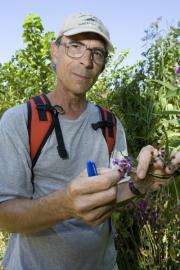
According to research published today by a University of Cincinnati faculty member, native plants in southwestern Ohio are flowering significantly earlier, a finding he attributes, at least in part, to global warming.
UC biologist Denis Conover, field service associate professor, has spent countless hours walking the Shaker Trace Wetlands at Miami Whitewater Forest over the last 18 years to survey hundreds of different plant species.
Conover's results, published in the December issue of Ecological Restoration, reveal that for species that were observed flowering during two distinct multi-year surveys, a significant number of wild plants (39 percent) bloomed earlier from 2005 to 2008 than when he recorded the same species' blooming times from 1992 to 1996. Forty-five percent of the plants bloomed at the same time, and 16 percent bloomed earlier.
"I was doing a plant survey to see how the wetlands had changed over the years, and I noticed a lot of the plants were blooming earlier than they had in the previous survey," said Conover.
The biologist pointed out that the mean annual temperature during the survey periods increased nearly 2 degrees from 53.38 degrees (11.88 C) to 55.27 degrees (12.93 C) in roughly a decade's time.
"This is a big change for such a short time period," said Conover. "There is a lot of data coming from all over the world indicating that biological communities are being impacted by warmer temperatures."
To determine the impact of these changes, Conover said scientists would need to look closely at the complete ecological picture, including the impact on insects and birds that interact with the plants.
"If the right insects aren't out at the right time, it could affect some of the cross-pollination that goes on," he said. Or it could affect certain birds that depend on the seeds from those plants. Everything is interrelated. It is hard to say what impact it will have. We could also see things like more invasive species moving in because of the warmer conditions."
Conover worked closely with UC's Steve Pelikan, a math professor, who crunched all the data from the surveys. Pelikan said he found both the number of earlier-flowering plants and the temperature change from one survey to the next to be statistically significant.
Conover's wild-plant research follows a similar pattern of findings from a recent 30-year garden-plant study in southwestern Ohio (McEwan, et al.). Pelikan points out that Conover's published research is significant because it is one of the first to highlight the earlier flowering phenomena among plants in a natural habitat as opposed to a more-controlled garden setting.
"His is one of the first papers to reach this conclusion when working with native plants in a native setting," said Pelikan.
Further substantiating the work, Conover has found that his observations also aren't unique to the Shaker Trace Wetlands. He's finding similar results as he compares data he collected from a plant survey in 2000 at Oxbow — a wetland at the confluence of the Great Miami and Ohio Rivers that spans southeastern Indiana and southwestern Ohio — to data from today.
He's also noticed the presence of new invasive species in the Oxbow area such as Callery pear, Japanese stiltgrass and Japanese chaff flower.
Conover is no stranger to biological restoration. He's been performing plant surveys, invasive plant control research, and other ecological restoration work as a "hobby" for 25 years. In his day job, Conover teaches several different freshman biology courses to hundreds of UC students in the McMicken College of Arts and Sciences each year. He started teaching at UC's old University College in 1990.
Provided by University of Cincinnati


