Solar-powered disaster relief
As water and fuel remained scarce in the weeks following the earthquake in Haiti earlier this year, one resource that relief teams could have used to help prevent dehydration literally surrounds the Caribbean island: the ocean. Although systems that remove salt from saltwater, or desalination systems, have existed for decades, they are typically large-scale installations that require lots of energy to operate. As bottled water was given the highest priority in terms of airborne relief supplies in Haiti, what relief teams needed were small, portable, self-contained desalination systems that could turn seawater into drinking water without using exterior electrical power.
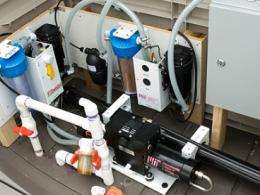
A team from MIT’s Field and Space Robotics Laboratory (FSRL) in the Department of Mechanical Engineering has designed a solution: a solar-powered desalination system that could be rapidly deployed in crisis situations to produce drinking water. The portable system could also be used in remote areas where supplying energy and clean water can be logistically complex and expensive, such as desert locations or farms and small villages in developing countries.
Led by Steven Dubowsky, a professor in both the Department of Mechanical Engineering and the Department of Aeronautics and Astronautics, and graduate students Amy Bilton and Leah Kelley, the group built a small prototype of the system last spring to test algorithms they had developed to run it. They have since demonstrated that the prototype is capable of producing 80 gallons of water a day in a variety of weather conditions. They estimate that a larger version of the unit, which would cost about $8,000 to construct, could provide about 1,000 gallons of water per day. Dubowsky and his students also estimate that one C-130 cargo airplane could transport two dozen desalination units — enough to provide water for 10,000 people.
The team presented a paper reporting preliminary results about its prototype system last week at the EuroMed 2010-Desalination for Clean Water and Energy Conference.
Designing for optimal control
Funded by MIT’s Center for Clean Water and Clean Energy in collaboration with the King Fahd University of Petroleum and Minerals (KFUPM), the research is aimed at designing small-scale systems for remote regions that don’t have access to vast amounts of electricity. The systems are also designed so that they can be cost-effectively assembled from standard parts and put into operation within hours using local human capital.
Another objective is to create a device that can operate efficiently over a range of solar conditions. Unlike conventional solar-powered desalination systems that run on expensive, short-life batteries when it gets cloudy, this system is designed for “optimal control,” meaning that the system’s computer can change certain variables, such as the power of the pump or the position of the valves, to maximize water output in response to changes in sunshine, temperature and water demand. Various sensors are connected to a control computer that alerts operators when to make these changes. “If it’s very sunny, the system will work faster and produce more water, but even when it’s cloudy, it will still produce water,” says MechE graduate student and team member Kelley.
The system relies on reverse osmosis, a filtration method that removes molecules and ions such as salt from solutions by applying pressure to the fluid as it flows over a permeable membrane. This process begins as photons, or particles of light from the sun, fall onto a solar photovoltaic panel and excite electrons in that panel. This activity generates electric power that pushes seawater through various pumps until it is sent — at extremely high pressure — into a vessel that has a permeable membrane made of polymer material. As a result of the high pressure, the water that diffuses through the membrane has had minerals removed.
Turnkey operations
Penny Boston, a professor in the Earth and Environmental Sciences Department at the New Mexico Institute of Mining & Technology, says the optimal-control design is a novel approach that hasn’t been used before for small plants in remote or postdisaster situations and may be crucial for operating the systems in the difficult circumstances that Dubowsky’s team envisions. But she cautions that the systems must be “extremely robust” and “almost turnkey” so that people without engineering backgrounds can use them.
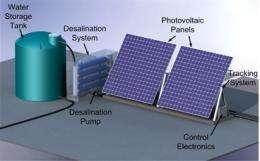
Dubowsky and his students agree, noting that they continue to address ease of operability as they gather data on how the system performs. Recently, they sent a small-scale unit to the Middle East for testing. In addition to trying to determine ways to produce more water, they are looking at how they might change the system’s design to make the system more durable.
This story is republished courtesy of MIT News (web.mit.edu/newsoffice/), a popular site that covers news about MIT research, innovation and teaching.
Provided by Massachusetts Institute of Technology


