Modern humans emerged far earlier than previously thought
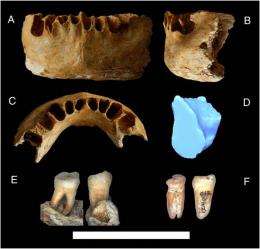
Fig. 1. The human remains from Zhiren Cave. The Zhiren 3 mandible in anterior (A), lateral left (B), and superior (C) views. The midsymphyseal cross-section of the Zhiren 3 mandible (D). The Zhiren 1M3 in buccal and mesial views (E), and the Zhiren 2 M3 in the same views (F). (Scale bar, 5 cm.) (Courtesy of Drs. LIU Wu and JIN Chang-Zhu)
(PhysOrg.com) -- An international team of researchers based at the Institute of Vertebrate Paleontology and Paleoanthropology in Beijing, including a physical anthropology professor at Washington University in St. Louis, has discovered well-dated human fossils in southern China that markedly change anthropologists perceptions of the emergence of modern humans in the eastern Old World.
The research was published Oct. 25 in the online early edition of the Proceedings of the National Academy of Sciences.
The discovery of early modern human fossil remains in the Zhirendong (Zhiren Cave) in south China that are at least 100,000 years old provides the earliest evidence for the emergence of modern humans in eastern Asia, at least 60,000 years older than the previously known modern humans in the region.
"These fossils are helping to redefine our perceptions of modern human emergence in eastern Eurasia, and across the Old World more generally," says Eric Trinkaus, PhD, the Mary Tileston Hemenway Professor in Arts & Sciences and professor of physical anthropology.
The Zhirendong fossils have a mixture of modern and archaic features that contrasts with earlier modern humans in east Africa and southwest Asia, indicating some degree of human population continuity in Asia with the emergence of modern humans.
The Zhirendong humans indicate that the spread of modern human biology long preceded the cultural and technological innovations of the Upper Paleolithic and that early modern humans co-existed for many tens of millennia with late archaic humans further north and west across Eurasia.
Provided by
Washington University in St. Louis
-
From lemons to lemonade: Reaction uses carbon dioxide to make carbon-based semiconductor,
28 comments
-
Every black hole contains a new universe: A physicist presents a solution to present-day cosmic mysteries,
214 comments
-
New silicon memory chip developed,
16 comments
-
Computing experts unveil superefficient 'inexact' chip,
45 comments
-
SpaceX private rocket blasts off for space station (Update),
41 comments
-
What does exophillic and endophillic mean in terms of mosquito and their control?
11 hours ago
-
Semen stains glows under black lights (uv light)?
May 23, 2012
-
Question on Human Chromosome 2
May 23, 2012
-
How important is composition of TBST in diluting antibodies and Western Blotting?
May 22, 2012
-
Does the medulla monitor blood pH
May 20, 2012
-
What physically constitutes memory?
May 17, 2012
- More from Physics Forums - Biology
More news stories
Relatively speaking: Researchers identify principles that shape kinship categories across languages
Different languages refer to family relationships in different ways. For example, English speakers use two terms grandmother and grandfather to refer to grandparents, while Mandarin Chinese uses four terms. ...
Other Sciences / Social Sciences
8 hours ago |
4 / 5 (2) |
0
|
Psychologists examine how race affects juvenile sentencing
When it comes to holding children accountable for crimes they commit, race matters.
Other Sciences / Social Sciences
6 hours ago |
5 / 5 (1) |
0
Social welfare cuts ultimately come with heavy price, researchers say
(Phys.org) -- Slashing government funding for Medicaid, food stamps and other programs that serve the poor while politically popular with some lawmakers and many conservatives may do more harm ...
Other Sciences / Social Sciences
15 hours ago |
4.3 / 5 (6) |
27
Oldest art even older
New dates from Geißenklösterle Cave in Southwest Germany document the early arrival of modern humans and early appearance of art and music.
Other Sciences / Archaeology & Fossils
3 hours ago |
5 / 5 (1) |
0
CWRU class earns Science magazine prize for innovation
Science magazine has awarded a prize for Inquiry-Based Instruction to a Case Western Reserve University class that melds biology, computer modeling, mathematical analysis and writing.
Other Sciences / Social Sciences
8 hours ago |
not rated yet |
0
Is a classical electrodynamics law incompatible with special relativity?
(Phys.org) -- The laws of classical electromagnetism that were developed in the 19th century are the same laws that scientists use today. They include Maxwell’s four equations along with the Lorentz la ...
HyperSolar shows dirty water no barrier to power world
(Phys.org) -- The Santa Barbara, California, company, HyperSolar, is set to transparently share the ups and downs of its research experiences toward the companys ultimate vision, successfully producing ...
Organic carbon from Mars, but not biological
Molecules containing large chains of carbon and hydrogen--the building blocks of all life on Earth--have been the targets of missions to Mars from Viking to the present day. While these molecules have previously ...
Asteroid nudged by sunlight: Most precise measurement of Yarkovsky effect
Scientists on NASA's asteroid sample return mission, Origins, Spectral Interpretation, Resource Identification, Security, Regolith Explorer (OSIRIS-REx), have measured the orbit of their destination asteroid, ...
In nanorod crystal growth, nanoparticles seen as artificial atoms
In the growth of crystals, do nanoparticles act as "artificial atoms" forming molecular-type building blocks that can assemble into complex structures? This is the contention of a major but controversial theory ...
First direct observation of oriented attachment in nanocrystal growth
Berkeley Lab researchers have reported the first direct observation of nanoparticles undergoing oriented attachment, the critical step in biomineralization and the growth of nanocrystals. A better understanding ...
Oct 25, 2010
Rank: 3.8 / 5 (4)
In any case, the true antiquity and distribution of modern man is likely to be much greater than the the established consensus allows for, and keeps getting pushed further and further back with new findings, with new evidence for the populating of the New World, much earlier than supposed urban settlement, plant domestication, et c. coming to light on a regular basis.
Sites such as Caral, Gobelka Tepe, the ruins atop which Johannesberg is built, the Topper site in S. Carolina, new revelations about Aboriginal settlement of Australia and a newly discovered culture in the Caucasus- all add up to an imminent rewrite of much of Prehistory.
Oct 25, 2010
Rank: 4.5 / 5 (6)
Oct 25, 2010
Rank: 4 / 5 (2)
Oct 25, 2010
Rank: 3 / 5 (4)
Oct 25, 2010
Rank: 4 / 5 (2)
I can tell usually by their level of cleanliness. The homos in the west village are a bit more modern then say the San Fran hippe homos.
I kid, but wow, quite interesting.
Oct 25, 2010
Rank: 5 / 5 (5)
Oct 25, 2010
Rank: 2.5 / 5 (2)
Oct 26, 2010
Rank: 2.5 / 5 (2)
@gary7,
Yeah, but that doesn't preclude(necessarily) the survival of a second(or even third) lineage. It's all evidence-based -enntirely dependent upon findings in the field, which will change our understanding, as new findings become part of the record.
I'm not saying that the record is entirely incorrect -but I think that it must remain open to the findings, which will likely change over as we dig deeper into the past of human antiquity.
Oct 26, 2010
Rank: 1.7 / 5 (9)
Unfortunately the article isn't available for reading at the PNAS.At least not without registration/subscription. Maybe I just don't know how to access it.
Oct 26, 2010
Rank: 1.4 / 5 (10)
The overwhelming trend is to try and ignore the presence of C-14 in everything, claiming that it's contaminated by modern carbon 14. This allows a convenient escape hatch from the problem of having to deal with an age of less than 10 000 years as normally indicated by the C14 content.
So the age is determined more by what one wants it to be rather that what the evidence represents.
Oct 26, 2010
Rank: 5 / 5 (5)
Oct 27, 2010
Rank: 5 / 5 (5)
Thought not.
Oct 28, 2010
Rank: not rated yet
Solution: the first h.sap. arrivals ate all the homo erectus etc. they found there. The second wave out of Africa ate all the first wave, leaving no inheritors of their mitochondria.
There! All fiksed!
:)
Oct 28, 2010
Rank: 5 / 5 (1)
Oct 31, 2010
Rank: 4.5 / 5 (2)
All they have to do is have more kids faster. Natural attrition may then solve the problem of who becomes the mitochondrial eve.
Nov 01, 2010
Rank: 1 / 5 (2)
The other clues in history are not so subtle and much more controversial if people begin to doubt the proof as set in this article.