Is the shape of a genome as important as its content?
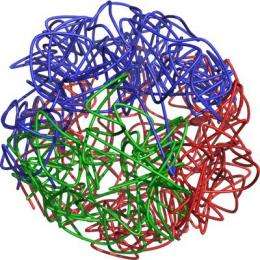
If there is one thing that recent advances in genomics have revealed, it is that our genes are interrelated, "chattering" to each other across separate chromosomes and vast stretches of DNA. According to researchers at The Wistar Institute, many of these complex associations may be explained in part by the three-dimensional structure of the entire genome. A given cell's DNA spends most of its active lifetime in a tangled clump of chromosomes, which positions groups of related genes near to each other and exposes them to the cell's gene-controlling machinery. This structure, the researchers say, is not merely the shape of the genome, but also a key to how it works.
Their study, published online as a featured article in the journal Nucleic Acids Research, is the first to combine microscopy with advanced genomic sequencing techniques, enabling researchers to literally see gene interactions. It is also the first to determine the three-dimensional structure of the fission yeast genome, S. pombe. Applying this technique to the human genome may provide both scientists and physicians a whole new framework from which to better understand genes and disease, the researchers say.
"People are familiar with the X-shapes our chromosomes form during cell division, but what they may not realize is that DNA only spends a relatively small amount of time in that conformation," said Ken-ichi Noma, Ph.D., an assistant professor in Wistar's Gene Expression and Regulation program and senior author of the study. "Chromosomes spend the majority of their time clumped together in these large, non-random structures, and I believe these shapes reflect various nuclear processes such as transcription."
To map both individual genes and the overall structure of the genome, Noma and his colleagues combined next generation DNA sequencing with a technique called chromosome conformation capture (3C). They then used fluorescent probes to pinpoint the exact location of specific genes through a microscope. With these data, the researchers were able to create detailed three-dimensional computer models of the yeast genome.
Using this novel approach, the researchers can view genes as they interact with each other. Noma and his colleagues can view where highly active genes are located, or see if genes that are turned on and off together also reside near each other in the three-dimensional structure of the genome. In total, the Wistar researchers also studied 465 so-called gene ontology groups – groups of genes that share a related purpose in the cell, such as structure or metabolism.
"When the chromosomes come together, they fold into positions that bring genes from different chromosomes near each other," Noma said. "This positioning allows the processes that dictate how and when genes are read to operate efficiently on multiple genes at once."
This structure is not merely an accident of chemical attractions within and among the chromosomes – although that is certainly a part of the larger whole – but an arrangement guided by other molecules in the cell to create a mega-structure that dictates genetic function, Noma says. He envisions a scenario where accessory molecules, such as gene-promoting transcription factors, bind to DNA and contribute to the ultimate structure of the genome as the chromosomes fold together.
"I believe we are looking at a new way to visualize both the genome itself and the movements of all the various molecules that act on the genome," Noma said.
According to the Wistar scientists, their techniques are scalable to the human genome, even though fission yeast only has three chromosomes. In fact, the researchers found signs of "transcription factories" – clusters of related genes that are read, or "transcribed," at discrete sites – which have been proposed to exist in mammals.
Provided by The Wistar Institute


