Flexible LEDs for implanting under the skin
Oct 18, 2010 by Lin Edwards report
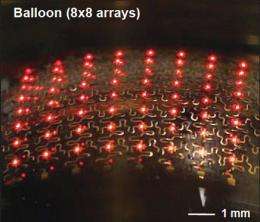
Optical image of an 8x8μ-ILEDs array on a thin PDMS substrate in its on state under deformed conditions. Image credit: Nature Materials, doi:10.1038/nmat2879

(PhysOrg.com) -- Researchers in the US, China, Korea and Singapore have collaborated to develop flexible ultra-thin sheets of inorganic light emitting diodes (LEDs) and photodetectors for implantation under the skin for medical monitoring, activating photo-sensitive drugs, and other biomedical applications.

The research, led by John Rogers of the University of Illinois at Urbana-Champaign in the US, and published today in developed flexible arrays 2.5 μm thick and 100 x 100 μm square, which is much smaller than any commercially available array. They printed circuits directly onto a rigid glass substrate and then transferred them to an inexpensive biocompatible polymer called poly(dimethylsiloxane) (PDMS) to create a mesh-like array of LEDs and photodetectors.

The PDMS substrate is flexible enough that the circuits can still function even if twisted or stretched by even as much as 75 percent. Rogers said most research has concentrated on organic LEDs (OLEDs), which are extremely sensitive to water and oxygen, but the flexible arrays are encapsulated in a thin layer of silicon rubber, which makes them waterproof and allows them to function well when implanted or completely immersed in biofluids. The design also eliminates the mechanical constraints normally imposed on such devices by the inflexible semiconductor wafers that support them.

The researchers successfully tested the LEDs by integrating a sheet into the fingertip of a vinyl glove, which they then immersed in soapy water, and they have also implanted an array beneath the skin in an animal model.
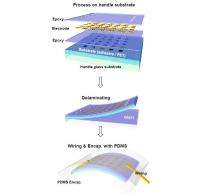
Schematic illustration of the encapsulation of an implantable array of μ-ILEDs. Image credit: Nature Materials, doi:10.1038/nmat2879

Potential biomedical applications for the include implantable patches for monitoring wound healing, for use in diagnosis or spectroscopy, or to control the delivery of drugs triggered by light in photodynamic drug therapy. They could also be used in light-emitting sutures or implantable illuminated plasmonic crystals, and may find application in robotics.

Rogers has recently founded a company in Cambridge, Massachusetts, mc10, to work on commercializing the new technology, which is a goal he regards as "incredibly appealing." Rogers said he wanted the technology to have an impact, and that was the end goal serving as the motivation for the work.

Explore further: Non-wetting fabric drains sweat

More information: Rak-Hwan Kim, et al., Waterproof AlInGaP optoelectronics on stretchable substrates with applications in biomedicine and robotics, Nature Materials, Advance online publication (2010) doi:10.1038/nmat2879

Related Stories

Researchers make new electronics -- with a twist

Nov 19, 2008

They've made electronics that can bend. They've made electronics that can stretch. And now, they've reached the ultimate goal -- electronics that can be subjected to any complex deformation, including twisting.

UI licenses flex electronics technology

Dec 19, 2006

The University of Illinois-Champaign has signed a licensing agreement regarding the development of flexible, stretchable and printable electronic circuitry.

OLED Displays on Flexible Metallic Substrates

Jun 23, 2004

Universal Display Corporation, a leading developer of organic light emitting device (OLED)technologies for flat panel displays, lighting and other opto-electronic applications, and Palo Alto Research Center (PARC), a subsidiary ...

Theory promises brighter plastic LEDs

Apr 14, 2004

A new take on the theory of light-emitting polymers suggests that their efficiency could be doubled, a development that would boost the introduction of flexible displays or possibly reduce the cost of flat-panel ...

Recommended for you

Unique method creates correct mirror image of molecule

2 hours ago

Many molecules have a right and a left form, just like shoes. In pharmaceuticals, it is important that the correct form of the molecule is used. Researchers at the University of Gothenburg, Sweden, have been ...

New method for producing clean hydrogen

19 hours ago

Duke University engineers have developed a novel method for producing clean hydrogen, which could prove essential to weaning society off of fossil fuels and their environmental implications.

Non-wetting fabric drains sweat

May 20, 2013

(Phys.org) —Waterproof fabrics that whisk away sweat could be the latest application of microfluidic technology developed by bioengineers at the University of California, Davis.

Beautiful 'flowers' self-assemble in a beaker

May 16, 2013

By simply manipulating chemical gradients in a beaker of fluid, materials scientists at Harvard have found that they can control the growth behavior of crystals to create precisely tailored structures—such ...

User comments : 12

Adjust slider to filter visible comments by rank

Display comments: newest first

genastropsychicallst
1 / 5 (6) Oct 18, 2010
... still no fifty-fifty relative trying all unrelative choices, to be read on my renewed website ...
JRDarby
4.4 / 5 (7) Oct 18, 2010
I'm just waiting for my OLED tattoos. :)
Coldstatic
1 / 5 (1) Oct 18, 2010
Thats what I'm saying, this opens up a whole new door to body mod.
dnatwork
2.8 / 5 (4) Oct 18, 2010
Beyond body-mod. We're talkin' video tattoos and cuttle-fish people. Get this thing wired to respond to your brain waves and make yourself into the perfect ninja. Of course, you'd have to shave off all your hair and go naked all the time for that to work.
thales
5 / 5 (3) Oct 18, 2010
Of course, you'd have to shave off all your hair and go naked all the time for that to work.


Finally a good reason to do it.
dirk_bruere
not rated yet Oct 18, 2010
Power supplies?
ecotek2u
4.5 / 5 (2) Oct 18, 2010
Caffein powered, just like the rest of me!
HealingMindN
not rated yet Oct 18, 2010
I'm waiting for the glowing tattoos that use body heat for energy. I'm not in the mood for getting cyborganized with OLED implantation. Next thing you know, they're shooting you up with nanobots, so you become a technology dependent cyborg. I don't want any "Borg Queen" telling me what to do.
scenage
5 / 5 (2) Oct 18, 2010
I'm just waiting for my OLED tattoos. :)


I'm waiting for the period when the OLED's can create light sabres that come out of the skin like Wolverines claws :P
Javinator
5 / 5 (1) Oct 19, 2010
or to control the delivery of drugs triggered by light in photodynamic drug therapy


To me this is the coolest part of the article. Assuming you could remotely trigger the lights somehow we could have remote controlled drug delivery at very specific locations in the body.

Coooool.
Santiro17
5 / 5 (1) Oct 24, 2010
I'm sure that Science Fiction has made an optimist out of me, but the potential uses for something similar to this seem huge.

A built in display would be a nice step on human integration with machines. Imagine: a wristwatch literally in your wrist, reading texts on the back of your hand, it could be synced with implanted measuring devices so that you could constantly monitor your own vitals.

So many possibilities, all waiting to be realized through technological advancement...
NocturnalLady
not rated yet Oct 26, 2010
OH..... i cant believe i found this... i live in New Hampshire and if at all possible i would SO love to volunteer to be the first person to have these LEDs implanted.. backlighting the tattoo on my foot wouldnt be a good idea too easy to damage but my other one probably wouldnt be too hard for them to do..

More news stories

DNA damage: The dark side of respiration

(Phys.org) —Adventitious changes in cellular DNA can endanger the whole organism, as they may lead to life-threatening illnesses like cancer. Researchers at LMU now report how byproducts of respiration cause mispairing ...

How healthy are you for your age?

On May 22, JoVE will publish details of a technique to measure the health of human genetic material in relation to a patient's age. The method is demonstrated by the laboratory of Dr. Gil Atzmon at New York's Albert Einste ...

Addiction as a disorder of decision-making

New research shows that craving drugs such as nicotine can be visualized in specific regions of the brain that are implicated in determining the value of actions, in planning actions and in motivation. Dr. Alain Dagher, from ...