Researchers develop alternative to gold in electrical applications
October 13, 2010

Researchers develop alternative to gold in electrical applications

Enlarge

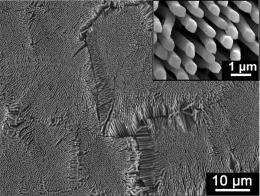
A scanning electron microscope image from an etched section through one of the new alloys. The magnified image inset shows rods of copper 300 nm in diameter emerging from a copper-lanthanum matrix. Image provided by Mark Aindow

(PhysOrg.com) -- Researchers at the University of Connecticut, partnering with United Technologies Research Center (East Hartford, CT) engineers, have modeled and developed new classes of alloy materials for use in electronic applications that will reduce reliance on costly gold and other precious metals.

The research appears online in the October 12th issue of the journal .

With the price of currently hovering around $1,340 per ounce, manufacturers across the globe, including Connecticut’s United Technologies Corporation (UTC), are scrambling for alternatives to the costly noble metals that are widely used in electronic applications, including gold, platinum, rhodium, palladium and silver. What makes these metals attractive is their combination of excellent conductivity paired with resistance to oxidation and corrosion. Finding less costly but equally durable and effective alternatives is an important aim.

Mark Aindow and S. Pamir Alpay, UConn professors of materials science and engineering, and Joseph Mantese, a UTRC Fellow, have developed new classes of materials that behave much like gold and its counterparts when exposed to the oxidizing environments that degrade traditional base metals. Their research was funded by a grant from the U.S. Army Research Office.

The team has investigated nickel, copper and iron – inexpensive materials that may offer promise. Based on their research, they have laid out the theory and demonstrated experimentally the methodology for improving the electrical contact resistance of these base metals. Aindow said, “We used a combination of theoretical analysis to select the appropriate constituents, and materials engineering at the atomic level to create designer materials.”

The researchers synthesized various alloys, using inexpensive base metals. Higher conductivity native oxide scales can be achieved in these alloys through one of three processes: doping to enhance carrier concentration, inducing mixed oxidation states to give electron/polaron hopping, and/or phase separation for conducting pathways.

Their work has demonstrated an improvement in contact resistance of up to one-million-fold over that for pure base metals, so that base metal contacts can now be prepared with contact properties near those of pure gold.

More information: M. Aindow et al., Base metal alloys with self-healing native conductive oxides for electrical contact materials, Appl. Phys. Lett. 97, 152103 (2010); doi:10.1063/1.3499369

Provided by University of Connecticut search and more info website

4.8 /5 (18 votes)  

Filter


Move the slider to adjust rank threshold, so that you can hide some of the comments.


Display comments: newest first

Nik_2213
Oct 13, 2010

Rank: not rated yet
But will they grow dendrites ??
Shakescene21
Oct 14, 2010

Rank: not rated yet
This is great technology, but the really intense focus should be on platinum and rhodium rather than gold.
Gold is expensive, but it's not that rare -- most gold is used in ingots, coins, and jewelry. Platinum is rarer than gold and is used mostly in important industrial and environmental applications.
Rank 4.8 /5 (18 votes)
Relevant PhysicsForums posts

More news stories

Good vibes: Coupling electron spin states and carbon nanotube vibrations

(Phys.org) -- An electron’s spin is separate from its motion, and is suitable for use in both highly-precise magnetic sensing as well as a qubit in quantum computing. Recently, scientists at the University ...

Physics / General Physics

created 19 hours ago | popularity 4.6 / 5 (5) | comments 1 | with audio podcast feature

Lying in wait for WIMPs: Researchers seek to increase the sensitivity of Large Underground Xenon detector by orders of m

Although it's invisible, dark matter accounts for at least 80 percent of the matter in the universe. No one knows what it is, but most scientists would bet on weakly interacting massive particles, or WIMPs.

Physics / General Physics

created 15 hours ago | popularity 3.3 / 5 (3) | comments 5 | with audio podcast

Hawaii lab turns laser-powered bubbles into microrobots

(Phys.org) -- A team of scientists from the University of Hawaii are working on microrobots created from bubbles of air in a saline solution. The bubbles take on their title of “robots” as a laser ...

Physics / General Physics

created 16 hours ago | popularity 5 / 5 (3) | comments 1 | with audio podcast weblog

Repulsive polaron: Austrian physicists realize elusive quasiparticles

(Phys.org) -- In quantum physics physical processes in condensed matter and other many-body systems can often be described with quasiparticles. In Innsbruck, for the first time Rudolf Grimm’s team of ...

Physics / Quantum Physics

created 15 hours ago | popularity 5 / 5 (7) | comments 1 | with audio podcast

Efficient and tunable interface for quantum networks

(Phys.org) -- Quantum computers may someday revolutionize the information world. But in order for quantum computers at distant locations to communicate with one another, they have to be linked together in ...

Physics / Quantum Physics

created 15 hours ago | popularity 5 / 5 (4) | comments 0 | with audio podcast


Yahoo seeks to shake up search, Web browsing

(AP) -- Joining the battle to redefine Internet search, Yahoo is taking aim with a new browser enhancement it calls "Axis."

Forensic sleuth probes fate of royal lovers and lion hearts

The French media like to call him the "Indiana Jones of the graveyards", but perhaps a better tag would be the Sherlock Holmes of forensic science.

Internet voting still faces hurdles in US

Shop online. Bank online. Why not vote online?

New estimates up dementia rates in mid-income countries

(HealthDay) -- Use of 10/66 dementia diagnosis criteria (10/66) results in an increase in the estimated incidence of dementia in middle-income countries, according to a study published online May 23 in The La ...

Clot buster seems to help up to 6 hours after stroke

(HealthDay) -- The largest study of its kind finds that stroke patients benefit from a clot-busting drug even six hours after a stroke, suggesting that the current recommended 4.5-hour limit could be expanded.

Deep sea animals stowaway on submarines and reach new territory

Marine scientists studying life around deep-sea vents have discovered that some hardy species can survive the extreme change in pressure that occurs when a research submersible rises to the surface. The team's ...