Advance could change modern electronics: High-performance 'metal-insulator-metal' diode created
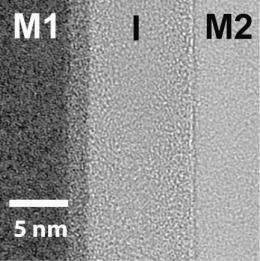
This image of an asymmetric MIM diode reflects a major advance in materials science that could lead to less costly and higher speed electronic products. (Image courtesy of Oregon State University)
Researchers at Oregon State University have solved a quest in fundamental material science that has eluded scientists since the 1960s, and could form the basis of a new approach to electronics.
The discovery, just reported online in the professional journal Advanced Materials, outlines the creation for the first time of a high-performance "metal-insulator-metal" diode.
"Researchers have been trying to do this for decades, until now without success," said Douglas Keszler, a distinguished professor of chemistry at OSU and one of the nation's leading material science researchers. "Diodes made previously with other approaches always had poor yield and performance.
"This is a fundamental change in the way you could produce electronic products, at high speed on a huge scale at very low cost, even less than with conventional methods," Keszler said. "It's a basic way to eliminate the current speed limitations of electrons that have to move through materials."
A patent has been applied for on the new technology, university officials say. New companies, industries and high-tech jobs may ultimately emerge from this advance, they say.
The research was done in the Center for Green Materials Chemistry, and has been supported by the National Science Foundation, the Army Research Laboratory and the Oregon Nanoscience and Microtechnologies Institute.
Conventional electronics made with silicon-based materials work with transistors that help control the flow of electrons. Although fast and comparatively inexpensive, this approach is still limited by the speed with which electrons can move through these materials. And with the advent of ever-faster computers and more sophisticated products such as liquid crystal displays, current technologies are nearing the limit of what they can do, experts say.
By contrast, a metal-insulator-metal, or MIM diode can be used to perform some of the same functions, but in a fundamentally different way. In this system, the device is like a sandwich, with the insulator in the middle and two layers of metal above and below it. In order to function, the electron doesn't so much move through the materials as it "tunnels" through the insulator almost instantaneously appearing on the other side.
"When they first started to develop more sophisticated materials for the display industry, they knew this type of MIM diode was what they needed, but they couldn't make it work," Keszler said. "Now we can, and it could probably be used with a range of metals that are inexpensive and easily available, like copper, nickel or aluminum. It's also much simpler, less costly and easier to fabricate."
The findings were made by researchers in the OSU Department of Chemistry; School of Electrical Engineering and Computer Science; and School of Mechanical, Industrial and Manufacturing Engineering.
In the new study, the OSU scientists and engineers describe use of an "amorphous metal contact" as a technology that solves problems that previously plagued MIM diodes. The OSU diodes were made at relatively low temperatures with techniques that would lend themselves to manufacture of devices on a variety of substrates over large areas.
OSU researchers have been leaders in a number of important material science advances in recent years, including the field of transparent electronics. University scientists will do some initial work with the new technology in electronic displays, but many applications are possible, they say.
High speed computers and electronics that don't depend on transistors are possibilities. Also on the horizon are "energy harvesting" technologies such as the nighttime capture of re-radiated solar energy, a way to produce energy from the Earth as it cools during the night.
"For a long time, everyone has wanted something that takes us beyond silicon," Keszler said. "This could be a way to simply print electronics on a huge size scale even less expensively than we can now. And when the products begin to emerge the increase in speed of operation could be enormous."
Provided by
Oregon State University
-
From lemons to lemonade: Reaction uses carbon dioxide to make carbon-based semiconductor,
27 comments
-
Every black hole contains a new universe: A physicist presents a solution to present-day cosmic mysteries,
208 comments
-
New silicon memory chip developed,
16 comments
-
Computing experts unveil superefficient 'inexact' chip,
45 comments
-
SpaceX private rocket blasts off for space station (Update),
39 comments
-
How toxic is strontium 90 (lab use)?
51 minutes ago
-
Room temperature superconductor
1 hour ago
-
Focusing magnetic field?
1 hour ago
-
Cross Product vs. Dot product
4 hours ago
-
DC Cable Loss
5 hours ago
-
Radiowaves bouncing off of ionosphere
5 hours ago
- More from Physics Forums - General Physics
More news stories
Non-invasive intracellular 'thermometer' with fluorescent proteins created
A team from the Institute of Photonic Sciences (ICFO) has developed a technique to measure internal cell temperatures without altering their metabolism. This finding could be useful when distinguishing healthy ...
Nanotechnology / Bio & Medicine
18 hours ago |
not rated yet |
0
|
How ion bombardment reshapes metal surfaces
To modify a metal surface at the scale of atoms and molecules for instance to refine the wiring in computer chips or the reflective silver in optical components manufacturers shower it with ions. ...
May 23, 2012 |
5 / 5 (2) |
0
|
Building site for molecular complexes
Often the sum is greater than its parts. Using an atomic force microscope as a crane, Ludwig Maximilian University of Munich researchers have succeeded in bringing two biomolecules together to form an active complex ...
20 hours ago |
not rated yet |
0
Dopant gives graphene solar cells highest efficiency yet
(Phys.org) -- By taking advantage of graphene’s favorable electrical and optical properties, and then adding an organic dopant, researchers have achieved the highest power conversion efficiency yet for ...
Nanomedicine: Quantum dots appear safe in pioneering study on primates
A pioneering study to gauge the toxicity of quantum dots in primates has found the tiny crystals to be safe over a one-year period, a hopeful outcome for doctors and scientists seeking new ways to battle diseases ...
Nanotechnology / Bio & Medicine
May 20, 2012 |
4.3 / 5 (3) |
8
|
Yahoo seeks to shake up search, Web browsing
(AP) -- Joining the battle to redefine Internet search, Yahoo is taking aim with a new browser enhancement it calls "Axis."
Forensic sleuth probes fate of royal lovers and lion hearts
The French media like to call him the "Indiana Jones of the graveyards", but perhaps a better tag would be the Sherlock Holmes of forensic science.
New estimates up dementia rates in mid-income countries
(HealthDay) -- Use of 10/66 dementia diagnosis criteria (10/66) results in an increase in the estimated incidence of dementia in middle-income countries, according to a study published online May 23 in The La ...
Deep sea animals stowaway on submarines and reach new territory
Marine scientists studying life around deep-sea vents have discovered that some hardy species can survive the extreme change in pressure that occurs when a research submersible rises to the surface. The team's ...
Good vibes: Coupling electron spin states and carbon nanotube vibrations
(Phys.org) -- An electron’s spin is separate from its motion, and is suitable for use in both highly-precise magnetic sensing as well as a qubit in quantum computing. Recently, scientists at the University ...
Oct 29, 2010
Rank: 5 / 5 (1)
Oct 29, 2010
Rank: 4.5 / 5 (2)
Oct 29, 2010
Rank: not rated yet
Oct 29, 2010
Rank: 3.1 / 5 (9)
Well diodes don't "switch". They're one way.
Vacuum tubes are diodes. Part of the reason why transistors were such a hugh innovation is that they could be made incredibly small when compared to diodes, however, with this breakthrough, diodes can be far smaller than they used to be. This is a huge breakthrough for electronics.
Oct 29, 2010
Rank: not rated yet
Oct 29, 2010
Rank: 4.8 / 5 (4)
Oct 29, 2010
Rank: 5 / 5 (3)
Oct 29, 2010
Rank: not rated yet
Oct 29, 2010
Rank: 3 / 5 (2)
??do you know how to read??? maybe you need to go and re-read....jesus i hate these people>
Oct 29, 2010
Rank: 1.8 / 5 (5)
I bet you this gets buried for years while current electronics manufacturers continue to rape us for every penny they have left and send it off to the banksters just like every big business nowadays does, sucking your country dry. This works great on cell phones, super facial scanning will make them into nice spy drones.
Oct 29, 2010
Rank: 3 / 5 (8)
Karl Marx is dead and stupid people keep resurrecting his fully discredited dead ideas so they can demonstrate again how they simply don't work.
Better go back on your meds.
Oct 30, 2010
Rank: 5 / 5 (2)
Begore there was TTL, there was DTL; before there was DTL, there was DRL, Diode Resistor Logic. It's power consuming, but it's nanosecond fast. The Oregon State University probably have something better than DRL in mind.
Oct 30, 2010
Rank: 5 / 5 (2)
If this pans out, I wonder what effect this could have to limit research/advances in quantum computing. Think of how cheap oil has killed other energy technologies.
This IS huge!
Oct 30, 2010
Rank: 5 / 5 (4)
Oct 30, 2010
Rank: not rated yet
True it's pretty impressive but most of RF electronics cannot support such frequencies anyway (by support i mean produce a coherent signal of course); On the other hand, this research opens the door for a new type of transistors unlike anything we've used before; if MIM diodes doesn't revolutionize electronics, those would surely do. In this optic, this IS a major breakthrought
Oct 30, 2010
Rank: not rated yet
Oct 30, 2010
Rank: 4 / 5 (1)
GDDR5 is basically a slight redesign of DDR3, but it's rebalanced to give much higher performance at the cost of excessive power use and enormous amounts of waste heat. This is a large part of the reason why graphics cards are so bloody hot, and why they have such a high failure rate. That's fine for a graphics card, but not fine for normal system ram.
Nov 01, 2010
Rank: not rated yet
On the not-so-good side, I notice one little thing in this article that sets alarm bells ringing for me: "and it could probably be used with a range of metals that are inexpensive and easily available, like copper, nickel or aluminum" and this part too: "with techniques that would lend themselves to manufacture of devices on a variety of substrates"
Those two statements imply very early stage laboratory trial success, perhaps without enough application trials to zero in on the best combinations of metals and insulators/substrates. I'm always a cautious skeptic though, and maybe I'm being overly so, but again, I'd be willing to bet money that I'm right. It could still be years before it is used.
Nov 01, 2010
Rank: 5 / 5 (3)
Beyond tinkering to the right combination of materials, there is the whole logic issue. We have spent decades optimizing circuit design to get to the currently inefficient state semiconductors are at. Throw in a whole new device type and we're still years away from matching current technologies with MIM, but if the production economies prove out like the scientists claim, I wager it will still be revolutionary when it happens.
Nov 02, 2010
Rank: not rated yet
No wrong. Maybe initially but tubes soon had a grid between the cathode and anode that allowed control of current flow just as a transistor does. The transistors advantage was of course a huge size reduction (as you say) plus ruggedness.
@Dirk - Transistors are often analysed as 2 diodes back to back because you get a 3 terminal analog that physically compares to the semiconductor structure of a transistor.
Field effect transistors and tunnel diodes both are understood to use the electron tunneling effect to function. So exactly what this method of device fabrication offers as an advantage is not clear in the article. Certainly its not groundbreaking material physics. Perhaps just a neat piece materials engineering looking for an application.
Nov 02, 2010
Rank: 5 / 5 (1)
http://www.eetime...nneling-
Nov 06, 2010
Rank: 5 / 5 (1)
The advantage is that FET (and tunnel effect transistors like SET) are structured in a much more complex way than the presented layer structure.
Therefore using this MIM structure you could reduce the size of transistors (and increase manufacturing quality) by quite a bit.