Carbon nanotube harpoon catches individual brain-cell signals
Neuroscientists may soon be modern-day harpooners, snaring individual brain-cell signals instead of whales with tiny spears made of carbon nanotubes.
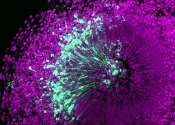
A team of New York University biologists has found that a series of genes sequentially expressed in brain stem cells control the generation of neural diversity in visual system of fruit flies. Their results are reported in ...
After decoding the Iceman's genetic make-up, a research team from the European Academy of Bolzano/Bozen (EURAC), Saarland University, Kiel University and other partners has now made another major breakthrough ...
Scientists at the Danish Stem Cell Center, DanStem, at the University of Copenhagen have discovered that they can make embryonic stem cells regress to a stage of development where they are able to make placenta ...
Scientists have taken a vital step forward in understanding how cells from skin tissue can be reprogrammed to become stem cells.
Researchers in Japan used state-of-the-art micro-sculpting techniques on a new type of resin that can be molded into complex, highly conductive 3-D structures (in this case the famous "Stanford bunny") with ...
KAIST Physics Department's Professor Tae-Young Yoon has successfully identified the hidden structure and operation mechanism of the SNARE protein, which has a central role in transporting neurotransmitters ...
Scientists from the University of Southampton have developed a device which records the brain activity of worms to help test the effects of drugs.
A new tool being developed by UT Arlington assistant professor of physics could help scientists map and track the interactions between neurons inside different areas of the brain.
(Phys.org) —A team of researchers from the University of California has found that one part of the brain in rats responds differently to virtual reality than to the real world. In their paper published in ...
Most of us are familiar with the "winter blues," the depression-like symptoms known as "seasonal affective disorder," or SAD, that occurs when the shorter days of winter limit our exposure to natural light ...
Understanding exactly how stem cells form into specific organs and tissues is the holy grail of regenerative medicine. Now a UC Santa Barbara researcher has added to that body of knowledge by determining ...
(Phys.org) —Researchers at The University of Queensland have discovered that, like humans, flies sleep in stages of different intensities.
Animals navigate and orient themselves to survive – to find food and shelter or avoid predators, for example. Research conducted by Dr. Nachum Ulanovsky and research student Michael Yartsev of the Weizmann ...
An Indiana University School of Medicine breast cancer surgeon is pursuing research that will utilize glass, gold, nanotechnology and Greek mythology hoping to vanquish breast cancer that has metastasized ...