Mobile phones can soon survive being dropped
Mar 20, 2007
Mobile phones can soon survive being dropped
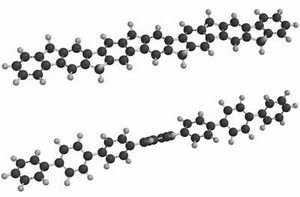
The reconstructed polymer (top) was found to conduct one thousand times better than the standard polymer (below) due to its fixed ladder-like structure. Credit: NWO

Dutch researcher Paulette Prins has demonstrated that plastic does not have to be a poorer conductor than present-day semiconductors. This opens up the way for a revolution in consumer electronics: mobile phones and MP3 players will soon survive being dropped.

Just imagine it. Consumer products that do not break if accidentally dropped, devices with flexible screens that can be rolled up, and products becoming a lot cheaper. Up until now it was a mere pipe dream. The limiting factor is the chips in such devices. These need to conduct electricity and plastic chips fail to make the grade. Plastic conducts at least 1000 times less well than the current generation of semi-conductors.

Prins showed that specially developed plastic can conduct just as well as existing semiconductors.

Conduction occurs when charge moves through the material. Prins discovered that in plastics, the movement of charge was mainly hindered by the structure of the material. Plastic is built up from polymers, which consist of complex chains. The greatest hindrances for conduction were the ends of the chains, fractures in the chains, and the chaos in and along the chains.

A German group of researchers rebuilt the chains. They formed a polymer with a relatively fixed, ladder-like structure. Prins made clever use of this. This polymer was found to conduct 1000 times better than had previously been shown for plastics.

The combination of simulations and advanced techniques makes Prins' research unique. She bombarded the material with electrons from a particle accelerator, which enabled her to study the rapid reactions in the plastic to an accuracy of 100 microseconds.

Subsequently she determined the conductance of the polymers by measuring the microwave absorption. This avoided the need to use electrodes. Such electrodes often disrupt the measurement. Prins published some of her findings in the leading journal Physical Review Letters.

Prins' research was funded by NWO.

Source: NWO

Explore further: Study provides better understanding of water's freezing behavior at nanoscale

add to favorites email to friend print save as pdf

Related Stories

Recommended for you

Promising doped zirconia

May 17, 2013

Materials belonging to the family of dilute magnetic oxides (DMOs)—an oxide-based variant of the dilute magnetic semiconductors—are good candidates for spintronics applications. This is the object of ...

Nanocrystals grow from liquid interface

May 17, 2013

An international collaboration of scientists has discovered a unique crystalizing behavior at the interface between two immiscible liquids that could aid in sustainable energy development.

User comments : 0

More news stories

Optics: Statistics light the way

Millions of years of evolution have molded our eyes into highly sensitive optical detectors, surpassing even many man-made devices. Now, Leonid Krivitsky and his co-workers at the A*STAR Data Storage Institute ...

Making quantum encryption practical

One of the many promising applications of quantum mechanics in the information sciences is quantum key distribution (QKD), in which the counterintuitive behavior of quantum particles guarantees that no one can eavesdrop on ...

Sony mulls hedge fund's entertainment sale idea

Sony's CEO Kazuo Hirai says the electronics giant's board will discuss a proposal by U.S. hedge fund manager Daniel Loeb to spin off up to 20 percent of its movie, TV and music division.

Italy approves law on controversial stem cell therapy

Italian lawmakers on Wednesday gave their final approval to a law that allows limited use of a controversial type of stem cell therapy which has been condemned by many scientists but has given hope to families of terminally-ill ...

Social media puts HR ethics under the spotlight

Social media has definitely changed the game for job-seekers and recruiters. Traditionally, HR recruiters placed an advertisement, sifted through the responses, and interviewed the shortlisted candidates ...