Research aims to calm your car's rattling
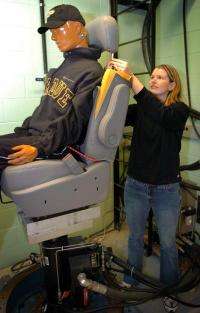
Researchers at Purdue University are getting close to eliminating those rattling and squeaking noises in your car's headrest and other components, major sources of consumer dissatisfaction that automakers would like to eliminate.
The headrest and its seemingly simple adjusting mechanism have proved surprisingly complex, said Douglas Adams, an associate professor of mechanical engineering. He and doctoral student Janette Jaques have applied mathematical models that simulate rattling headrests for analyses aimed at reducing vibration and enabling designs that eliminate the annoyance.
Noise and vibration are important factors in customer satisfaction, Adams said.
"If you are driving down the street and something is rattling or squeaking, the perception is that the vehicle is of poor quality," he said. "So, quality and noise and vibration sort of go hand-in-hand. Virtually every car has headrests, so this problem is particularly interesting."
The same modeling and experimental techniques developed for the research could be used to reduce squeaking and rattling in other components, such as instrument panels, seats, transmission gears, suspension components and seatbelt mechanisms.
"A car has thousands of parts," Adams said. "Any time you have one component sitting next to another and they're not welded together, you've got the potential for them to hit one another, causing rattling. It's an industrywide problem."
A new research paper describes rattling in the headrest, which is held in place by a small pin that fits into slots in one of the two posts connecting the headrest to the seat.
"It's a surprisingly complicated little system," Adams said. "The mechanism has to be rigid enough to keep the headrest from falling down, but not so rigid that you can't easily adjust it. In other words, you have to put some mechanical free play into it, but you can't put too much because then it rattles."
The paper will be presented on Feb. 20 during the International Modal Analysis Conference in Orlando, Fla. The paper was written by Jaques and Adams.
The model contains four equations corresponding to four key structural elements in the headrest system, making it possible to simulate headrest vibration. The engineers have tested their model by comparing its simulations with data recorded by shaking a car seat with hydraulic equipment. As the seat is shaken, sensors attached to various points on the headrest record vibration data.
"We used the model to identify how susceptible a certain design would be to rattle," said Adams, whose research is based at Purdue's Ray W. Herrick Laboratories.
The hydraulic shaker recreates the precise frequencies at which the suspension and seats vibrate, making it possible to analyze how the vibration causes the headrest to rattle.
"We then use these measurements to see whether our model's predictions agree with the experimental results so that we can validate our model," Adams said.
As the seat shakes, the headrest adjustment pin rattles inside the plastic housing. The model provides information about two key rattling phenomena: how many times per second the pin hits the sides of the housing and how hard the pin hits the plastic housing. The model also simulates how the headrest rattles depending on its mass and other design characteristics.
Determining precisely which vibration frequencies are causing the headrest to rattle could enable automakers to better "tune" automotive suspension systems, altering the stiffness of shock absorbers and coils to reduce the rattling.
"Or, one of the main things you could do is modify the design of the headrest itself, which is our objective," Adams said. "The main motivation here is to develop a modeling technique where you could do most of the design work before you ever built a prototype. Reducing the amount of building and prototype testing would save you a lot of money, time and frustration.
"You need a model because there are so many potential ways to fix the problem. Imagine trying to do this study entirely by building and testing prototypes."
Increasing the mass of the headrest might be one approach to reduce the rattling, a design change that could be tested with the model. The model also could be used to learn whether the rattling might be reduced by increasing the friction or stiffness of the adjusting pin.
"We determined that it is practical to use a model for designs that reduce rattling, spending less time and money building and testing, and cutting down on the frustration of trying to find a needle in a haystack," Adams said.
Source: Purdue University


