Portable 'lab on a chip' could speed blood tests
Testing soldiers to see if they have been exposed to biological or chemical weapons could soon be much faster and easier, thanks to MIT researchers who are helping to develop a tiny diagnostic device that could be carried into battle.
By tweaking the design of a tiny pump, researchers affiliated with MIT's Institute for Soldier Nanotechnologies have taken a major step towards making an existing miniature "lab on a chip" fully portable, so the tiny device can perform hundreds of chemical experiments in any setting.
"In the same way that miniaturization led to a revolution in computing, the idea is that miniature laboratories of fluid being pumped from one channel to another, with reactions going on here and there, can revolutionize biology and chemistry," says Martin Bazant, associate professor of applied mathematics and leader of the research team.
Within the lab on a chip, biological fluids such as blood are pumped through channels about 10 microns, or millionths of a meter, wide. (A red blood cell is about 8 microns in diameter.) Each channel has its own pumps, which direct the fluids to certain areas of the chip so they can be tested for the presence of specific molecules.
Until now, scientists have been limited to two approaches to designing labs on a chip, neither of which offer portability. The first is to mechanically force fluid through microchannels, but this requires bulky external plumbing and scales poorly with miniaturization.
The second approach is capillary electro-osmosis, where flow is driven by an electric field across the chip. Current electro-osmotic pumps require more than 100 volts of electricity, but the MIT researchers have now developed a micropump which requires only battery power (a few volts) to achieve similar flow speeds and also provides a greater degree of flow control.
The key to boosting energy efficiency is altering the electric field in the channel, Bazant said. Instead of placing electrodes at each end of the channel, as in capillary electro-osmosis, the voltage can be lowered substantially with alternating current (AC) applied at closely spaced microelectrode arrays on the channel floor. Existing AC electro-osmotic pumps, however, are too slow for many applications, with velocities below 100 microns per second.
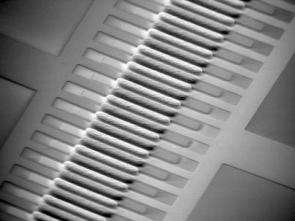
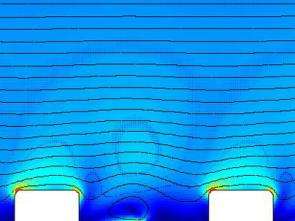
In the new system, known as a three-dimensional AC electro-osmotic pump, tiny electrodes with raised steps generate opposing slip velocities at different heights, which combine to push the fluid in one direction, like a conveyor belt. Simulations predict a dramatic improvement in flow rate, by almost a factor of twenty, so that fast (mm/sec) flows, comparable to pressure-driven systems, can be attained with battery voltages. Experiments in the lab of Todd Thorsen, assistant professor of mechanical engineering, have recently demonstrated the effectiveness of the design.
"It's just a huge improvement with a very simple idea," said Bazant.
Thorsen's group is working toward integrating the pumps into a portable blood analysis device, which soldiers could carry onto the battlefield. If exposure to chemical or biological weapons were suspected, the device could automatically and rapidly test a miniscule blood sample, rather than sending a large sample to a lab and waiting for the results. The chips are so small and cheap to make that they could be designed to be disposable, Bazant said, or they could be made implantable.
Potential applications are not limited to military use - imagine going to a doctor's office and getting test results immediately. The technology could also be useful for first responders. If emergency personnel knew immediately whether a person had suffered a heart attack or a stroke, they could start the appropriate treatment right away.
Labs on a chip can also be used in traditional chemistry or biology labs to speed up processes such as DNA testing or screening for the presence of certain antigens. Only tiny amounts of reactants would be needed, and experiments could be done more rapidly and efficiently.
"Instead of a thousand people pouring test tube A into test tube B in different laboratories, you've got a tiny little chip with thousands of experiments all going on at once," Bazant said.
Source: Massachusetts Institute of Technology


