Ripples in the cosmic background
Sep 07, 2010
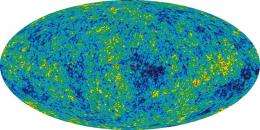
Faint ripples in the cosmic microwave background radiation as seen mapped on a full-sky projection. Colors represent tiny temperature deviations from the average (red regions are warmer and blue regions are colder). Credit: NASA and the WMAP mission

(PhysOrg.com) -- The universe was created 13.73 billion years ago in a blaze of light -- the big bang. We also think that, about 380,000 years later, after matter (mostly hydrogen atoms) had cooled enough for neutral atoms to form, light was able to travel through space relatively freely. We see that light today as the cosmic microwave background radiation (CMBR). The light appears extremely uniform in brightness across the sky. Astronomers have discovered, however, that the radiation has very faint ripples and bumps in it, at a level of only about one part in one hundred thousand.

These ripples reflect the architecture of the universe when the light was freed, and the subsequent cosmic structures (galaxies and clusters of galaxies) as the light passed by them on its journey through space and time. These ripples hold clues, therefore, to the and how it has evolved, and are consequently among the top priorities of modern astronomy research.

The wavelengths of the CMBR ripples span a continuous range of sizes. The larger ones (which are also brighter) are the result of the waves in the cosmic structure when the light was released; the universe has stretched in size so much since then (a factor of about 1000) that they are now comparatively big. The smaller ones imposed on the light later, as it was scattered by or other objects, are shorter and dimmer. Over the past few decades astronomers have been able to measure the larger ripples with great accuracy, and to use that information to substantiate and refine many details of the big bang scenario. The smaller bumps have been harder to pin down.

Writing in this month's , a large team of scientists including SAO astronomers Brian Stalder and Tony Stark report the successful measurement of CMBR ripples using the the South Pole Telescope, a ten-meter-diameter submillimeter telescope located at the Amundsen-Scott South Pole station in Antarctica.

The team was able to make the first significant measurements of the weakest, shortest wavelength yet studied. They discovered that the amplitude of the fluctuations is only about half that previously measured (or indicated by other related, previously measured parameters) -- a significant deviation. Moreover, their uncertainties of 35% are the smallest yet, yielding further refinements to big bang models. The results imply that although the formation of the first galaxies is still poorly understood, continuing improvements to the observations are rapidly enabling astronomers to zero in on these basic puzzles of cosmic origins.

Explore further: Researchers explain magnetic field misbehavior in solar flares

Related Stories

Studying Matter and Radiation from the Early Universe

Apr 12, 2010

(PhysOrg.com) --Almost 400,000 years after the universe was created in the big bang, matter cooled sufficiently for neutral atoms to form, thereby allowing the pervasive light to propagate almost completely ...

Durham astronomers' doubts about the 'dark side'

Jun 14, 2010

(PhysOrg.com) -- New research by astronomers in the Physics Department at Durham University suggests that the conventional wisdom about the content of the Universe may be wrong. Graduate student Utane Sawangwit ...

Fossil Galaxy Reveals Clues to Early Universe

Jan 12, 2006

A tiny galaxy has given astronomers a glimpse of a time when the first bright objects in the universe formed, ending the dark ages that followed the birth of the universe.

'Big baby' galaxy found in newborn Universe

Sep 28, 2005

The NASA/ESA Hubble Space Telescope and NASA’s Spitzer Space Telescope have teamed up to 'weigh' the stars in distant galaxies. One of these galaxies is not only one of the most distant ever seen, but it appears to be unusually ...

Recommended for you

A hidden population of exotic neutron stars

3 hours ago

(Phys.org) —Magnetars – the dense remains of dead stars that erupt sporadically with bursts of high-energy radiation - are some of the most extreme objects known in the Universe. A major campaign using ...

Very Large Telescope celebrates 15 years of success

8 hours ago

(Phys.org) —With this new view of a spectacular stellar nursery ESO is celebrating 15 years of the Very Large Telescope—the world's most advanced optical instrument. This picture reveals thick clumps ...

Fragile mega-galaxy is missing link in history of cosmos

May 22, 2013

Two hungry young galaxies that collided 11 billion years ago are rapidly forming a massive galaxy about 10 times the size of the Milky Way, according to UC Irvine-led research published Wednesday in the journal ...

User comments : 6

Adjust slider to filter visible comments by rank

Display comments: newest first

Davinci_is_me
1.3 / 5 (7) Sep 07, 2010
Seriously, you call that an article? Pretty soon Physorg will be down to just bumper stickers.
Pyle
4.9 / 5 (9) Sep 07, 2010
@D_i_m,

Did you read the abstract of the article? There is a reason the "article" is like it is. Only an astrophysicist would understand the actual research, and interested astrophysicists should go read the research paper. The synopsis is about as good as it gets if you aren't in the field.

Physorg just gathers what it thinks are important publications from many different fields and points us in the right direction if we are so inclined. If you think the summary doesn't do the research justice, criticize it substantively with what you think is missing and down rate it. That is what the ratings are for.

MrPressure
1 / 5 (8) Sep 08, 2010
Galaxies born from the middle out of the way around.

Like from the inside out.

Each galaxy was once a small big bang in three dimensions.

Space does not expand.

Energy is more densely concentrated together and they are expanding three-dimensionally in space which does not expand.

Simultaneously focus on the visible universe composed of energy field expands and moves three-dimensionally in a certain direction of the "new" to an existing space.

This movement because of all the energy is composed of clusters suitable for expanding the three-dimensionally like out of the pre-existing condition.

sorry about terrible english.

google: Etimespace videos

thanks
DamienS
4.5 / 5 (8) Sep 08, 2010
sorry about terrible english.

You should be sorry for far more than your English.
genastropsychicallst
1 / 5 (5) Sep 08, 2010
Hahaha, 0 jet/ray. Fourthing of 'this' can only by machines like popping out fifthse electrons [also to be read as half], that's why w/z boson(s).
genastropsychicallst
1 / 5 (5) Sep 08, 2010
Mean, w/z is for the differents. Otherwise no past until future to let us see, hear, feel, taste after etc.

More news stories

A hidden population of exotic neutron stars

(Phys.org) —Magnetars – the dense remains of dead stars that erupt sporadically with bursts of high-energy radiation - are some of the most extreme objects known in the Universe. A major campaign using ...

Russia evacuates drifting Arctic research station

Russia has ordered the urgent evacuation of the 16-strong crew of a drifting Arctic research station after ice floe that hosts the floating laboratory began to disintegrate, officials said Thursday.

A quantum simulator for magnetic materials

Physicists understand perfectly well why a fridge magnet sticks to certain metallic surfaces. But there are more exotic forms of magnetism whose properties remain unclear, despite decades of intense research. ...

Scientists discover molecule triggers sensation of itch

Scientists at the National Institutes of Health report they have discovered in mouse studies that a small molecule released in the spinal cord triggers a process that is later experienced in the brain as the sensation of ...